Emmanuel Tijani

  • How Nigerians Abroad Send Money Home with Crypto in 2026: Three Real Stories

    How Nigerians Abroad Send Money Home with Crypto in 2026: Three Real Stories

    The rules changed on 1 May 2026. The Central Bank of Nigeria instructed all International Money Transfer Operators (IMTOs), including Western Union, MoneyGram, Remitly and other licensed operators, to pay out remittances only in naira, at the official rate set by the Bloomberg BMatch rate. 

    The Bloomberg BMatch rate is the foreign exchange (FX) spot rate generated on BMatch, Bloomberg’s electronic trade-matching system. No dollar payouts. No recipient choice. For millions of Nigerians abroad, this was more than a regulatory update. It changed how they support their families back home.

    Nigeria is one of Africa’s largest remittance destinations. Diaspora inflows reached $21.8 billion in 2025, supporting millions of households across the country. For some families, the new rule barely meant anything, because they were already receiving naira. Others felt it immediately. It removed something they valued deeply: the ability to receive and hold dollars before deciding when to convert.

    In the weeks that followed, a familiar conversation began appearing in WhatsApp groups, Facebook communities and diaspora circles stretching from Manchester to Houston and Toronto. People were asking the same question: How are Nigerians abroad sending money home now? They wanted to know how to send money to Nigeria in 2026.

    Many people who had quietly been using crypto remittances for a long time already knew the answer. Not for speculation or trading, but simply as a faster and more flexible way to move value across borders. This article shows the case of three Nigerians abroad who made that transition.

    In short

    Since 1 May 2026, licensed money transfer operators must pay remittances to Nigeria in naira at the official rate. So many Nigerians abroad now send dollar stablecoins instead — USDT on the TRC20 network, or USDC from Canada. Family receives it in the Swapto app, converts it to naira, and gets paid into a Nigerian bank account within minutes.

    Send USDT (TRC20) or USDC Convert in Swapto Naira in your bank in minutes

    First is Chiamaka in Manchester, who sends money to her mother in Onitsha. Then Tunde in Houston, who supports a family business in Lagos. Then Adaeze in Toronto, who funds her brother’s education and a building project in Aba. Their stories and needs are different. Their transfer sizes are very different. Yet all three arrived at the same destination: sending dollar stablecoins from abroad and having family members in Nigeria convert them to naira through the Swapto app. We’ll show you how they do it as you read on.

    Why This Article Exists Now: The May 2026 CBN Policy Change

    The May 2026 directive fundamentally changed how licensed money transfer operators handle remittances into Nigeria. Under the new framework, recipients can no longer collect foreign currency directly from IMTOs. Funds must be settled in naira using the official Bloomberg BMatch exchange rate.

    For many diaspora senders, the issue wasn’t simply exchange rates. It was flexibility. Previously, some families preferred receiving dollars, holding them for a while, and deciding when to convert. That option disappeared through official remittance channels. Diaspora crypto remittances, particularly USDT transfers, became increasingly relevant because they still let recipients receive dollar-pegged value and decide when to convert it into naira. Not much has changed for the family, except that they no longer hold physical dollar notes.

    Importantly, this is not a loophole. Cryptocurrency operates through a separate framework from IMTO remittances, and crypto activity in Nigeria now sits within the country’s evolving regulatory environment under the Investments and Securities Act 2025.

    Chiamaka’s Story: Manchester to Onitsha, £200 Every Month

    The Background

    Chiamaka, who is 34, moved to Manchester in 2019 to pursue a master’s degree. What was supposed to be a temporary move became permanent after she secured employment and built a life in the UK. Back home, her mother remained in Onitsha. Unfailingly, Chiamaka sends about £200 home every month. The money covers groceries, electricity bills, transportation, and the countless everyday expenses that rarely make it into family conversations.

    For years, Western Union handled those transfers. Fees varied between £3 and £8 per transfer, and the exchange rate was 3 to 4% below the real market. As long as the process worked and the money got to the right place, that was enough. She never spent much time calculating the real cost. The money arrived, her mother was happy, and life continued.

    The Shift

    In 2024, a cousin introduced her to Wise. The fees dropped noticeably, to about £1 per transfer, and the exchange rates were more transparent. For a £200 transfer the savings weren’t dramatic: about £6 to £8 a month, or roughly £80 a year. Then came the May 2026 policy change. Chiamaka’s mother had sometimes preferred receiving value she could hold before converting. That flexibility disappeared.

    Curious, Chiamaka spent a Saturday afternoon researching “diaspora crypto remittances Nigeria”. She watched several TikTok and YouTube videos, read articles, and asked questions. Then she decided to give it a try.

    The Workflow

    Today, her new method is remarkably fast and simple. She buys USDT on her preferred exchange, and her mother’s Swapto wallet address is already saved on her phone. She copies the address and sends the USDT on the TRC20 network, where the withdrawal fee is as low as about $1. Within minutes, the funds appear in her mother’s wallet.

    Her mother opens Swapto, taps Sell USDT, and sees the naira amount upfront. After she confirms, the naira goes straight to her bank account. Shortly afterward, Chiamaka receives the same WhatsApp message she always gets after sending money to her mum: “Received my dear, thanks and God bless you.”

    The Math

    Interestingly, Chiamaka discovered that crypto was not dramatically cheaper than Wise for transfers of this size. That surprised her.

    The real benefit was elsewhere: speed, flexibility, control. Her mother could receive value within minutes and choose when to convert it. For Chiamaka, that autonomy mattered more than a few extra pounds saved each year.

    What Chiamaka Learned

    In Chiamaka’s words: “My mother is not a tech person. She’s a retired teacher. I assumed crypto would be too complicated. It turned out the difficult part wasn’t the technology. It was simply deciding to try something new.”

    Want to set this up for your family? Forward the Swapto app link to them and let them create a wallet before your first test transfer.

    Tunde’s Story: Houston to Lagos, Running a Family Business from 8,000 Kilometres Away

    The Background

    Tunde, whose parents are in Lagos, moved to Houston in 2014 for an oil and gas role. His younger sister manages the family’s logistics business. Some months the business needs nothing. Other months it needs urgent cash for repairs, diesel, maintenance or unexpected expenses. Tunde’s transfers typically range from $1,000 to $3,000.

    At first, he relied on a mix of wire transfers and Remitly. Wire transfers cost up to $35 each and took 3 to 5 business days. Remitly Express took minutes but ate 2.5 to 3.7% in FX markup. Both worked. Neither felt efficient.

    The Shift

    When Nigeria reopened banking relationships with crypto-related businesses in late 2023, Tunde began paying attention. Not because he was interested in trading crypto, but because he was interested in anything that made his payments more efficient. He started with a small test transfer of just $200.

    He didn’t do anything strange or spectacular, and the funds arrived successfully. He doubted the system at first, so he tried again, and got the same result. Within months, crypto became his default method, especially for larger amounts. By May 2026, he had not used a wire transfer in 18 months, so the CBN’s naira-only rule didn’t touch him. He was already on a payout route that still gave him and his family a choice.

    The Workflow

    Every Sunday evening, he follows the same routine. He buys USDT on Kraken, one of the US exchanges that lets you withdraw USDT on the TRC20 network, and sends it for a withdrawal fee of a dollar or two. His sister receives it in her Swapto wallet and converts it to naira. The funds land in the family business account, and the whole cycle often finishes before bedtime in Houston. Mechanics, suppliers and drivers in Lagos get paid the same day. It is a completely different system from the way he used to send money.

    The Math at His Scale

    On a typical month sending $2,000, Tunde compares routes mentally:

    • Wire transfer: $35 wire fee plus roughly 3% FX markup at the receiving Nigerian bank. Total cost: about $95, and it takes 3 to 5 days.
    • Remitly Express: $3.99 fee plus 2.5 to 3.7% FX markup. Total cost: about $54 to $78, delivered within minutes.
    • Crypto route: about $5 in Kraken trading fees, about $2 to withdraw on TRC20, and a 1% Swapto spread ($20). Total cost: about $27, done in minutes.

    Compared with the mix of wires and Remitly he used before, Tunde saves about $600 a year at $2,000 a month. That’s money that would otherwise have gone into wire fees and FX margins. If $600 sounds like a small loss, think about this: over the eight years he expects to keep supporting the business, it adds up to roughly $5,000. That’s a new set of tyres for one of the business’s trucks, or half a year of his daughter’s school fees in Houston.

    What Tunde Learned

    “The wire transfer wasn’t expensive per transfer. It was expensive cumulatively. The crypto route saves me about $600 a year at this volume. At $5,000 a month, the same maths saves roughly $1,400 a year. At $10,000 a month, it’s about $2,600.” The larger the transfer volume, the more attention the fees and exchange-rate margins deserve.

    Adaeze’s Story: Toronto to Aba, Sending Bigger Money with Higher Stakes

    The Background

    Adaeze, a healthcare administrator, has been in Toronto since 2016. She supports her younger brother Chinedu’s education. She also bought land in Aba and began building a modest retirement property. Unlike Chiamaka’s monthly support transfers, Adaeze often needs to send several thousand dollars at a time. She sends $3,000 to $5,000 home every quarter for the construction, plus about $800 a month for Chinedu’s expenses.

    Larger amounts amplify everything. The fees that felt manageable on $300 transfers become punishing at $5,000. Her old method, a bank wire from RBC to her contractor’s GTBank account, cost $45 per wire and took up to 7 business days. The exchange rate at the Nigerian end was usually 3.5% below market. On a $5,000 transfer, she was losing about $220 to fees and FX. Imagine what that looks like when you’re sending four times a year, plus monthly amounts.

    The Shift

    She first used Wise for smaller payments, and it worked well. But the larger project transfers still went through traditional banking channels. The fees felt painful, and the waiting felt worse. In early 2025, her contractor’s son, a 26-year-old in Aba, suggested she try sending stablecoins. He was already a Swapto user from his freelance work. He agreed to receive payments on her behalf and pass the naira to his father. They tested with $500. The naira arrived in 19 minutes. Adaeze wept for joy.

    The Workflow at Larger Amounts

    Canadian exchanges no longer list USDT, so Adaeze uses its closest cousin, USDC, another dollar stablecoin. She buys $5,000 of USDC on Newton, a registered Canadian platform, paying about 1% ($50) in fees. She sends it to her contractor’s son’s Swapto wallet on a network Swapto supports. He sells it for naira in the Swapto app, the naira lands in his Nigerian bank account, and he transfers it to his father in less than 10 minutes. Construction payments that once took a week can now be completed the same day.

    The Math at Her Scale

    For a $5,000 construction payment, the crypto route costs her about $100: $50 in Newton fees, a network fee of about $1 on a low-fee network, and a 1% Swapto spread of about $50. The wire transfer used to cost her about $220: a $45 wire fee plus $175 lost to the 3.5% FX gap. That’s a saving of about $120 per transfer.

    Across four construction payments a year, that’s about $480. Add the $800 she sends each month for Chinedu, compared with wiring it, and the crypto route saves Adaeze roughly $1,100 a year in fees and FX markups. On top of that come the time saved (minutes instead of days) and the certainty that the funds arrived, without calling her bank. Adaeze has not sent a wire transfer in 14 months.

    What Adaeze Learned

    In Adaeze’s words: “The bigger the amount, the more fees matter. Small fees become large fees when you’re sending thousands of dollars repeatedly.”

    Sending larger amounts changes the maths significantly. Instead of rushing to make the payment, slow down and calculate the full cost of each remittance route before deciding which one works best for your situation.

    NB: The fees and rates in these stories are approximate and change often. Check each provider’s current pricing before you send, and see today’s USDT to naira rate on Swapto or a tracker like Monierate.

    The Common Thread Across All Three Stories

    ChiamakaTundeAdaeze
    RouteManchester to OnitshaHouston to LagosToronto to Aba
    Typical transfer£200 a month$2,000 a month$5,000 a quarter
    Old cost per transferAbout the same as crypto (Wise)About $95 (wire) or $54 to $78 (Remitly Express)About $220 (wire)
    Crypto route costSmall fees, much fasterAbout $27About $100
    What they gainedFlexibility for her motherAbout $600 a yearAbout $1,100 a year

    Although their circumstances differ, all three stories share several important patterns:

    • They send dollar stablecoins rather than volatile cryptocurrencies like BTC or ETH: USDT from the UK and US, and USDC from Canada, where registered exchanges no longer list USDT.
    • Chiamaka and Tunde send USDT on the TRC20 network because of its low transfer costs.
    • Their recipients convert the funds to naira using Swapto, a Nigerian off-ramp that operates within Nigeria’s regulatory framework through a licensed partner, with naira paid to the recipient’s bank in minutes.
    • They all started with small test transfers ($500 or less) before sending larger amounts.
    • The recipient’s experience mattered just as much as the sender’s. None of these stories would work if the Nigerian recipient couldn’t figure out the app. In all three cases, the recipient found Swapto easy to use.

    Most importantly, none of them switched because they were crypto enthusiasts. They switched because a problem needed solving: a delayed transfer, an expensive fee, a frustrating process or a regulatory change.

    How to Set This Up for Your Own Family

    If you’re new to this and want to send USDT to Nigeria from the UK, USA or Canada, here’s a careful step-by-step guide.

    For the Sender Abroad

    1. Create an account with a reputable exchange in your country that lets you withdraw on the network you need.
    • UK: Revolut or Kraken. Both let you withdraw USDT on the Tron (TRC20) network.
    • US: Kraken, which supports USDT withdrawals on TRC20.
    • Canada: a registered platform such as Newton. Canadian exchanges only list USDC, so you’ll send USDC instead of USDT.
    1. Complete identity verification on the exchange. This usually takes a few minutes.
    2. Buy a small amount for your first test ($50 to $100). If you’re sending USDT, choose the TRC20 network: withdrawal fees are around $1 to $2.50 at most exchanges, whatever the amount. If you’re sending USDC, choose a network Swapto supports.
    3. Ask your recipient for their Swapto wallet address and send the small test amount first.
    4. Confirm receipt before sending larger transfers.

    For the Recipient in Nigeria

    1. Download Swapto from the App Store or Google Play. Setup takes about 3 minutes.
    2. Create an account and verify it with your BVN.
    3. Tap “Receive”, choose USDT on TRC20 (or the USDC network your sender is using), and copy your wallet address. Send it to your family member on WhatsApp.
    4. Once the crypto arrives in your Swapto wallet (usually 2 to 5 minutes after it’s sent), tap Sell. The naira amount is shown upfront.
    5. Confirm. Naira arrives in your Nigerian bank account in 5 to 10 minutes.

    Your family doesn’t need to become crypto experts. They simply need Swapto installed and ready before the first transfer arrives. If you’re not in the diaspora yourself but have friends abroad, share this with them so their families can get set up too.

    What About the Risks?

    Volatility

    USDT and USDC are pegged to the US dollar. For remittances, most users choose a stablecoin because it is designed to stay close to the value of the dollar. That avoids the price swings of cryptocurrencies like Bitcoin or Ethereum. See the full USDT to naira fee maths.

    Scams

    Mistakes usually happen when wallet addresses are entered incorrectly, or when people deal with unverified third parties, especially on P2P platforms. Always check addresses carefully and send a small test transfer before larger amounts. Before your first transfer, read how to avoid crypto scams in Nigeria.

    Legality

    It is legal to send crypto to Nigeria. Digital assets are legally recognised in Nigeria under the Investments and Securities Act 2025. The CBN reversed its 2021 banking ban in December 2023, and licensed Virtual Asset Service Providers operate within the SEC’s regulatory framework. The crypto remittance route is legal.

    Tax

    Genuine gifts, including money sent by family abroad, are exempt from income tax and capital gains tax under the Nigeria Tax Act 2025. However, if the recipient earns from the crypto itself, such as trading gains, that income is taxable. Anyone with taxable income needs a Tax ID, and for individuals, the NIN now serves as the Tax ID. Tax obligations vary with individual circumstances, so recipients should seek professional advice for large or recurring transfers.

    Frequently Asked Questions

    Is it legal for Nigerians abroad to send money home using cryptocurrency?

    Yes. Digital assets are legally recognised in Nigeria under the Investments and Securities Act 2025. The CBN reversed its 2021 crypto banking ban in December 2023, and licensed Virtual Asset Service Providers operate within the SEC’s regulatory framework. The May 2026 remittance directive applies to licensed IMTOs, not cryptocurrency transfers. Crypto operates through a separate framework and remains accessible to eligible users.

    What is the cheapest way for a Nigerian abroad to send money home?

    It depends on the transfer size. For small amounts, around a few hundred pounds or dollars, Wise can cost about the same as crypto, as Chiamaka found. From around $1,000 upward, the crypto route (buying a stablecoin abroad and converting it to naira on a Nigerian off-ramp like Swapto) pulls ahead. On a $2,000 transfer, it costs about $27, compared with about $95 by wire and $54 to $78 through Remitly Express. The savings grow with the amount.

    How long does a crypto remittance to Nigeria take?

    From the sender pressing “send” to naira arriving in a Nigerian bank account usually takes under 30 minutes. Buying USDT on an exchange like Kraken or Revolut takes minutes. The USDT transfer on the TRC20 network arrives in 2 to 5 minutes. Selling for naira on Swapto and the bank payout add another 5 to 15 minutes. That’s much faster than wire transfers, which take 3 to 7 days.

    My family members are not tech-savvy. Can they still use Swapto?

    Yes. The Swapto app is built for first-time crypto users, not traders. Generating a wallet address takes one tap. Swapto also offers free WhatsApp support at +234 811 337 2579, 9am to 9pm WAT, every day, to walk new users through their first receive-and-cash-out.

    What happens if I send crypto to the wrong wallet address?

    Blockchain transactions are generally irreversible. Always double-check the wallet address and the network, and send a small test amount first.

    Did the May 2026 CBN policy affect my family’s ability to receive crypto?

    No. The policy covers licensed money transfer operators and how they pay out. It does not govern crypto remittances, and it does not stop Nigerian families from receiving crypto.

    Will my family in Nigeria be taxed on the money I send them via crypto?

    Genuine gifts from a relative abroad are exempt from income tax and capital gains tax under the Nigeria Tax Act 2025. Simply receiving and converting family support is not taxed. Any income earned on the crypto itself, such as trading gains, is taxable, and anyone with taxable income needs a Tax ID (for individuals, the NIN). Recipients should speak to a tax adviser about large or business-sized transfers.

    Crypto remittance or Western Union: which is better for Nigeria?

    Crypto remittance is often faster and can cost less, especially on larger amounts, and recipients in Nigeria can receive funds within minutes. Western Union remains a trusted option for cash pickup and bank transfers, but it may involve higher fees and longer processing times depending on the method and location.

    The Quiet Revolution

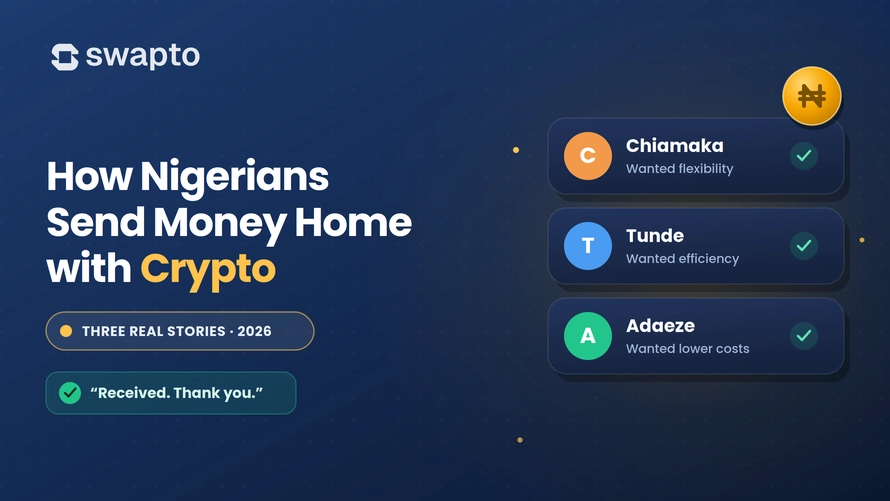
    The shift toward crypto remittances did not begin in May 2026. The policy change simply accelerated a trend that was already underway. Chiamaka wanted flexibility. Tunde wanted efficiency. Adaeze wanted lower costs on larger transfers. Different motivations, different cities, different family situations. Yet all three arrived at the same conclusion. Technology was not the obstacle. The obstacle was deciding to try a different way of sending money home.

    For many Nigerians abroad, that decision gets easier with every successful transfer, every satisfied family member, and every WhatsApp message that simply says “Received. Thank you.” When you’re ready, start with the first step: download the Swapto app and send the link to your family.
  • How to Receive Crypto from a Foreign Client in Nigeria (2026): The Complete Workflow

    How to Receive Crypto from a Foreign Client in Nigeria (2026): The Complete Workflow

    Last Tuesday, Tomi, a frontend developer in Lagos got the message every Nigerian freelancer hopes to see, his US client wrote “Share your USDT wallet address and the network. I’ll send the first 50% today.” To Tomi, that was a real client. The project was real, and the money was real.

    The problem now is that Tomi had never actually received crypto from a foreign client before, although he had heard of USDT. He even had an old Binance account from 2021 which became dormant due to lack of consistent activity on it.

    At that point, Tomi had myriads of questions running through his head. What address was he supposed to send? What exactly did “network” mean? What happens after the crypto arrives? How does he turn it into naira without getting scammed or losing money on bad exchange rates? 

    That is exactly why people search phrases like “how to receive crypto from foreign clients”, “verify crypto payment transaction hash”, etc. They are not looking for theory; they want to solve a situation practically. Beginners must understand that the world is changing at a very fast pace. It’s either you evolve with these changes or you get left behind and lose relevance without you knowing.

    This article is for Tomi, everyone who is in a similar situation, and those who want to know how to get paid in USDT from foreign clients.

    At the end of this guide, you’ll know exactly which wallet to use, which network to specify, what payment details to send your client, how to confirm the payment, how to receive USDT in Nigeria in 2026 and how to turn the crypto into naira in your Nigerian bank account. Once everything is set up, the entire process usually takes under 30 minutes. The first payment might feel intimidating, but you’ll do the third or fourth one without thinking too much. 

    As you proceed reading this article, download Swapto immediately to follow the instructions in this guide.

    Is It Legal to Receive Crypto from a Foreign Client in Nigeria?

    Yes. With the passage of the Investment and Securities Act (ISA) 2025, cryptocurrency has been legally recognized in Nigeria. The law brings digital assets and crypto-related service providers into SEC regulation. Licensed Virtual Asset Service Providers (VASPs) also operate within this framework. 

    Step 1: Choose Your Receiving Wallet

    This is the first decision to make by anyone who wants to know how to get paid in USDT from foreign clients. The crypto enters into your wallet before you either hold or change to naira. If you’re wondering which crypto wallet for foreign payment Nigeria users should choose, it’s important to consider factors like security, supported cryptocurrencies, transaction speed, etc. 

    There are three types of wallets that are used by most freelancers in Nigeria.

    Option A: Non-Custodial Wallets (Trust Wallet, MetaMask, Phantom)

    These are wallets which are completely managed by you. It is you that get to hold your private keys, not the company. Examples of these wallets are Trust Wallet, MetaMask, and Phantom.

    Advantages

    • You fully control your funds.
    • No one is able to freeze your wallet remotely.
    • Works across many coins and blockchain networks.
    • This category has better long-term flexibility.

    Downsides

    • If you lose your seed phrase, the money may be unrecoverable.
    • There is no reliable customer support.
    • It has a slightly steeper learning curve for beginners.

    Best For: It is best for Developers, designers, crypto-native freelancers, and users who are getting large payments and who want maximum control. For many Nigerian freelancers, this becomes the preferred long-term setup.

    Option B: Exchange Wallets (Binance, Bybit, KuCoin)

    This is the wallet that is already integrated into a crypto exchange account. Binance, KuCoin, Bybit are examples of such exchanges.

    Advantages

    • It is easy for someone already using the exchange.
    • It offers simple coin swapping.
    • It can be helpful for traders who are active.

    Downsides

    • The wallet is under the control of the exchange.
    • Access may be temporarily locked due to KYC review or restrictions.
    • Withdrawal functionality may be impacted by regulatory actions.

    This was something that many Nigerians were taught during the days of disruptions by Binance’s NGN-related disruptions.

    Best For: Individuals who are already active crypto traders.

    Option C: Nigerian Cash-Out App Wallets

    These are applications that are designed and built primarily for receiving crypto and automatically converting directly to naira. They are also known as OTC (Over-the-Counter) platforms. Here, the platform is the buyer. You send your crypto, the platform converts it, and the Naira lands in your bank automatically. An example of this is Swapto.

    Swapto - send your crypto

    Advantages

    • They have an extremely simple workflow.
    • They are built specifically for Nigerian bank withdrawals.
    • The OTC platforms are popular for a faster naira conversion experience.
    • It is useful for freelancers who do not want to hold crypto long-term.

    Downsides

    • It has a custodial setup.
    • It is not good for a long-term storage

    Best For: Freelancers who want naira in their bank account as soon as possible.

    Download Swapto on iOS or Android. Cash out your first trade in under 10 minutes. Support available on WhatsApp at +234 811 337 2579.

    Download Swapto

    The Practical Setup Most Freelancers End Up Using

    Take an instance where you want to get USDT as a Nigerian freelancer and convert the USDT to naira instantly. This is what the cleanest workflow looks like:

    1. Receive USDT in Trust Wallet (where you own the keys and can hold or convert any time), then verify the payment safely.
    2. Send the USDT to Swapto when ready to cash out.
    3. On Swapto, sell your USDT and get your naira in your local bank.

    That setup combines the security of self-custody with the speed of a professional naira off-ramp. If you want a single-app workflow, the Swapto wallet works as both your receiving address and your instant naira cash-out, with customer crypto held by a third-party digital asset custodian and 24/7 phone support on +234-811-3372-579.

    Step 2: Decide Which Crypto and Which Network

    This is where most beginners get confused, but we’ll break it down for you. To send you crypto, your client needs two things; the crypto and the network

    Which Crypto Should You Ask For?

    The first option is to request for USDT. USDT has remained a default recommendation. For several reasons, tether has remained the standard choice for Nigerian freelancers. This is because:

    • The USDT has a Stable value. 1 USDT is pegged roughly to $1 (making a 1:1 ratio)
    • The USDT is greatly recognized globally as the market’s stable coin.
    • It is supported almost on all platforms

    So if your client says he’ll send you $500 USDT, you’ll immediately know that the value should remain close to $500 during the transfer. That stability matters a lot, you’ll see why USDT is recommended (instead of other popular coins) in this article as you read further.

    The second option is to request for USDC. USDC is also good and similar to USDT. Some users prefer it for its transparency. Although in Nigeria:

    • USDT generally has better liquidity
    • USDT is supported by more OTC platforms
    • USDT has more widespread usage

    NB: Avoid BTC and ETH for Normal Freelancer Payments because Receiving payment in Bitcoin and Ethereum can cause volatility risk. Bitcoin can swing 5–10% between the time the client sends you money and the time you cash out. That swing can eat-up your project’s profit.

    A client may send $500 worth of BTC and by the time you cash out, the value could have shifted noticeably. That difference means a lot when rent, internet bills, or project expenses depend on that particular income. Stablecoins reduce that frustration and that is why it is strongly advised to use USDT.

    Which Network Should You Specify?

    It is very important to pay close attention here. Sending crypto on the wrong network can cause you to permanently lose funds. Here is the practical breakdown:

    NetworkTypical FeeSpeedBest Use
    TRC20 (Tron)$1About 5 minsDefault Nigerian freelancer option
    BEP20 (BSC)$0.10–0.50Up to 5 minsBinance-heavy users
    SolanaUnder $0.01Few minutesWeb3-native clients
    ERC20 (Ethereum)$1–$10+10–15 minsLarge payments
    PolygonUnder $0.10About 5 minsGrowing Web3 usage

    USDT TRC20 vs ERC20 for freelancers- TRC20 offers lower fees and faster transfers, while ERC20 provides a larger compatibility but usually comes with higher costs.

    We recommend that Nigerian freelancers should ask for USDT on TRC20. TRC20 is currently the safest option due to its low fees, speed, compatibility, and reliability

    Step 3 — Send the Wallet Address to Your Client

    This is the exact point where many freelancers panic. In case you’re confused on what content to send to your client regarding details of your wallet address or how exactly to draft it out, we’ve got you covered. Below is a simple but professional guide to use as a template. No need to complicate it.

    Subject: Payment Details

    Hi [Client Name],

    Here are my payment details for the project:

    • Currency: USDT (Tether)
    • Network: TRC20 (Tron)
    • Wallet Address: [PASTE YOUR ADDRESS HERE]

    Important: Please confirm that the network is TRC20 before sending. Sending USDT on a different network (like ERC20 OR BEP20) will not reach my wallet and may result in permanent loss of funds.

    Once sent, please share the transaction hash so I can track and verify the payment. Confirmations usually take 2-5 minutes.

    Thank you,

    [Your Name]

    Three important rules to note with the template above:

    • Always specify the network clearly. Don’t assume that your client knows it.
    • Always include the wrong-network warning. This will help your clients to know the difference between the right and wrong network.
    • Always request the transaction hash. This is how you verify the payment is real before you do any work.

    A good part of a beginner’s crypto transfer problems come from missing a single detail. Don’t give that chance.

    Step 4 — Verify the Payment When It Arrives

    Do not rely only on screenshots. There are digital apps that can manipulate a screenshot without causing any suspicion, this is to tell you that a screenshot cannot be completely trusted. A blockchain transaction hash is the proof that matters to you. There are three ways to safely verify payment:

    1. Check Your Wallet

    This is the quickest way to know your client has made payment. You do this by opening your wallet app and check your transaction history to confirm if the agreed amount has dropped in your account. For TRC20 payments, the USDT usually appears within a few minutes.

    2. Verify Using Blockchain Explorers

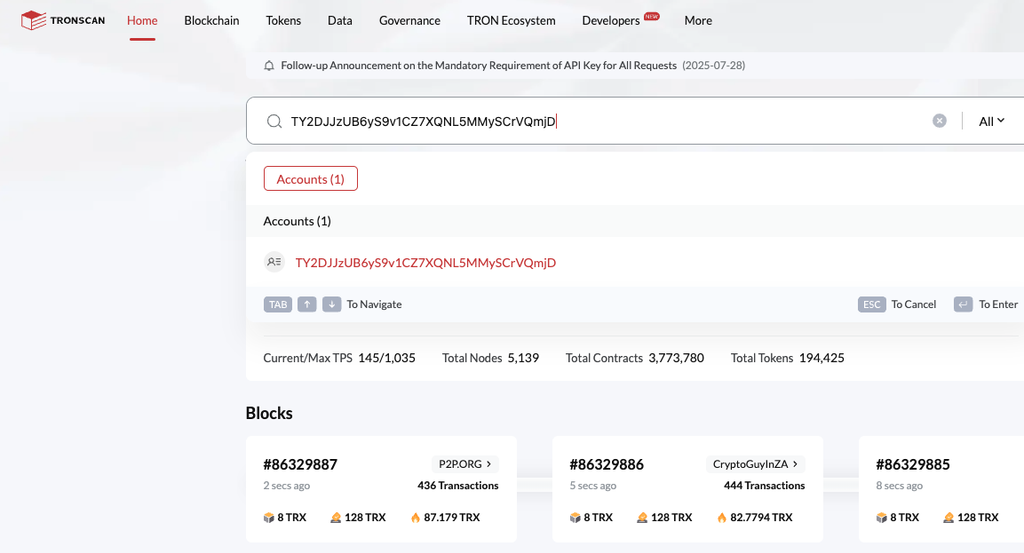
    To verify using blockchain explorers, paste the transaction hash into tronscan (for TRC20), bscscan (for BEP20), or etherscan (for ERC20). You’ll see if the transaction succeeded, the exact amount sent, and whether it landed at the right address or not.

    Tronscan showing a successful TRC20 USDT transfer

    3. Wait for Confirmation

    Do not rush to deliver work before confirmation. Don’t allow your client or anyone to pressure you to do this. Most networks take a few minutes to confirm.

    Important Anti-Scam Rule to note

    Always verify on the blockchain explorer using the transaction hash, not on a screenshot. The client may send a screenshot of a ‘transaction’ that never actually happened. If a client can’t or won’t share the transaction hash after sending, treat that as a red flag. A sender who truly made payment will always have a transaction hash.

    Step 5: Convert the Crypto to Naira

    I. If You Received USDT in Trust Wallet

    Trust Wallet can be used for freelancer payments in Nigeria. If the sender transfers USDT to your Trust Wallet instead of directly to Swapto, you can still cash out easily by moving the funds to your Swapto wallet and converting them to naira. Follow these steps:

    Open Swapto → ‘Receive’ → choose TRC20 → copy the address. Open Trust Wallet → Send USDT → paste the Swapto address → send. Confirms in 2–5 minutes.

    Once the USDT reflects in your Swapto account, you can proceed to convert it to naira instantly.

    II. If you received USDT directly on Swapto

    The process here is simpler, faster, and more transparent:

    • Open the Swapto app and log in to your account.
    • Tap “Sell USDT“ on the Swapto app. The current naira rate is shown upfront
    • Enter or select the amount of USDT you want to convert.
    • Review the exchange rate and naira amount displayed upfront.
    • Confirm the transaction.

    Your naira balance will be credited immediately after the trade is completed. Withdraw the funds directly to your Nigerian bank account (GTBank, Opay, Palmpay, Access Bank, UBA, First Bank, Zenith Bank, and others popular Nigerian banks are all supported).

    In most cases, the entire process, from receiving USDT to getting naira in your bank account can be completed within 5-10 minutes, making Swapto one of the fastest and most convenient ways to convert crypto to cash in Nigeria.

    The major advantage of OTC conversion (involving Swapto) is the simplicity involved, absence of buyer negotiation, absence of P2P disputes, absence of scam and the absence of anxiety that your bank account might be frozen.

    The Math: What You Actually Take Home and Why Freelancers Keep Switching to Crypto Payments

    Let’s use a realistic example, say $500 Client Payment

    StepResult
    Client sends $500 USDTNetwork fee: $1
    Amount of USDT that arrives in your Swapto wallet$499 equivalent
    Sell USDT on Swapto at 1% OTC spread$499 × ₦1,363 (current rate) = ₦680,137
    Swapto 0.5% Cashback+₦3,400
    Withdraw to your local bankUsually free (except for local charges)
    Total amount received₦683,537
    Total timeLess than 20 minutes after confirmation

    With Swapto, your Final outcome is close to ₦685k depending on rates. But the same $500 routed through Payoneer would arrive as approximately ₦460k after Fiverr or Upwork fees plus Payoneer’s 4.5% chain plus 2–5 days of waiting. The direct crypto route returns about ₦223,000 more on a $500 payment, in 30 minutes instead of 5 days.

    Over 12 months of $500-per-month direct payments, that’s over ₦2million in retained earnings . As a freelancer, you must know how to navigate your ways by learning how to convert upwork USDT to Naira, how to avoid crypto scams, as well as know how to take Fiverr clients off-platform safely. 

    Please Note: The rates used at ~₦1,331./$ mid-market as of September 17 . For better insights on the peculiarity of each platform, endeavour to check their respective website and social media pages.

    Common First-Time Mistakes to Avoid

    • Sharing the wrong network address: When your client tells you to send your USDT address and you send a TRC20 address but they use ERC20 instead, the money goes void. Always specify your network as boldly as possible.
    • Sample transaction: This importantly reduces the chance of you or your client making a mistake in the payment process. For your first time with a new client, ask them to send a small amount ($10 or $20) as a ‘test’ before the full payment. This helps you both to learn the workflow safely.
    • Trusting screenshots: Just as emphasized above, a client showing you an ordinary screenshot of a transaction is not proof. Always check the transaction hash on a blockchain explorer before proceeding to deliver your work.
    • Cashing out P2P with strangers: Most P2P transactions carry real counterparty risks (such as fake payment alerts, EFCC account freezes, etc) in Nigeria. OTC platforms like Swapto remove this risk. Stay away from this method so you don’t fall victim.
    • Not keeping records. The Nigeria Tax Act 2025 requires income reporting. Keep a simple spreadsheet of every client payment: date, client name, amount in USD, amount in naira, transaction hash. For easy tax payment.

    What to Do If Something Goes Wrong?

    The Payment Hasn’t Arrived After One Hour

    Most crypto transactions are completed within a few minutes. The first step is to verify whether the transaction was successfully sent and confirmed on the blockchain. Ask the sender for the transaction hash (TXID) or transaction ID. This unique reference allows you to track the status of the transfer in real time.

    Depending on the network used, you can verify the transaction on the appropriate blockchain explorer Tronscan for TRC20 (TRON) transactions, BscScan for BEP20 (BNB Smart Chain) transactions, and Etherscan for ERC20 (Ethereum) transactions

    When you enter the transaction hash, check for the transaction status (successful, pending, or failed), number of confirmations received, sender and recipient wallet addresses, amount transferred and network used for the transaction

    If the transaction shows as successful on the blockchain but the funds are still not visible in your wallet, contact your wallet or platform’s support team with the transaction hash for further assistance.

    The Payment Was Sent on the Wrong Network

    Sending cryptocurrency through the wrong network is one of the most common mistakes users make. For example, a sender may transfer USDT using the BEP20 network when the receiving platform only supports TRC20. In such cases, the funds may not appear automatically in the recipient’s wallet.

    Recovery is sometimes possible if the receiving wallet provider supports the wrong network, in this case, you should contact their support for assistance. Don’t promise the client anything until you’ve checked, because funds are sometimes irrecoverable.

    A few extra seconds spent confirming the correct network can prevent delays, support issues, and potentially irreversible loss of funds.

    The Naira Conversion Is Lower Than Expected

    Rates fluctuate hour to hour. The Swapto app rate is shown upfront, check it before initiating the sale. If you suspect a platform is giving you a poor rate, screenshot it and compare it to Monierate or two other similar apps.

    Frequently Asked Questions

    Is it legal to receive crypto from foreign clients in Nigeria?

    Yes. Cryptocurrency is legally recognised in Nigeria under the Investment and Securities Act (ISA) 2025. The Securities and Exchange Commission regulates digital asset platforms, and the Central Bank of Nigeria reversed its 2021 banking ban in December 2023.

    Which crypto is best for freelancer payments?

    USDT (Tether) on the TRC20 network is the default for Nigerian freelancers. It’s pegged to $1 so the amount you receive equals the amount agreed, network fees are around $1, and confirmation takes 2–5 minutes. USDT on TRC20 because of its stability, low fees, speed and widespread support. 

    What wallet should I use to receive crypto from a client?

    For most freelancers, Trust Wallet or MetaMask works well for receiving. Once the payment arrives, transfer it to Swapto for conversion to naira. If you want a single-app workflow, Swapto wallet can serve as your receiving address, it converts to naira in 5–10 minutes with 0.5% cashback.

    How long does the full process take?

    Receiving the crypto takes about 2–5 minutes on TRC20, 10–15 minutes on ERC20, seconds on Solana. Converting on Swapto takes 5–10 minutes once you initiate the sale. Total time from client clicking send to naira in your Nigerian bank account takes less than 30 minutes. This is faster than Payoneer (2–5 days) or wire transfer (3–7 days).

    Do I need to be a crypto expert?

    No. You only need your wallet, your correct network, your foreign client wallet address, the correct payment message and the basic verification knowledge that we’ve discussed in this article. That is enough to start safely.

    The Bottom Line

    Receiving crypto payments from foreign clients is one of the most important financial workflows for Nigerian freelancers, this is because it is faster than Payoneer, cheaper than Fiverr withdrawal chains, accessible globally and increasingly gaining more recognition in remote work. The first payment may seem complicated because everything is unfamiliar, but after a few successful payments, the entire workflow becomes simple.

    Download Swapto on iOS or Android. Cash out your first trade in under 10 minutes. Support available on WhatsApp at +234 811 337 2579.

    Download Swapto
  • Cheapest Way to Send Money to Nigeria in 2026: The Honest Cross-Size Comparison

    Cheapest Way to Send Money to Nigeria in 2026: The Honest Cross-Size Comparison

    TL;DR: For transfers under $500, Wise is usually cheapest thanks to the mid-market rate and low fees. Above $500, especially for regular or large sends, buying USDT and cashing out through a Nigerian off-ramp like Swapto typically wins, because blockchain network fees stay near $1 at any size.

    Millions of Nigerians abroad send money home to parents, siblings, spouses, and business partners every month. Most of them use the same handful of apps, such as Wise, Remitly, WorldRemit, Western Union, Sendwave, or MoneyGram. Most of these apps may be popular, but people subtly lose more money using them than they need to.

    If you’ve made findings on the cheapest way to send money to Nigeria from the UK or fastest way to send money to Nigeria from the US, you must have noticed that every comparison article looks almost identical. They compare remittance brands against each other, move a few percentages around, then recommend whichever company sponsored the article. But there is one option those articles usually don’t discuss adequately, that is the crypto route.

    The crypto route is such a mind-blowing option because the math changes interestingly once transfers get bigger. Under $500, Wise is usually the best option. Above $500, sending USDT and cashing out through a Nigerian off-ramp like Swapto often becomes cheaper and faster.

    In 2024, Nigeria received roughly $4.76 billion in formal remittance inflows (according to metrics from the Central Bank of Nigeria). Across Africa, Nigerians abroad sent home billions through informal and crypto channels. The painful part is that remittance fees still consume 4% to 8% of many transfers. That means hundreds of millions of dollars disappear yearly in hidden FX markups, card fees, and transfer spreads. To solve this issue, we have prepared a guide to give a more practical comparison and solution. 

    This guide compares every major option for sending money to Nigeria in 2026 using real fee structures and worked examples at $100, $500, and $2,000. We’ll show where Wise wins, where Western Union still makes sense, and where the crypto route becomes the cheapest option available. As you proceed reading this article, download Swapto immediately to follow the instructions in this guide.

    The 6 Real Ways to Send Money to Nigeria in 2026

    There are six realistic methods most Nigerians abroad use today. Each has its strengths and weaknesses.

    Wise

    wise-  global technology company

    Wise is a global technology company that offers multi-currency accounts and cheap, fast international money transfers. Wise remains a top-choice for transparency. It uses the mid-market exchange rate and charges a visible flat fee instead of hiding profit inside the FX rate. Its sweet spot is small-to-medium transfers below $500.

    Remitly

    remitly digital money transfer service

    Remitly is a digital money transfer service that allows people to send money internationally to friends and family safely and quickly. Remitly is built around speed and convenience. Its Express transfers arrive quickly, and the app experience is smooth for first-time users. The downside is the exchange rate markup, which quietly increases the total cost.

    WorldRemit

    worldremit - fast flexible and secure money transfers

    The WorldRemit app is a digital money transfer platform that allows you to send and receive funds across 130+ countries. WorldRemit performs well for African payment corridors and mobile-wallet delivery. It’s especially useful when recipients prefer mobile money or need flexible payout methods.

    Western Union

    Western Union - send money online from the united states at our best price

    Western Union is one of the most popular and oldest multinational financial services companies, primarily known for cross-border money transfers and remittance services to every country on Earth except Iran and North Korea. Western Union still dominates rural cash pickup and older users who trust physical agent locations. The tradeoff is cost and It remains one of the most expensive ways to send money to Nigeria in 2026.

    Sendwave

    Sendwave is a mobile app that allows users to send money internationally from the UK, North America, and Europe to countries across Africa, Asia, and the Americas. Sendwave works well for micro-transfers. Its no-fee marketing is attractive for £20 to £100 sends, although the exchange rate spread still exists.

    Crypto Route (USDT + Swapto)

    The crypto routes allow you to send money to Nigerian bank accounts from abroad. This is the option most remittance articles usually ignore. Instead of sending money through a remittance company, the sender buys USDT, sends it directly to the recipient’s wallet, and the recipient converts it to naira using a global platform like Swapto. For larger transfers, the savings become significant.

    Download Swapto on iOS or Android. Cash out your first trade in under 10 minutes. Support available on WhatsApp at +234 811 337 2579.

    Download Swapto

    How These Fees Actually Work (Read This Before the Tables)

    Most people compare transfer apps incorrectly. They focus only on the visible fee but the visible fee is usually not where most providers make their money. There are two costs involved in every transfer:

    1. The Flat Fee

    This is the obvious fee you see upfront.

    For example:

    • $0.99 transfer fee
    • $3.99 Express fee
    • £0 advertised fee

    This part is easy to compare.

    2. The Exchange Rate Markup

    This is where the real cost hides. Many providers quietly give you a worse USD/NGN or GBP/NGN exchange rate than the real market rate. If the true market rate is ₦1,377 per dollar and the provider gives you ₦1,330, the provider keeps the difference. That difference can quietly cost more than the visible fee. To send $1,000 to Nigeria, a 3% exchange-rate markup equals roughly $30. That’s why a so-called “free transfer” can still be one of the most expensive options available.

    The correct way to compare providers is simple: Always compare how much naira your recipient actually receives, not the advertised fee.

    The Comparison: Sending $100 to Nigeria

    For small transfers, the crypto route loses some of its advantage because the setup effort and network costs matter more proportionally.

    This is where Wise performs extremely well.

    MethodFeeFX MarkupNaira ReceivedTime
    Wise$0.500% (mid-market)₦137,0301-2 Minutes for cards.1-2 days for manual bank transfer
    Sendwave£01.5%₦135,015Takes between few minutes (other methods take few days)
    Remitly$3.991–3.7%₦131,500Express: same dayEconomy: 3-5 days
    WorldRemit$1.990.5–2%₦132,800Within 1hr
    Western Union$2.50+ card fee2–4%₦129,500Cash Pickup: few minutes Bank transfer: 1-5 days
    Crypto(Swapto off-ramp)$1 network1% spread₦135,4005–30 mins

    $100 Verdict

    Wise wins clearly at this amount. The mid-market exchange rate plus tiny fee make it extremely difficult to beat for small transfers. Sendwave comes close for UK senders.

    The crypto route is still competitive, but the setup overhead doesn’t justify itself if you only send small amounts occasionally. If Chiamaka in Manchester is sending £70 to her mother for groceries, Wise is probably the smartest option.

    The Comparison: Sending $500 to Nigeria

    This is where the gap starts narrowing. Crypto begins competing directly with Wise.

    MethodFeeFX MarkupNaira ReceivedTime
    Wise$3.500% (mid-market)₦683,7501-2 Minutes for cards.1-2 days for manual bank transfer
    Crypto(Swapto off-ramp)$1 network1% spread₦681,0005–30 mins
    Sendwave£01.5%₦676,000Takes between few minutes (other methods take few days)
    WorldRemit$2.990.5–2%₦671,000Within 1hr
    Remitly Express$3.991–3.7%₦663,000Express: same dayEconomy: 3-5 days
    Western Union$5 + card fee2–4%₦656,000Cash Pickup: few minutes Bank transfer: 1-5 days

    $500 Verdict

    Wise still edges out the competition, but now the crypto route is close enough that the choice depends more on convenience and recipient preference. If the recipient already has Swapto installed, crypto becomes extremely attractive especially due to speed advantage. Western Union loses roughly ₦27,000 versus Wise at this amount (that’s the cost of hidden spread and legacy infrastructure).

    The Comparison: Sending $2,000 to Nigeria

    This is where the structural advantage of crypto becomes obvious. Traditional providers scale fees with transfer size. Blockchain network fees barely change.

    MethodFeeFX MarkupNaira ReceivedTime
    Crypto(Swapto off-ramp)$1 network1% spread₦2,724,0001-2 Minutes for cards.1-2 days for manual bank transfer
    Wise$10–150% (mid-market)₦2,734,000Hours
    Sendwave£01.5%₦2,693,000Takes between few minutes (other methods take few days)
    WorldRemit$2.990.5–2%₦2,690,000Within 1hr-1 day
    Remitly Express$3.991–3.7%₦2,659,000Express: same dayEconomy: 3-5 days
    Western Union$10+ card fee2–4%₦2,625,000Cash Pickup: few minutesBank transfer: 1-5 days

    $2,000 Verdict

    The crypto route and Wise are now essentially tied as both massively outperform Western Union. At this transfer size, Western Union can quietly destroy nearly ₦100,000 in value between fees and exchange-rate markup. If someone sends $2,000 monthly for school fees, rent, or family support, that difference compounds into over ₦1 million yearly. That is no longer “just a fee.” That is real household money. 

    When Crypto Wins, When It Doesn’t

    Honesty matters here. Crypto is not automatically the best solution for every situation.

    ScenarioCheapest OptionWhy
    Under $200 monthlyWise or SendwaveLowest overhead
    $200–$500WiseMid-market rate dominates
    $500–$2,000Wise or cryptoExtremely close
    $2,000+Crypto routeFees scale better
    Recipient has no bank accountWorldRemitBetter mobile-wallet support
    Recipient in rural areaWestern UnionLargest pickup network
    Need same-day deliveryWise, Remitly, cryptoFastest timelines
    Business paymentsWise + cryptoCompliance plus efficiency

    The honest answer is this:

    • Wise is genuinely excellent below $500.
    • Crypto becomes increasingly powerful above $1,000.
    • Western Union still matters for rural cash pickup.
    • WorldRemit is useful for mobile-wallet recipients.

    Different transfer sizes deserve different tools. 

    NB: The rates used are typically the prevailing market rates as at the time of writing this article. For better insights on the peculiarity of each platform, endeavour to check their respective website and social media pages.

    How the Crypto Route Actually Works (For Anyone New to It)

    Many people sending from abroad hear “crypto is cheaper” but never actually understand the workflow. Understanding how to send USDT to Nigeria is easy and simpler than most people expect. Below is a breakdown:

    The Sender’s Side

    1. Buy USDT on Coinbase, Kraken, Revolut, Newton, or another regulated exchange.
    2. Select the TRC20 network when withdrawing (this holds the cheapest option)
    3. Send the USDT to the recipient’s wallet address.
    4. Network fee is usually around $1.
    5. Confirmation typically takes 2 to 5 minutes.

    The Recipient’s Side in Nigeria

    Receiving and converting USDT to naira is designed to be simple, even for first-time users. As a beginner, you can follow the basic procedures below and you’re good to go:

    • Start by downloading the Swapto app and creating an account. Once your account is set up, navigate to the wallet section and generate your unique USDT wallet address. Share this address with the sender abroad so they can transfer the funds directly to you.
    • After the USDT arrives in your Swapto wallet, open the app and select “Sell USDT.” Enter the amount you wish to convert, review the exchange rate and transaction details displayed on the screen, and confirm the trade.
    • Once the transaction is completed, the equivalent naira value will be credited to your account. You can then withdraw the funds directly to your Nigerian bank account, making the entire process fast, secure, and convenient.

    Most payouts complete within 5 to 10 minutes. The entire sender-to-bank timeline is often under 30 minutes. For someone like Chiamaka sending money from Manchester to Onitsha every month, the first transfer may feel unfamiliar, but by the third transfer, it becomes routine.

    Why the Crypto Route Gets Cheaper at Scale

    Traditional remittance companies grow more expensive as transfer size increases, however, crypto doesn’t behave that way. A $5,000 USDT transfer on TRC20 costs nearly the same network fee as a $200 transfer. That difference is why crypto becomes dominant at larger amounts. This is the part most comparison articles under-explain: they weigh remittance brands against each other and rarely give the crypto route the same attention.

    Common Concerns About the Crypto Route

    Is Sending Crypto to Nigeria Legal?

    Simply Yes! Nigeria’s crypto environment changed significantly after the Central Bank of Nigeria (CBN) reversed its banking restrictions in December 2023. The Investment and Securities Act (ISA) 2025 further established the legal framework for digital assets and Virtual Asset Service Providers. Platforms operating within SEC-regulated compliance frameworks now function in a much clearer regulatory environment. As always, regulations evolve, so users should verify the latest guidance before large transfers.

    Will the Recipient Get Scammed?

    The risk isn’t the blockchain itself; the risk is usually the cash-out step. Random peer-to-peer traders can introduce counterparty problems. That’s why the receiving platform matters. Using a structured off-ramp like Swapto removes much of the uncertainty because the recipient sells directly through the platform rather than negotiating with unknown traders.

    What If My Recipient Doesn’t Understand Crypto?

    Most recipients don’t need to understand crypto deeply; they only need to understand the receive-and-sell workflow. This involves generating wallet addresses, receiving USDT and selling for naira.

    That’s the entire process and the first setup takes a few minutes. After that, the experience becomes very similar to receiving any other digital transfer. 

    What If the Crypto Price Drops While It’s in Transit?

    For remittances, stablecoins matter more than Bitcoin. USDT is pegged to the US dollar; that means the recipient isn’t exposed to Bitcoin-style price swings during transfer. Although, the exchange rate risk still exists between the dollar and naira, but not between the dollar and the stablecoin itself. That’s why stablecoins dominate remittance use cases.

    A Note for US Senders About the 1% Remittance Tax (now in effect, 2026)

    US-based Nigerians should pay attention to evolving remittance tax discussions. A 1% US federal excise tax on certain international money transfers took effect on 1 January 2026. It applies mainly to transfers funded with cash or a money order — sends funded from a bank account or a debit/credit card are generally exempt, so traditional providers collect it only on cash-funded transfers. Crypto transfers may be treated differently because buying USDT is not structured identically to a conventional remittance transfer, however, this area is still evolving. So, always verify the latest IRS and federal guidance before transacting. 

    Likewise, parties involved in the transfer and receipt of funds must learn how to Avoid Crypto Scams.

    How to Avoid the Hidden FX Markup Trap

    Most people still compare transfer apps incorrectly. Here are three simple rules to note:

    • Compare Naira Received, Not Advertised Fees

    A “free transfer” can still be more expensive. Always compare the actual naira amount arriving in Nigeria.

    • Check the Mid-Market Rate First

    Look up the real USD/NGN rate before sending, then compare each provider’s implied exchange rate. If the gap is large, the provider is hiding profit inside the FX spread.

    • Don’t Trust First-Transfer Promotions

    Many apps offer artificially good first-transfer rates, but their second and third transfers are often worse. So, always compare rates every time.

    Cheapest Way to Send Money to Nigeria: The Decision Tree

    If you only remember one section from this article, let it be this one. Here’s the method to use:

    • To send under $200 occasionally, use Wise or Sendwave
    • To send $200–$500 monthly, use Wise
    • To send $500–$2,000 to a Nigerian bank, try Wise or crypto route
    • To send $2,000+ regularly, try the crypto route
    • If your recipient needs cash pickup, consider Western Union
    • If your recipient only has mobile wallet access, try WorldRemit
    • If you need maximum speed, don’t think too much, use Wise, Remitly, or crypto route
    • If you want the most transparent pricing, use Wise

    Don’t assume one provider is best for every amount, this is the biggest mistake people make. The best option may change depending on transfer size and recipient needs, but generally speaking, it’s advisable to send money to Nigeria with crypto.

    How to Set Up the Crypto Route for Your Family

    If your recipient in Nigeria is open to trying the crypto route, setup is straightforward.

    1. Tell your family member to download Swapto on App Store or Google Play
    2. They create an account and generate a USDT wallet address.
    3. You buy USDT on Coinbase, Kraken, Revolut, or another exchange.
    4. Send the USDT using the TRC20 network.
    5. They’ll receive the USDT inside Swapto.
    6. Then they tap “Sell USDT.”
    7. Naira arrives in their Nigerian bank account.

    Many first-time users complete the entire setup in under 15 minutes.

    Frequently Asked Questions

    Which app is cheapest for sending money to Nigeria in 2026?

    Below $500, Wise is usually the cheapest because it uses the mid-market exchange rate and keeps fees transparent. Above $500, the crypto route using USDT and a Nigerian off-ramp like Swapto often becomes cheaper because blockchain network fees stay low even as transfer sizes increase.

    How much does Western Union charge to send money to Nigeria?

    Western Union’s total cost often ranges between 4%-8% once you combine visible fees and exchange-rate markup. On larger transfers, that difference becomes significant compared to Wise or the crypto route.

    Is Wise cheaper than Remitly for Nigeria transfers?

    Usually, Yes. Wise uses the mid-market exchange rate and charges a small transparent fee (around 0.43% on most corridors). Remitly’s exchange rate markup ranges from 1% to 3.7% above mid-market, plus a flat fee of $3.99 for Express transfers. On a $500 sent to Nigeria, Wise usually returns roughly ₦20,000 more than Remitly Express.

  • Bybit is Delisting 8 Nigerian Payment Methods: What This Means and What You Can Do

    Bybit is Delisting 8 Nigerian Payment Methods: What This Means and What You Can Do

    On September 1, 2026, Bybit delisted 8 Nigerian payment methods from its P2P marketplace. Users who rely on PAGA, Chipper Cash, Carbon Microfinance, Jaiz Bank, Stanbic IBTC Bank, Ecobank, Polaris Bank, or Union Bank were grossly affected by this development, as these methods are no longer available for creating or trading against the NGN.

    For users who depend on one of those fintech accounts, the practical questions are; ‘what happens now?’, ‘what are your alternatives?’

    There are a few options. You can also change your payment method that is supported by Bybit, switch to another P2P market, or look into OTC as well, where you trade directly with the platform instead of another individual trader. Here is what the change means, why it matters, and what Nigerian users should know.

    The Full List of Affected Payment Methods and their Respective Banking Category

    The 8 payment methods named in Bybit’s delisting announcement on the 1st of September are:

    • PAGA: Nigerian digital payments and fintech platform under the Mobile Money Operator (MMO) category.
    • Chipper Cash: Fintech and digital payments platform. It falls under the International Money Transfer Operator (IMTO) and Payment Service Provider (PSP)
    • Carbon Microfinance: Digital lending and financial services platform under the Microfinance Bank (MFB) category.
    • Jaiz Bank: Nigerian Islamic bank. It is a Non-Interest Commercial Bank.
    • Stanbic IBTC Bank: Commercial bank.
    • Ecobank: Commercial banking group operating in Nigeria.
    • Polaris Bank: Commercial bank.
    • Union Bank: Commercial bank.

    This is not a change that is limited to a single bank. It impacts a combination of fintech payment accounts, microfinance institutions, an Islamic bank and a number of commercial banks.

    What did Bybit say Delisting 8 Nigerian payment methods means?

    Bybit’s announcement described the move as an effort to “optimize the NGN market on Bybit P2P.” The exchange said the 8 payment methods would no longer be available for creating NGN advertisements or trading against advertisements using them, thereby instructing users who currently have any of the affected methods in their P2P payment settings to add other supported payment methods. Active advertisements using the delisted methods would be removed.

    Please note that Bybit did not announce that it was shutting down its Nigerian operations altogether. The announcement is specifically about 8 payment methods within its NGN P2P marketplace. So describing this as “Bybit leaving Nigeria” would go further than what the company has actually announced.

    In case you’re wondering what P2P advertisement means, P2P (peer-to-peer) advertisements are custom listings that users create on a cryptocurrency marketplace to buy or sell digital assets with other people using local fiat currency. So instead of buying crypto instantly from a centralized exchange at a set market price, a user or merchant sets their own rules by posting an ad.

    Why Is Bybit  Delisting 8 Nigerian Payment Methods?

    Bybit did not extensively breakdown the exact reasons why these 8 institutions were chosen or whether it is a government directive. However, it can be deduced that the action was aimed at improving the safety, reliability, and overall trading experience of their users.

    We can also draw observations from the happenings in the wider Nigerian crypto market. The country’s P2P market has been under pressure since Binance discontinued its naira services in March 2024, where Binance announced that it would discontinue NGN-related services amidst increased regulatory scrutiny in Nigeria.

    That change pushed some Nigerian traders towards other exchanges. A TechCabal report published in April 2024 found that Nigerian users were moving to platforms including Bybit, Bitget and KuCoin after Binance’s restrictions.

    Since then, exchanges have continued similar changes to individual markets, currencies and payment methods. This proves that the payment methods and local P2P markets are not features that can be sustained for long.

    For Nigerian users, the message is clear; a payment method being available today does not mean it will always remain available.

    What This Means for Users

    The immediate impact is noticeable in practice. As there were sufficient Bybit advertisers willing to transact through Stanbic IBTC, Ecobank, and others, removing those payment methods reduces the pool of compatible offers. This results in fewer advertisers, less competition between available offers and potentially less attractive rates. It can also mean spending more time looking for a suitable trading partner.

    Likewise, users of Jaiz Bank may also feel the impact, due to their reluctance to get a commercial bank alternative that doesn’t promote similar interest as the Islamic bank.

    There is also the presence of P2P fraud. A report by Technext and republished by MEXC, which surveyed more than 100 active Nigerian P2P traders and examined more than 20,000 social media posts. More than 70% of surveyed traders said they had lost money to scams at least once. Fake payment proofs were among the problems highlighted by the study.

    The risks are real. P2P involves dealing with another person, and mistakes around payment confirmation, fake screenshots, account disputes, or moving conversations outside the platform can create problems.

    Your Options Now

    1. Add another Bybit-supported payment method

    This is the simplest alternative recommended by Bybit. It involves the addition of another supported payment method and reviewing existing advertisements affected by the change. The downside here is that you may have to open a new account with the supported bank or payment account.

    2. Try another P2P platform

    Examples of platforms that may be a good alternative include Bitget and MEXC, which Nigerian crypto users have also explored, particularly since Binance’s NGN restrictions. However, changing platforms does not remove the fundamental P2P problem, which involves dealing with another trader you don’t know. This may expose you to counterparty risk, payment disputes, and scams.

    3. Consider an OTC platform such as Swapto (Formerly Dtunes)

    This is where the difference in transaction structure becomes evident. With traditional P2P, you are exposed to the risk of dealing with a stranger who is buying or selling crypto. With the OTC model, the platform itself handles the transaction rather than match you to a stranger willing to trade with your particular bank.

    The beauty of this is that Swapto(Formerly Dtunes)operates under Nigeria’s Investment and Securities Act 2025, partnering with SEC-regulated infrastructure providers for secure transaction processing.

    Swapto, formerly known as Dtunes, is a Nigerian OTC crypto-to-naira platform. Its current app listing says it supports payouts to every major Nigerian bank and specifically names banks including GTBank, Access Bank, UBA, Zenith, First Bank, Opay, and PalmPay.

    For users of one of the 8 affected payment methods, the good news is therefore not simply in getting another P2P marketplace, it is the possibility of not having the need to find an individual advertiser who accepts your particular payment method.

    Ready to try a P2P-free alternative? Download Swapto on iOS or Android. Cash out your first trade in under 10 minutes. Support available on WhatsApp at +234 811 337 2579.

    Download Swapto

    Why OTC Can Solve This Particular Problem

    The main difference between P2P and OTC is who you are dealing with. On the P2P marketplace, your transaction depends on another trader. Their bank, their payment method, their responsiveness, and truthfulness all become part of the transaction. But with the OTC service, instead of negotiating with an unknown advertiser, you transact directly with the platform.

    That removes any counterparty risk that comes with conventional P2P, even though it is advisable for users to cross-check the platform’s regulatory status, fees, prevailing market rates and customer support.

    Swapto service supports naira payouts to major Nigerian banks (including the 8 banks that were delisted by Bybit) within five to 10 minutes. Its app listing also says the platform operates under the Investment and Securities Act 2025 and within the SEC framework.

    For someone affected by the Bybit change, the OTC platform has proven to be the most appealing alternative, where you don’t have to find a stranger who accepts Jaiz Bank, Ecobank or Stanbic IBTC. You only need a service that can settle directly into your bank account.

    How to Sell on Swapto

    For users who have their crypto already and want to use a compliant service, the process is generally straightforward:

    1. Create an account with the platform: Swapto is available through the App Store and Google Playstore. Download the app and create an account.
    2. Complete the platform’s identity verification: This takes less than 5 minutes. Swapto’s current listing describes identity verification as part of its onboarding process.
    3. Send crypto to your Swapto wallet at the shown network: Always confirm the network and receiving address before sending anything.
    4. Review the quoted naira before confirming the transaction.
    5. Withdraw to any Nigerian bank in 5-10 minutes: Receive the naira payout into your Nigerian bank account once the transaction is processed.

    Swapto’s current app listing says it supports cryptocurrencies such as Bitcoin, USDT, Ethereum, etc., and with five to ten minutes bank payouts.

    Please note that the exact rates, supported asset, network, verification requirements and payout time can change slightly based on different factors. Users should check the app before every transaction and not rely on previously displayed facts.

    Frequently Asked Questions

    Is Bybit leaving Nigeria completely?

    No. Bybit’s September 2026 announcement does not say that the exchange is shutting down Nigerian operations. It specifically stated the 8 payment methods which will no longer be available.

    When exactly did the change take effect?

    The change took effect on September 1, 2026, at 10:00 AM UTC, which was around 11:00 AM Nigerian time. From then, the 8 affected payment methods could no longer be used to create NGN P2P advertisements or trade against advertisements using those methods.

    What are the affected payment methods?

    The affected methods are PAGA, Chipper Cash, Carbon Microfinance, Jaiz Bank, Stanbic IBTC Bank, Ecobank, Polaris Bank and Union Bank. Bybit listed all 8 in its official announcement.

    What should I do if I use one of these banks?

    You have three options. You can add another payment method supported by Bybit, consider another P2P marketplace, or use an OTC service that can pay directly into your Nigerian bank account.

    Are P2P alternatives still safe?

    By default, P2P is not unsafe, but it carries counterparty risk. According to Breet’s 2025 study, a larger percentage of its surveyed Nigerian P2P traders had lost money to scams at least once, with fake payment proofs among the problems identified. Using another P2P exchange therefore does not eliminate the underlying risks.

    Does Swapto support Jaiz Bank, Ecobank, Stanbic IBTC and the other affected banks?

    Yes, Swapto’s supports payouts to every major Nigerian bank, including GTBank, Access Bank, UBA, Zenith, First Bank, Opay and PalmPay.

    The Bottom Line

    Bybit’s removal of 8 Nigerian payment methods confirms that the country’s P2P crypto market is becoming more restrictive. It does not mean Bybit has left Nigeria, but it means affected users need to reconsider how they access NGN liquidity.

    A wise response is not to jump from one P2P platform to another, but to observe the options, understand the counterparty and regulatory risks, and choose the route that guarantees you safe and secured transactions over a longer period of time.

    For readers considering an OTC alternative, Swapto is available as an official upgrade of Dtunes, with support through its app and WhatsApp at +234 811 337 2579. If you want to see how Swapto handles crypto-to-naira conversion without P2P complications, check the live rate calculator to see what your crypto is worth in naira right now.

  • OPay USSD Codes 2026: Complete Guide to 955# (All Codes + Shortcuts)

    OPay USSD Codes 2026: Complete Guide to 955# (All Codes + Shortcuts)

    The OPay USSD code is *955#. Dial *955# from the phone number linked to your OPay account to access transfers, balance checks, airtime, data, bill payments, and account security. For quick actions, use shortcuts like *955*0# for balance, *955*1*AmountNumber# for OPay-to-OPay transfers, and *955*1*3*1# to block your account in emergencies. Works on MTN, Airtel, Glo, and 9mobile without internet.

    TL;DR

    The USSD code for OPay is *955#. The code is a one-stop code that allows users to perform essential financial tasks without internet access.

    Quickly send money using *955*1*AmountPhoneNumber#.

    Top-up airtime for yourself or others with *955*3*Amount#.

    Pay bills instantly with *955*6#.

    Swapto(Formerly Dtunes) app makes OPay even easier, offering quick bill payments and earning rewards in the process.

    In 2026, Opay has become a widely familiar word to every household. The familiarity is not limited to households alone, but to every setting of the society, even to the market women out there. This is the extent to which OPay has become widely accepted in Nigeria. 

    In this article, we will see OPay USSD codes in 2026, what they are used for, and every necessary thing you need to know about activating the codes.

    One of its key features is enabling customers to perform transactions easily without internet access, using a range of USSD codes. This means you don’t have to go about saying ‘bro, abeg on hotspot for me, I just wan do data.’ 

    What Is the OPay USSD Code?

    The USSD code for OPay is *955#, and it gives users quick access to a wide range of transactions directly from their mobile phones. This feature was introduced to make OPay’s services more convenient, especially for people in areas with little or no internet connectivity. By enabling offline transactions, it has further strengthened OPay’s reputation as one of Nigeria’s leading digital payment platforms.

    In order to access this service, users have to create an OPay account and connect it to their phone number. The phone number that is registered as the account number can then be used to transact smoothly and securely using the USSD code.

    Have quick glance at all the Opay USSD Codes:

    The Complete List of OPay USSD Codes (2026 Master Table)

    Service USSD Code What It Does
    Access main menu *955# Opens full OPay USSD menu.
    Check balance *955*0# Instant balance display.
    OPay-to-OPay transfer *955*1*Amount*PhoneNumber# Send money to another OPay user.
    Bank transfer *955*2*Amount*AccountNumber# Transfer money to any Nigerian bank.
    Buy airtime (self) *955*3*Amount# Recharge your own phone line.
    Buy airtime (others) *955*3*Amount*PhoneNumber# Recharge another person’s phone line.
    Buy data *955*4*PhoneNumber# Purchase a data bundle.
    Get OTP *955*5# or *955*010# Generate a one-time password (OTP).
    Pay bills *955*6# Pay electricity, cable TV, betting, and other bills.
    Block account *955*131# Emergency account freeze.
    Block card *955*132# Block your OPay card.
    Customer care *955*9# Contact OPay customer support.

    How to Activate OPay USSD Banking

    How to Activate the OPay USSD Code. To activate and use the OPay USSD code, follow these steps:

    Step 1: Register with OPay

    Before you can use the OPay USSD codes, you need to have an OPay account. Here’s how to register:

    1. Download the OPay App: Install the OPay app from Google Play or the App Store, or visit an OPay agent to sign up.

    2. Provide Basic Details: Enter your phone number and personal information.

    3. Link Your Phone Number: Your phone number will serve as your account number.

    Once registered, you can now access the OPay USSD services.

    Step 2: Link Your Phone Number

    For seamless transactions, you must link the phone number to your OPay account. This is crucial because your phone number serves as your OPay account number when performing transactions.

    Step 3: Dial *955# to Activate

    Once you’ve registered and linked your phone number, dial *955# on your mobile device to open the menu. Follow the on-screen prompts to set up your PIN and complete your registration.

    Step 4: Set Up Your PIN

    You’ll be asked to create a 4-digit PIN. This PIN will be used to authorize your transactions, ensuring that your account remains secure.

    OPay USSD Code for Balance Check (*955*0#)

    Want to know how much you have left in your account? Here’s how to check your balance:

    1. Dial *955# on your phone.

    2. Select the “Check Balance” option (usually option 4).

    3. Enter your PIN to proceed.

    You’ll receive an SMS with your current account balance, giving you quick insight into your finances.

    OPay USSD Code for OPay-to-OPay Transfers (*955*1#)

    Sending money to an OPay user is incredibly easy. All you need is the recipient’s phone number, and you can transfer funds instantly. Here’s how:

    1. Send Money to Another OPay User: *955*1*Amount*PhoneNumber#

    2. For example, to send ₦5000 to a friend whose OPay number is 08012345678, you’d dial:
    *955*1*5000*08012345678#

    OPay USSD Code for Bank Transfers (*955*2#)

    OPay allows you to transfer funds to any Nigerian bank account with ease. Just use the following code to send money directly to a bank account:

    Transfer to Bank Account: *955*2*Amount*AccountNumber#

    For example, to send ₦10000 to a bank account with Account Number 0123456789, you’d dial: *955* 2* 080000123456789#

    OPay USSD Code for Airtime Purchase (*955*3#)

    Running low on airtime? With OPay, you can buy airtime for yourself quickly and easily. Simply dial:

    Buy Airtime for Yourself: *955*3*Amount#

    For example, to purchase ₦500 worth of airtime, just dial: *955*3*500#

    OPay USSD Code for Data Purchase (*955*4#)

    Stay connected by purchasing data for yourself or others. With OPay’s data purchase code, you can buy data in seconds:

    Purchase Data: *955*4*PhoneNumber#

    For example, to buy data for the phone number 08012345678, simply dial: *955*4*08012345678#

    Most Nigerian utility bills can be paid through *955*6# as well. If you’re managing prepaid electricity specifically, see our guide to checking your prepaid meter debt before topping up.

    OPay USSD Code for Bill Payments (*955*6#)


    Paying your bills is now easier than ever. OPay’s USSD code allows you to pay your electricity, water, or other utility bills directly from your account:

    Pay Utility Bills: *955*6#

    Simply follow the on-screen instructions, and the payment will be processed instantly.

    OPay USSD Code to Get OTP (*955*5# or *955*010#)

    Sometimes you start a transaction on the OPay app and the OTP never arrives. The network is slow, the SMS is stuck somewhere, and you’re staring at a screen asking for a code you don’t have.

    Dial *955*5# from your OPay-linked phone number. Your OTP generates instantly. If that shortcut doesn’t work on your account, try *955*010#.

    Save this one. You won’t think you need it until you’re stuck at a checkout counter with no data and a frozen transaction.

    A few things to remember:

    The OTP expires within minutes. Use it as soon as you receive it.

    If the code doesn’t work, your SIM is probably not the one linked to your OPay account. OTPs are tied to the registered phone number.

    Never share an OTP with anyone, even someone claiming to be from OPay. If they’re asking, they’re scamming you.

    OPay Emergency Code to Block Account (*955*131#)

    If your phone is stolen or lost, every second between losing it and blocking your OPay account is a window for someone to drain your wallet.

    Dial *955*131# from any phone, as long as the SIM is registered to your OPay account. The block is instant. No transfers, no airtime, no transactions until you unblock through OPay support.

    To block your OPay card specifically, dial *955*132#.

    Quick advice from people who’ve been through this:

    After losing your phone, your first call is *955*131# from a friend’s phone or a roadside kiosk. Not your bank, not your insurance. OPay first, because it moves fastest.

    The block only works when the dialing SIM matches your OPay-registered number. If you have multiple SIMs and aren’t sure which one is registered, try each.

    To unblock later, call OPay support at *955*9# from your registered line and verify your identity.

    Memorize this code or save it as “OPay Emergency” in your contacts. Five seconds spent searching during a real crisis is five seconds too many.

    Common Problems and Fixes

    USSD is reliable but not perfect. Here’s what to do when something breaks.

    1. “Invalid code” or “Service not available”

    You’re either dialing from the wrong SIM, your network has a temporary glitch, or OPay’s USSD is briefly down.

    Confirm you’re using your OPay-registered phone number. Restart your phone. Try again in 5-10 minutes. If nothing works, contact OPay support at *955*9#.

    2. Transaction Fails Despite Sufficient Balance

    Often a network handshake issue between OPay and your carrier.

    Switch to airplane mode for 10 seconds, then back on. Re-dial. If still failing, your wallet may have a small pending hold. Wait 15-30 minutes and retry.

    3. You Forgot Your PIN

    Don’t guess. Three wrong attempts lock your account.

    Open the OPay app, tap Profile, then Security, then Reset PIN. If you don’t have data, visit any OPay agent with your ID.

    4. Code Hangs or No Response

    Network congestion. Most common during 12pm-2pm, 5pm-8pm, and end-of-month salary days.

    Wait two minutes, re-dial. If you have dual-SIM, switch networks.

    5. Transaction Went Through, But Recipient Didn’t Receive

    Wait 5 minutes first. Inter-bank transfers occasionally lag.

    After 5 minutes, double-check the account number you sent. A single wrong digit is the most common cause. If you’re receiving inflows from foreign clients into your OPay or any Nigerian bank, see how to cash out crypto to your Nigerian bank safely. Direct OTC routes avoid the reversal risk that traditional transfers sometimes carry.

    6. “Insufficient Balance” When You Have Money

    USSD briefly desynced from your actual balance.

    Open the OPay app to confirm your balance. If the app shows the right amount but USSD still says insufficient, log out, log back in, and retry the code.

    7. Account Blocked Without You Doing It

    Someone tried to access your account multiple times with the wrong password, triggering auto-block. Treat it as suspicious.

    Dial *955*9# to reach customer care. Tell them you didn’t initiate the block. They’ll verify your identity and walk you through reactivation. Change your password immediately after, then check your transaction history for unauthorized activity.

    8. Network Charges You Didn’t Expect

    USSD is free to dial, but your mobile carrier may charge a session fee (around ₦6-7) depending on your tariff. This is your network’s charge, not OPay’s.

    9. When None of the Above Works

    Open the OPay app, tap Help, and use WhatsApp Support. Real humans respond within 10-30 minutes during business hours.

    Avoid third-party “OPay agents” online claiming to fix issues for a fee. Genuine OPay support is free and goes through official channels only.

    Are OPay USSD Codes Safe?

    When it comes to choosing a reliable financial service platform in Nigeria, there are quite several options available. However, OPay continues to stand out for several compelling reasons. Whether you’re new to digital banking or looking to switch platforms, here are five solid reasons why OPay deserves your attention.

    1. Ease of Use and Accessibility

    One of the biggest advantages of OPay is how simple it is to use. The app is user-friendly, making it easy for both tech-savvy individuals and beginners to navigate. Even better, its USSD feature (*955#) ensures that you can carry out transactions without internet access—perfect for users in areas with limited connectivity.

    2. Fast and Reliable Transactions

    Speed matters when it comes to financial transactions, and OPay delivers on that front. Transfers, bill payments, and airtime purchases are processed almost instantly, helping you save time and avoid unnecessary delays.

    3. All-in-One Financial Services

    Instead of juggling multiple apps, OPay brings everything together in one place. From sending and receiving money to paying bills, buying airtime, saving funds, and even accessing loans, it serves as a complete financial solution.

    4. Wide Network of Agents and Merchants

    Another strong advantage of OPay is its extensive network of agents and merchants across Nigeria. This means you can easily find nearby POS agents for cash withdrawals, deposits, or assistance, making it highly convenient for everyday use.

    5. Rewards, Bonuses, and Cost Savings

    Who doesn’t love a good reward? OPay frequently offers cashback deals, discounts, and bonuses on transactions like bill payments and airtime purchases. These little savings can add up over time, giving you more value compared to many traditional banking options.

    Choosing the right financial platform can make a big difference in how you manage your money. With its ease of use, speed, wide accessibility, and added benefits, OPay proves to be the top choice for millions of Nigerians today. Whether you’re looking for convenience, reliability, or extra value, OPay ticks all the right boxes.

    Are There Charges for Using OPay USSD?

    OPay doesn’t charge you anything for dialing *955# or using its USSD service. The code itself is free.

    What you may pay:

    Network session fee. Your mobile carrier (MTN, Airtel, Glo, 9mobile) may charge around ₦6-7 per USSD session depending on your tariff plan. This is the network’s charge, not OPay’s. It applies to most USSD codes across all Nigerian banks and fintechs, not just OPay.

    Transfers to other Nigerian banks attract a small fee, usually ₦10-25 depending on the amount. If you frequently transfer between banks, see what those fees look like across other Nigerian USSD codes for comparison.

    Stamp duty. Inflows above ₦10,000 attract the standard ₦50 federal stamp duty, charged once per qualifying deposit. This applies to all Nigerian banks under CBN rules, not just OPay.

    Airtime and data purchases. No extra fee. You pay the exact face value of the airtime or data bundle.

    Bill payments. Most utility payments through *955*6# are free. Some service providers (cable TV, betting) may add their own service charge, which is shown before you confirm.

    What’s never charged:

    Checking your balance with *955*0# is free. Generating OTP with *955*5# is free. Blocking your account with *955*131# in an emergency is free. OPay would never charge you for protecting your own money.

    If you ever see an unexplained deduction after a USSD transaction, check your transaction history in the app first. If you can’t account for the charge, dial *955*9# to reach customer care. Don’t accept “service charge” explanations from third parties online claiming to be OPay agents.

    OPay’s *955# remains one of the fastest ways to handle everyday transactions without internet in 2026. Whether you’re transferring money, paying bills, or recovering from a stolen phone, the codes above cover everything you’ll realistically need. For more secure ways to manage your Nigerian finances, including crypto cash-outs and freelancer payment routes, explore our other guides.

    Frequently Asked Questions About OPay USSD

    What is the OPay USSD code?

    The USSD code for OPay is *955#. It allows users to perform various banking transactions such as transfers, airtime purchases, and bill payments without internet access.

    How do I check my OPay balance with USSD?

    To check your balance on OPay, dial *955# on your mobile device. Follow the on-screen prompts, and your balance will be displayed.

    How do I transfer money on OPay without internet?

    You don’t need an internet connection. The USSD service provided by OPay works on any mobile phone, making it ideal for areas with limited or no internet.

    Are OPay USSD codes safe to use?

    Yes, as long as you keep your PIN private. Every USSD transaction requires your 4-digit PIN, and OPay never asks you to share it. If anyone, including someone claiming to be from OPay support, asks for your PIN or OTP, it’s a scam. The USSD code itself runs on a secure GSM signaling channel that doesn’t expose your data the way unsecured public Wi-Fi might. Treat your PIN like your ATM PIN and you’re safe.

    Does OPay USSD work on all networks?

    Yes. *955# works on MTN, Airtel, Glo, and 9mobile without any extra setup. As long as the SIM you’re dialing from is the one registered to your OPay account, the code goes through. You don’t need data, you don’t need a smartphone, and you don’t need to switch SIM provider to use it.

    How do I block my OPay account if my phone is stolen?

    Dial *955*131# from any phone. As long as the SIM in that phone is the one registered to your OPay account, the block is instant. No transfers or transactions can happen until you unblock through OPay support at *955*9#. If you have a friend or roadside kiosk nearby, do this within the first few minutes of losing your phone. Speed matters more than anything else here.

    Are there charges for using OPay USSD codes?

    OPay doesn’t charge you for dialing *955# or any of its shortcuts. Your mobile carrier may charge a small session fee (around ₦6-7) depending on your tariff plan, but that goes to the network, not OPay. Transfers to other Nigerian banks attract a small fee of ₦10-25, and the standard ₦50 federal stamp duty applies to deposits above ₦10,000. Balance checks, OTP generation, and emergency account blocking are always free.

    What do I do if the OPay USSD code says “invalid”?

    Three things usually cause this. The SIM you’re dialing from isn’t the one linked to your OPay account, your network is having a temporary glitch, or OPay’s USSD system is briefly down. Confirm you’re using your registered phone number first. Restart your phone. Try again in 5-10 minutes. If nothing works after 30 minutes, contact OPay support at *955*9# or use the WhatsApp support option inside the OPay app.

    Conclusion

    In 2025, OPay USSD codes continue to transform how Nigerians carry out everyday financial transactions. With just *955#, users can perform a wide range of activities quickly and conveniently, without relying on internet access.

    The simplicity and efficiency of this service make it easy for anyone to manage their finances on the go. From transferring money and paying bills to checking account balances, OPay provides a secure, reliable, and user-friendly solution that fits seamlessly into daily life. On a final note, if you’re looking to get even more value from your everyday transactions, you might want to explore Swapto(Formerly Dtunes) and download our app here.

    The app allows users to pay bills such as airtime, data, and utilities while earning rewards and bonuses in return. It’s a great complement to platforms like OPay, especially for users who want to maximize savings and enjoy extra benefits from their spending.

    Related Stories

    Moniepoint USSD Codes Updated (2025): Check Balance, Transfers, Airtime, and More

    How To Transfer Money From UBA To All Banks

    How to Check MTN Airtime Balance

  • Fiverr Crypto Payment to Naira in Nigeria: The Honest 2026 Guide

    Fiverr Crypto Payment to Naira in Nigeria: The Honest 2026 Guide

    You can’t deal with the high fees charged by Fiverr for withdrawals anymore and you’re beginning to find an alternative. ‘Can’t we have a Fiverr crypto payment to Naira’, you’ve asked your friends who are also freelancers. 

    In fact, you go further to ask your search engines “how to withdraw Fiverr in Nigeria” or “Fiverr crypto withdrawal Nigeria”. Worry no more! Keep your minds at rest because you’re just at the best spot. 

    Does Fiverr support crypto payments?

    Fiverr does not currently support cryptocurrency withdrawals. Not even USDT or Bitcoin. However, we’ll show you the closest thing to ‘Fiverr crypto payment to Naira Nigeria’. 

    Fiverr payment

    As of 2026, the official Fiverr withdrawal methods are PayPal, Payoneer, and bank transfer and since you’re frustrated with the high fees those methods charge, your next plan is to get a client from Fiverr who wishes to continue collaborating with you directly outside the platform, and establish reliable and trustworthy relationships with them. Once you’re outside the platform with this client, suggest crypto USDT as a mode of payment and you’re good to go. 

    After receiving the crypto, platforms such as Swapto(Formerly Dtunes) instantly helps you to convert your USDT to naira. The difference in price when Swapto(Formerly Dtunes) comes to play is just so substantial. The difference is easily noticeable.

    On a $500 project, the traditional Fiverr → Payoneer → Nigerian-bank route can leave you with roughly ₦525,888 after fees and FX losses. The direct USDT payment→ Swapto(Formerly Dtunes) route can leave you with about ₦683,538. That is a difference of roughly ₦162,612 on a single project.

    This guide explains what is obtainable, what is risky, and what the safest workflow looks like. Let’s proceed further.

    Why Fiverr Doesn’t Support Crypto Payments

    Fiverr’s body language suggests that they might consider the use of USDT (or crypto) as one of their methods of payment. However, due to the three major reasons below, Fiverr has avoided cryptocurrency payments:

    1.      Compliance: The first is compliance. Fiverr operates across more than 160 countries. Implementing cryptocurrency would mean the platform would have to deal with dozens of different regulatory systems, AML requirements, licensing regulations, and tax-reporting requirements all at the same time, these alone might be too complex to handle.

    2.      Dispute resolution: Dispute resolution is the second reason why Fiverr hesitates the implementation of the crypto route for payment. The payment system for Fiverr is based on the concept of escrow. If a buyer pays for a project, the money may be retained by Fiverr whilst the project is being delivered and reviewed. That is not the same with crypto transactions. It doesn’t work like that. For crypto, once the USDT or BTC has been sent, it is almost impossible for it to be withdrawn for any reason due to the buyer’s complaint later.

    3.      Tax reporting: Fiverr already adheres to several international tax systems. Addition of cryptocurrency would only create another layer of reporting and accounting complexities that the company has clearly determined is not worth the operational risk.

    In reality, Fiverr does not look like it’ll implement support for crypto natively anytime soon. This means Nigerian freelancers must understand the best workflow that exists today instead of waiting for a feature that Fiverr may not introduce.

    The Three Real Scenarios Behind This Search

    Scenario 1 — A Fiverr Client Wants to Work With You Directly

    This is the most common situation. When you complete several Fiverr projects successfully for the same client, he becomes happy with your service and develops trust in you naturally. Eventually the client would suggest that you continue the relationship outside Fiverr to avoid Fiverr’s fees and delays. At that point, the client may ask if he can pay you directly in USDT. This is where the Fiverr-to-crypto transition begins for many Nigerian freelancers.

    Download the Fiverr-to-Direct-Client Transition Toolkit. An Editable invoice for direct USDT payments

    Download Template

    NB: The conversation should come from the client, not from you. Fiverr’s Terms of Service prohibit sellers from soliciting clients away from the platform. Violating that term may cause a ban on your account.

    Scenario 2 — A Client Sends a Tip in Crypto

    There are certain clients who would like to pay bonuses or appreciation to those who have helped them on Fiverr, but outside Fiverr’s regular mode of payments. They don’t request another Fiverr order. Instead, they just request your USDT wallet address and send crypto straight to you

    This is more common among clients who are already familiar with the crypto rails as the USDT transfer is cheaper and faster than bank wires.

    Scenario 3 — You Want Future Clients to Pay You in Crypto

    Many freelancers will discover that Fiverr’s economics is getting to be pocket-tearing. As a platform that charges a fee as high as 20% of one’s cash-out, where losses are also incurred through Payoneer FX, the resulting take-home pay is usually affected significantly. This has made freelancers start looking for direct-client jobs, which will have USDT payment.

    Download the USDT Payment Terms Agreement Template. Send this to your client BEFORE you start any work

    Download Template

    The Risks — Read This Before You Take Crypto from a Fiverr Client

    Fiverr ToS Risk

    The Fiverr’s terms of service is the largest of them. Your account can definitely be restricted or banned if you ask clients to leave Fiverr. It is against the platform’s terms of service. Fiverr takes solicitation quite seriously. Here is a safe thing to do:

    • Fulfill the original Fiverr job on Fiverr and then
    • Allow the client to recommend that you work directly (outside the platform)

    If you have to start working off the platform, do so after the original project is completed. That sequence matters a lot. Don’t request a crypto payment for an active Fiverr order that is still inside Fiverr’s ecosystem.

    Buyer Dispute Risk

    The Fiverr’s escrow system is meant to protect both sides, but direct crypto payments do not. The absence of the escrow system makes the parties involved to be vulnerable in a way. Once USDT is sent, the transaction is final.

    If a client pays you in USDT and then claims the work was unsatisfactory, there’s no escrow to fall back on and this might lead to disagreements or work complications between you both. This means you must screen your clients adequately and ensure proper documentation and agreement when working directly outside Fiverr.

    For ongoing clients, the safest structure is to receive 50% upfront in USDT and 50% after delivery. That removes most of the risk of unpaid work.

    Tax Risk

    The tax law in Nigeria considers freelance income earned from any source, including Fiverr, Payoneer, bank transfers, or USDT, as taxable income. Earnings from crypto should be accounted for, they are not invisible income. Other records that should be kept include invoices, wallet transfers, bank settlements, and project agreements.

    Professional freelancers should consider earnings from activities such as crypto trading and mining as any other form of business revenue. Under the Nigeria Tax Act 2025, your foreign income is taxable above ₦800,000 annually. Crypto income falls under this, so you should endeavour to get your tax identification number.

    6 step direct-USDT workflow – How to Take Crypto Payment from a Former Fiverr Client

    Getting crypto payment from your client may not be as simple as you think, especially if you are doing this for the first time. To safely take crypto from a familiar client, go through the steps below carefully.

    Step 1 — Complete the Fiverr Order Normally

    This is the first thing to note. Ensure that you complete the original order through Fiverr first. Do an amazing job and deliver at the expected time. In fact, delivering before time creates a great impression around you. Get a review from your client, then close the project professionally. Fiverr remains valuable for trust-building, reviews, and client acquisition.

    Step 2 — Let the Client Initiate Off-Platform Work

    After closing the project, if the client wants to continue outside Fiverr, don’t be the one to initiate such a move, let that suggestion come from them. Do not pressure or hint aggressively. This is both safer and more professional.

    Step 3 — Agree on Terms Clearly

    Before any crypto payment happens, define:

    • project scope
    • timeline
    • payment amount
    • revision policy
    • wallet network

    Discussing all of these at length and having a mutual understanding before-hand will save you from unnecessary misunderstanding in the long run. TRC20 USDT is usually the default because fees stay around $1.

    Step 4 — Share Your Swapto(Formerly Dtunes) Wallet Address

    The next step here is to open the Swapto(Formerly Dtunes) official website app and generate your wallet address (of course, you must have an account with Swapto(Formerly Dtunes) already to do this). Choose:

    • USDT
    • TRC20 network

    Copy the address carefully and send it to the client. One wrong character can send funds permanently to the wrong wallet. In short, this is the route you follow to get your wallet address on Swapto(Formerly Dtunes):

    Open Swapto(Formerly Dtunes) app → Receive USDT → Choose TRC20 network → Copy address and send it to your client. (TRC20 fees are around $1)

    Step 5 — Confirm that the direct USDT Payment arrives in your Swapto(Formerly Dtunes)

    The confirmation of TRC20 transfers usually takes between 2–5 minutes. Do not deliver your service until the transaction is fully confirmed in your wallet. This is one of the advantages crypto has over other payment methods where fake bank alerts and delayed international transfers are common. Protect yourself from fake payment alerts.

    Step 6 — Sell USDT for Naira On Swapto(Formerly Dtunes)

    On the Swapto(Formerly Dtunes) app:

    • tap “Sell USDT”
    • confirm the displayed rate
    • enter your Nigerian bank account

    Naira typically arrives within 5–10 minutes. That entire process is dramatically faster than the Fiverr → Payoneer route.

    The Math — $500 Project via Fiverr vs Direct USDT to Swapto(Formerly Dtunes)

    This is where other guides fail to address. Here, the difference becomes very visible and impossible to ignore. For the purpose of comparison, we’ll make the assumptions below:

    • Project value: $500
    • User location: Lagos
    • Bank: GTBank
    • USD benchmark: ₦1,377
    • Swapto(Formerly Dtunes) USDT sell rate after OTC spread: ₦1,363

    At perfect mid-market conditions, $500 equals about ₦688,500. That becomes our benchmark.

    Route A — Fiverr + Payoneer Route

    StepCost
    Fiverr seller fee (20%)$100 deducted
    Remaining balance$400
    Fiverr clearance period14 days
    Fiverr → Payoneer fee$1
    Payoneer withdrawal fee$3
    Payoneer FX markup3.5%
    Effective post-fee amount$396
    Effective conversion rate (after 3.5% fx)₦1,328/USD
    Final payout₦525,888
    Time to Receive FundsApproximately: 17–21 days

    Final Value Retained is about 76.38% of ideal mid-market value

    Route B — Direct USDT → Swapto(Formerly Dtunes)

    StepCost
    Client sends 500 USDT$1 TRC20 fee
    USDT received499 USDT
    Fiverr fee 20% fee$0
    No 14-day clearanceNone
    Sell 499 USDT on Swapto(Formerly Dtunes) at 1% OTC spreadRate: ₦1,363 per USDT × 499 = ₦680,137
    Swapto(Formerly Dtunes) cashback (+0.5%)+₦3,401
    Final payout₦683,538
    Time to Receive FundsUsually Under 30 minutes

    The Final Value Retained isApproximately 99.3% of ideal value

    The Verdict — Side by Side

    RouteFinal ₦TimeLoss vs Crypto
    Direct USDT → Swapto(Formerly Dtunes)₦683,53830 mins—
    Fiverr → Payoneer₦525,88817–21 days−₦162,612

    Can you see why OTC will always be safer than P2P for your crypto sales.

    NB: The rates used are typically the prevailing market rates as at the time of writing this article. For better insights on the peculiarity of each platform, endeavour to check the respective website for each platform.

    Fiverr Payoneer vs crypto Nigeria

    There has been a shift from the “payment preference” discussion towards crypto vs Fiverr’s Payoneer route for many freelancers in Nigeria. There has been a serious discussion on fees, speed, exchange rates, cash flow, and the real money you get at your bank account after a project. The traditional Fiverr-Payoneer-Nigerian bank transfer method results in freelancers losing money in a series of places, including:

    • Fiverr’s 20% seller fee
    • Payoneer withdrawal charges
    • FX conversion markups
    • long withdrawal timelines

    When the money finally gets into naira, the amount would be smaller than what the client paid. That huge difference above is an eye-opener, it changes how freelancers think about money. For many Nigerian creatives, ₦162,612 is:

    • Monthly rent
    • A laptop repair or upgrade
    • Data or internet subscriptions
    • Adobe, Canva, CapCut, or editing software subscriptions
    • Transportation cost or daily work expenses for weeks

    Many freelancers are now getting USDT directly from trusted clients and are able to convert it to naira in no time, without having to wait for weeks for clearance and bank processing. The off-platform Fiverr client payment provides higher amount in the Nigerian bank account and is faster than the methods of payment on the platform 

    Common Questions Addressed

    What if My Client Wants to Pay Through Fiverr in Crypto?

    They won’t be able to do that as the facility is not yet available on Fiverr. Fiverr buyers are only allowed to pay through Fiverr’s payment methods, which are the channels that Fiverr officially supports. Crypto is not one of them. All cryptocurrency transactions need to be conducted outside of Fiverr’s payment system.

    What if the Client Wants to Pay in Bitcoin Instead?

    That works too. Bitcoin is one of the cryptocurrencies supported by Swapto(Formerly Dtunes). The workflow has great semblance: share your Swapto(Formerly Dtunes) BTC wallet address with the client, wait for the transaction to confirm (Bitcoin confirmations take 10–60 minutes), then sell on Swapto(Formerly Dtunes).

    NB: On BTC’s price volatility, for small projects, request USDT instead so the amount you receive doesn’t fluctuate before you can sell.

    Are there freelance platforms that support crypto natively as an alternative to Fiverr? 

    Yes, but they are very small when compared to Fiverr. Platforms like CryptoTask, Cryptogrind, and Bitwage exist but have a fraction of Fiverr’s traffic. For most Nigerian freelancers, staying on Fiverr for client discovery and using direct USDT payment for returning clients is more practical than switching platforms entirely.

    When This Strategy Doesn’t Work

    We all agree that direct crypto payment is powerful. However, it may not always be the right move for every freelancer, every client, or every project. Sometimes Fiverr’s built-in protections and visibility are actually more valuable than the money you save.

    Here are the situations where staying fully on Fiverr makes more sense

    You’re Working with a New Client

    If this is your first time working with a client, it is not advisable that you work with him outside Fiverr. Fiverr’s escrow system is usually worth the fees, because on Fiverr:

    • the client funds the order before work starts
    • Fiverr holds the payment securely
    • there is a documented agreement for the project
    • disputes can be reviewed by Fiverr support

    With direct crypto payment, none of those protections exist. If a stranger promises to pay “after delivery” through USDT and disappears, there is no Fiverr support ticket to open and no escrow protection to fall back on.

    The Project Is Very Small

    For a $40, $50, or $60 project, spending time optimizing payment routes usually does not affect you materially. At that level:

    • speed matters more than squeezing out every percentage point
    • the client may not understand crypto
    • setting up wallets and explaining networks can create unnecessary friction

    Sometimes the smartest decision is simply:

    • complete the Fiverr order
    • withdraw normally
    • move on to the next client quickly

    Direct crypto becomes far more meaningful on larger projects where Fiverr’s 20% fee starts becoming painful.

    You’re Still Building Your Fiverr Reputation

    For newer Fiverr sellers, Fiverr itself is still doing a huge amount of heavy lifting. The platform gives you:

    • visibility in search results
    • reviews and ratings
    • buyer trust
    • algorithm exposure
    • repeat-client opportunities

    At the beginning, those advantages are often more valuable than fee optimization. A Level 0 or Level 1 seller with only a few reviews should focus primarily on delivering excellent work, getting 5-star reviews, increasing response rate, improving rankings, building long-term client relationships

    Frequently Asked Questions

    Does Fiverr support cryptocurrency payments?

    There are no direct crypto withdrawals on Fiverr. The purchaser pays using the Fiverr payment system, and the seller can withdraw using the PayPal, Payoneer or bank transfer services only. The only means to get crypto from a customer on Fiverr is out of the platform, after the original Fiverr order is completed. To adhere to the ToS, going off platform must be a client decision. 

    Can I receive USDT from a Fiverr client?

    Yes, you can, but only after the initial Fiverr order is fulfilled. The safest thing to do is to allow the client to initiate the off-platform continuity. 

    How do I convert Fiverr USDT to naira in Nigeria?

    Install the Swapto(Formerly Dtunes) app, add USDT to your Swapto(Formerly Dtunes) wallet (cheapest rate is TRC20 at $1), click ‘Sell USDT’, confirm the rate and your naira will instantly be deposited into your Nigerian bank account within 5 – 10 minutes. Swapto(Formerly Dtunes) offers 0.5% cashback on all trades, and allows trading without a KYC below N500,000 volume. See the full USDT to naira fee breakdown

    Is receiving crypto from foreign clients legal in Nigeria

    Yes. Nigeria’s Investment and Securities Act regulation acknowledges cryptocurrency, this makes it legal. However, freelance earnings are still subject to taxes in Nigeria. 

    Which USDT network is cheapest for freelancers?

    For most freelancers in Nigeria, TRC20 is the most convenient option as its transaction costs are still low (usually $1 USD per transaction). 

    The Bottom Line

    Fiverr’s addition of cryptocurrency payments is not likely to happen anytime soon. Today (2026), Fiverr has 3 official withdrawal options, namely PayPal, Payoneer, and bank transfer.

    If you’re merely expecting a native “withdraw as USDT” button in Fiverr, you may find yourself disappointed. However, this does not mean that Nigerian freelancers will be stuck forever with costly payment options. Many Nigerian freelancers are now leveraging on the bright side of Fiverr, including:

    • The opportunity to find international clients on Fiverr
    • Building a good portfolio
    • collecting reviews
    • creating long-term trust
    • ability to show one’s reliability to buyers

    After a relationship is established and both parties are confident in one another, some clients eventually choose to continue interacting outside the platform. That’s where USDT comes in handy. Do not send all payments through: Fiverr → 20% seller fee → Payoneer → Nigerian bank → FX markup.

    The difference is phenomenally large in terms of money.

  • How to Convert Upwork USDT to Naira in Nigeria: The Full 2026 Workflow for Freelancers

    How to Convert Upwork USDT to Naira in Nigeria: The Full 2026 Workflow for Freelancers

    The question on ‘how to withdraw Upwork USDT in Nigeria’ is a question many freelancers have been trying to gain clarity on. 

    They go about social media and google search engines asking the same question with the hope of getting an answer that perfectly addresses this area of confusion. 

    Does Upwork pay in USDT?

    Upwork doesn’t pay you in USDT. Simple. Upwork only pays in USD via Direct to bank, wire transfer, Payoneer or Paypal. 

    As said previously, your curiosity isn’t strange or surprising. Many freelancers are on the lookout for a better means of getting paid, which raises the question “How can I convert USDT to naira on upwork?” What you actually need is a workflow that takes your USD and routes it through USDT. That workflow is real, especially in 2026. 

    How Upwork Payments Work

    upwork payment

    It is one of the cleverest ways for Nigerian freelancers to withdraw foreign monies. Instead of withdrawing the dollars via Payoneer and bearing an excruciating FX markup, many freelancers now transact via bridge platforms such as Cleva, Raenest, or Acctual to convert to USDT, and then sell the USDT for naira via OTC applications like Swapto(Formerly Dtunes). The reason is simple: the traditional withdrawal stack has become expensive.

    A freelancer withdrawing $1,000 monthly through Payoneer can lose over ₦75,000 due to withdrawal fee, hidden exchange-rate, annual account fee, and possible delay in settlement process. 

    The time factor is very important. If rent, subscriptions or salaries are due or client expenses are due the same day, it’s important to make sure that the settlement occurs the same day.

    This guide breaks down the complete workflow Nigerian freelancers are using in 2026, which includes:

    • the bridge platforms that connect Upwork USD to USDT,
    • the real fees attached to each route,
    • how long the process takes,
    • and how to convert the final USDT into naira with the least possible friction.

    By the end, you’ll understand exactly how freelancers move from:

    Upwork pays out in USD → converts to USDT → sent to your Nigerian bank account — often within the same day.

    Why Upwork Doesn’t Offer Native USDT Withdrawals (And Why You Should Care)

    Upwork has not been offering direct crypto withdrawals for years despite the requests of freelancers. Upwork stablecoin payment in Nigeria is thereby not yet activated as you won’t find a “Withdraw as USDT” button inside the platform. All official payouts continue to be fiat rails:

    • Direct to U.S. Bank
    • Wire Transfer
    • Payoneer
    • PayPal

    It is primarily due to regulation. Regulatory compliance concerning Crypto payouts comes with extra requirements for KYC, AML, sanctions screening, and international money transfer regulation. While adding stablecoin withdrawals is a more complex legal process than the regular USD banking rails, it’s not impossible for a global platform such as Upwork, which has dozens of jurisdictions.

    Well, the point is that each “Upwork to USDT” process is actually reliant on a middle layer. That middle layer is now known as a bridge platform by freelancers. A bridge platform provides you with a virtual USD account, U.S. banking details, ACH receiving capability, and in some cases, direct USD → USDT conversion. Practically, the bridge is like your own U.S. bank account that converts Upwork dollars to naira crypto.

    Look at this, a Lagos-based UI/UX freelancer, Adaobi, no longer pulls funds directly from her Upwork account to her Nigerian bank. Instead, her revenue from Upwork is deposited in Cleva, a portion of it is converted to USDT, transferred to Swapto(Formerly Dtunes) using TRC20 and cashed out the same day in naira. 

    This workflow may seem complex at first, but once it is set up, it is typically quicker and easier than regular Payoneer withdrawals, more importantly, it retains more of your money.

    The Bridge Platforms Nigerian Freelancers Use in 2026

    The most common misunderstanding in the “Upwork USDT withdrawals” is the belief that Swapto(Formerly Dtunes), Cleva or Raenest is going to replace Upwork. No! They are not. In fact, many people who are very familiar with the operation of these platforms find this misunderstanding very hilarious. Upwork continues to pay in USD and these platforms are mere facilitators that enable freelancers to get that USD into crypto paths more efficiently.

    Here are the major bridge platforms freelancers currently use.

    PlatformUpwork Deposit FeeUSD → USDT FeeSpeed to USDTSupported NetworksBest For
    Upwork to ClevaFree (waiver active through 2026)1% conversionSame-dayUSDT/USDC (TRC20, ERC20)High-volume Upwork freelancers
    Acctual$01% flat feeSame-dayMulti-chain USDT/USDCFreelancers with invoice clients
    Raenest4 free deposits/month, then $1 ACH0% conversionSame-dayUSDT/USDCMulti-currency earners
    CenoaFreeLow spreadSame-dayUSDT/USDCHybrid USD + crypto users
    Payoneer$4 + 3.5% FX markupNot supportedN/ANoneTraditional fiat withdrawals only

    Cleva — The Simplest Upwork-to-USDT Workflow

    Cleva - All-in-one financial solution for your business

    Cleva has now become the default recommendation for most Nigerian freelancers, simply because the workflow appears simple and straightforward. Here, your Upwork earnings are deposited into a virtual USD account which you can exchange for USDT directly in the app. You can read on how to withdraw from upwork through Cleva by checking their official platform.

    The best thing about the platform is that it is easy to operate. Here are some features that distinguishes Cleva from other platforms:

    • Free Upwork ACH deposits
    • Familiar banking-style interface
    • same-day stablecoin conversion
    • A relatively predictable and straightforward fee structure.

    For freelancers who are withdrawing regularly, Cleva does not charge a fee to convert your USD, nor do they charge a fee to withdraw that funds. While the swap itself is free, moving the crypto out of Cleva to an external network (like your OTC platform) requires a standard network transaction fee. Cleva charges a flat fee of $1.00 for USDT/USDC transfers. Isn’t that superb?

    Raenest — Strong for Multi-Client Freelancers

    raenest homepage

    Raenest is particularly suitable for freelancers who earn from multiple sources like Upwork, direct international clients, Deel, Wise, or agency payments. The platform provides users with several receiving accounts and provides greater flexibility for receiving balances in various currencies. That flexibility is important to freelancers who aren’t urgently in need of naira.

    Acctual — Best for Direct Stablecoin Operations

    Acctual - Send invoices in USDC, USDT or both

    Acctual is a little crypto native than Cleva. It is ideal for freelancers who are accustomed to using wallets, stablecoins, and crypto-related dealings. It has a strong emphasis on invoice-based workflows and stablecoin infrastructure, favoring Web3 contractors, developers, and designers who are already getting paid in crypto.

    Important Clarification About Swapto(Formerly Dtunes)

    Swapto(Formerly Dtunes) is not one of the bridge platforms. Swapto(Formerly Dtunes) is the last conversion layer: USDT → naira. That distinction matters because many competing articles blur these steps together and confuse readers. The actual workflow looks like this:

    Upwork → Bridge Platform → USDT → Swapto(Formerly Dtunes) → Nigerian Bank Account — often within the same day.

    Knowing the sequence helps to make things easier.

    The Full Workflow: Upwork → USDT → Naira in 4 Steps

    Once you understand the structure, the workflow becomes surprisingly simple.

    Step 1 — Create a Bridge Platform Account

    Start by registering on a bridge platform like Cleva, Raenest, or Acctual. To do this, you’ll need to complete your KYC verification, BVN/NIN submission, identity checks, and account activation.

    After approval, the platform gives you:

    • a virtual U.S. bank account,
    • routing number,
    • and ACH receiving details.

    This is what you’ll connect to Upwork.

    Step 2 — Add the Bridge Account Inside Upwork

    On Upwork:

    • Go to Settings

    • Click Get Paid

    • Choose Add a Withdrawal Method

    • Then select Direct to U.S. Bank (USD)

    You’ll enter the routing number and account details provided by your bridge platform. To Upwork, it is just a normal U.S. dollar bank account. There are no terms of Upwork policy that are violated in this. That is significant as many freelancers believe that crypto-related withdrawals are not allowed. Upwork is not concerned with the destination of the withdrawal. Upwork only is concerned with whether or not the withdrawal destination is valid and compliant.

    Step 3 — Convert Your USD Balance Into USDT

    To convert your USD to USDT, funds are released by Upwork, and as soon as they’re received in your Cleva, Raenest or Acctual, they can be converted to USDT. Most freelancers prefer TRC20 USDT because the network charges are typically around $1. ERC20 also supports this but smaller withdrawals using this network are inefficient due to Ethereum gas fees.

    At this stage, your workflow is now moved from traditional banking to crypto rails. That’s where the speed benefit is apparent. With international settlement, the process takes several business days, but with stablecoin transactions, it usually takes only a few minutes.

    Step 4 — Sell USDT for Naira on Swapto(Formerly Dtunes)

    Here you will sell USDT to Naira on Swapto(Formerly Dtunes). When you receive USDT to your Swapto(Formerly Dtunes) wallet, the final step is simple. You:

    • Open Swapto(Formerly Dtunes)
    • Tap “Sell USDT,”
    • Confirm the rate shown and,
    • Get naira directly in your Nigerian bank account.

    For most of the users the payouts will arrive within 5–10 minutes. That difference in speed is so significant that it is not emphasized enough by many articles. A freelancer waiting for payment from Payoneer might have to wait for 3–5 business days. Within that time, he might not be able to meet the deadline to pay his house rent and other urgent expenses like subscription renewals, payroll obligations, etc.

    In the crypto path, the whole transaction process is drastically shortened due to the number of intermediaries involved.

    The Math — $1,000 Upwork Withdrawal, Three Real Routes

    Most articles avoid a detailed breakdown section like this. They talk about “lower fees” vaguely without showing actual numbers. Let’s use the same benchmark across all routes and see full USDT to naira fee breakdown

    Assumptions Used

    • Upwork balance: $1,000
    • User location: Lagos
    • Destination bank: GTBank
    • USD benchmark: ₦1,377 Per dollar
    • Swapto(Formerly Dtunes) OTC spread: 1%
    • Network: TRC20

    Perfect mid-market value:
    $1,000 ≈ ₦1,377,000

    That becomes our benchmark.

     Route A — Traditional Payoneer Withdrawal

    StepCost
    Upwork → Payoneer$2
    Payoneer annual maintenance$2.50 monthly equivalent
    Payoneer FX markup3.5%
    Effective exchange rate$963
    Final payout (₦1,328/$)₦1,278,864
    Time2–5 business days

    This totals 92.87% of mid-market

    What Actually Hurts Here

    Most freelancers notice the visible fees. What they often miss is the FX spread. That hidden exchange-rate difference is where the largest losses occur. Payoneer’s conversion rate may look close to market value at first glance, but across larger withdrawals, the gap compounds extensively. For a freelancer withdrawing monthly, the yearly loss becomes substantial.

    Route B — Direct Bank Withdrawal (USD → Nigerian Bank)

    StepCost
    Upwork withdrawal fee$0.99
    Nigerian bank FX spread2–3%
    Effective USD value after fees$999
    Effective exchange rate₦1,335/$
    Final payout₦1,333,665
    Time1–3 business days

    This makes a total of 96.85% of mid-market

    Why This Route Is Better Than Most Freelancers Think

    One thing that is not always considered is direct bank withdrawal, as freelancers believe that local banks will always have poor rates. This is no longer the case. In fact, direct USD bank withdrawal can retain much more funds than Payoneer. For freelancers uncomfortable with crypto, this is still a strong option.

    The downside is mostly speed where you spend up to 3 days for the withdrawal process. Another shortcoming is that you lose the ability to hold stablecoins, move funds globally, or separate conversion timing from withdrawal timing.

    Route C — Upwork → Cleva → USDT → Swapto(Formerly Dtunes)

    StepCost
    Upwork → Cleva ACHFree
    Cleva USD → USDT conversion0%
    TRC20 transfer fee$1
    Net USDT$999
    USDT reaching Swapto(Formerly Dtunes)999 USDT
    Swapto(Formerly Dtunes) sell rate (₦1,363)₦1,361,637
    Swapto(Formerly Dtunes) cashback+₦6,808
    Final payout₦1,368,445
    TimeSame-day to under 24 hours

    This represents 98.4%. This is still best way to withdraw from Upwork in Nigeria 

    NB: The rates used are typically the prevailing market rates as at the time of writing this article. For better insights on the peculiarity of each platform, kindly check their official website.

    Why the Crypto Route Wins

    It’s not like crypto is magical, that’s not the thing. It thrives due to the fact that there are less expensive middlemen. The traditional international withdrawals go through correspondent banks, FX processors, settlement partners, intermediary rails, and local banking systems. This route provides the fastest Upwork withdrawal to Nigeria in 2026.

    The process is designed in each layer to extract value. The stablecoin path does that much of the infrastructure and simplifies the transfer process. This efficiency is reflected in the final amount that you get in naira.

    The Verdict — Side by Side

    RouteFinal Naira% of Mid-MarketSpeedLoss vs Crypto
    Cleva → Swapto(Formerly Dtunes)₦1,368,44598.4% Same-day—
    Direct Bank₦1,333,66596.85%1–3 days−₦21,082
    Payoneer₦1,278,86492.87%2–5 days−₦75,883

    The most important insight here is not even the money. It’s the combination of higher retained value, faster settlement, and operational predictability. For freelancers getting unpredictable income or managing irregular cash flow, that combination matters enormously.

    A freelancer withdrawing $1,000 monthly through the crypto route instead of Payoneer could retain roughly ₦910,000 extra annually. That’s not a rounding error anymore.

    Common Concerns Addressed

    Is This Legal in Nigeria? Will Upwork penalize me?

    Of course not. Crypto and the entire process of cashing out on Upwork through crypto is completely legal in Nigeria. You do not violate any rule on Upwork by cashing-out through the crypto route. Ensure you select “Direct to U.S. Bank” on Upwork. What happens after the USD reaches your bridge platform is your financial decision.

    Nigeria’s regulatory position toward crypto has evolved significantly since earlier banking restrictions. Under the Investment and Securities Act (ISA) 2025, digital assets now operate within a clearer legal framework.  The bridge platforms (like Cleva) are all licensed financial institutions operating within US and Nigerian regulatory frameworks.

    Having said that, freelancers should still:

    • maintain proper records,
    • declare taxable income,
    • and operate through compliant platforms.

    What if Upwork’s payment is delayed?

    Upwork holds funds for 5 days (security period) on hourly contracts and immediately on fixed-price milestone releases. Bridge platforms typically credit ACH deposits 1–3 business days after Upwork releases. Once in the bridge platform, USD→USDT conversion is same-day. Crypto-to-naira on Swapto(Formerly Dtunes) is under 10 minutes.

    Are there minimum or maximum amounts?

    Minimum Upwork withdrawal for most of the routes is $100. Cleva, Raenest, and Acctual have lower minimum amounts for USD→USDT conversion. Swapto(Formerly Dtunes) has no minimum sell amount and supports up to ₦500,000 cumulative volume without KYC.

    Why not just use P2P platforms to convert directly?

    P2P platforms (Binance P2P, Bybit P2P) sometimes offer marginally better rates than OTC apps like Swapto(Formerly Dtunes), but they introduce real counterparty risk. Fake payment alerts and EFCC account freezes are documented issues. Freelancers must learn how to avoid these risks. For most freelancers, the ₦5,000–₦15,000 rate advantage isn’t worth the operational risk. 

    When the Crypto Route May NOT Be Worth It

    The crypto route is very efficient, although it does not guarantee a hundred percent efficiency. It’s not automatically the best choice for everyone especially in under the conditions below:

    • You Withdraw Small Amounts Occasionally

    If you only withdraw low earnings like $100 or $150, or random side-income that is within that range, then the setup time and stress may not worth the entire cash-out process.

    • You Need to Hold USD

    Some freelancers spend directly in USD for things like SaaS subscriptions, AWS hosting, Meta ads, Canva, or international tools. In that case, holding USD inside Cleva or Raenest may be smarter than converting immediately.

    • You’re Uncomfortable With Crypto

    This is also a valid reason. If for personal reasons, you don’t prefer this method, then it’s advisable you stick to your preferred method. However, it is still a fact that the Direct-to-Bank route still beats Payoneer significantly in many cases, just the way OTC beats P2P considerably.

    Frequently Asked Questions

    Does Upwork pay freelancers in USDT?

    No. Upwork only makes payment in USD through Direct to Bank, Wire Transfer, Payoneer or PayPal. To receive your earnings through crypto rails, you need a bridge platform like Cleva, Raenest, or Acctual that converts USD into USDT. 

    Cleva vs Payoneer in Nigeria — Which Is Better for Freelancers?

    Cleva is cheaper and faster than Payoneer for receiving international payments. Cleva offers free Upwork ACH deposits, supports USDT withdrawals, and typically delivers better conversion rates when routing funds through crypto. Payoneer remains widely accepted and reliable, but its 3.5% FX markup, withdrawal fees, and slower payout times make it more expensive for frequent withdrawals.

    What is the fastest Upwork withdrawal method in Nigeria?

    For many freelancers, the fastest operational route is:
    Upwork → Cleva → USDT → Swapto(Formerly Dtunes) → Nigerian bank account.
    Once the setup is complete, the final USDT-to-naira usually takes minutes.

    What network should I use for USDT withdrawals?

    The default recommendation (especially on Swapto(Formerly Dtunes)) is TRC20, this is because of its exceptional peculiarities, such as low fees, fast confirmations, and widespread support. On a down side, ERC20 tokens fees can become more expensive for smaller transfers

    Can Upwork ban me for using bridge platforms?

    No! From Upwork’s perspective, as long as you are withdrawing to a valid USD account, you’re not violating any rule. Whatever you do after withdrawing your funds from Upwork is in no way a concern to Upwork. That workflow is fully supported. If for any reason, your account gets restricted, reach out to the upwork help center as quickly as possible.

    The Bottom Line

    Upwork does not pay freelancers in USDT directly. But Nigerian freelancers can still route their earnings through USD → USDT → Naira using bridge platforms like Cleva, Raenest, or Acctual.

    And in 2026, that workflow is often:

    • faster,
    • cheaper,
    • and more efficient than traditional Payoneer withdrawals.

    For a $1,000 withdrawal, the crypto route can preserve roughly ₦75,000 more than Payoneer, while also delivering funds the same day. Once you understand the structure, the workflow becomes very simple:

    Upwork → Bridge Platform → USDT → Swapto(Formerly Dtunes) → Nigerian Bank Account

    Set it up once. Save money every month afterward.

  • USDT to Naira for Freelancers in Nigeria in 2026 (Real Fees and Real Numbers Compared)

    USDT to Naira for Freelancers in Nigeria in 2026 (Real Fees and Real Numbers Compared)

    Your US client just sent you $1,000 USDT on TRC20. Your rent is due on Friday. Your GTBank balance is running low. Here comes the real question: How do you turn that USDT into naira fast, cheap, and into the right Nigerian bank account?

    This guide focuses specifically on USDT to naira for freelancers. Not theory, not unnecessary crypto hype. Just real arithmetic and relatable case studies. By the end of this article, you’ll know which cash-out route gives the most naira, how much $1,000 USDT becomes after fees, which network your client should use, why direct OTC conversion consistently beats double-conversion methods, and how to safely withdraw USDT into your Nigerian bank account.

    Rates and fee structures referenced in this article were verified in May 2026 and should always be rechecked before transacting. The USDT to naira rate today might not be the same tomorrow.

    Why Nigerian Freelancers Are Increasingly Paid in USDT Instead of USD

    The regular payment structure for freelancers in Nigeria was simple a few years ago. A client from the US/UK would transfer funds via payment platforms such as Payoneer, Wise, direct bank transfer, and sometimes Paypal. Freelancers would then convert those dollars to naira via their local bank or fintech application.

    Such a system still exists, but it is no longer the default method to most freelancers that work with foreign clients. In the international tech environment today, more and more Nigerian freelancers are getting paid in USDT, particularly on the TRC20 network.

    This is particularly common among web designers and developers, video editors, crypto-native marketers, writers and developers working with web3 startups, employees working for foreign agencies outside the familiar banking systems, and freelance workers who collaborate with customers who are not part of the traditional banking system.

    The shift happened gradually, but three big changes accelerated it up, they are:

    1.  International payout system’s unpredictability

    In recent years, Nigerian freelancers have faced fluctuating restrictions, slow payment, failed payouts, and unreliable support from payment service providers. In the last quarter of 2022, Wise paused its USD transfers to Nigeria due to regulatory and payout challenges.

    This made many freelancers who depended on Wise to seek alternatives. Same thing with Paypal whose restrictions against Nigeria users kept driving the freelancers to other payment options. On Payoneer or Grey as well, freelancers encountered FX conversion losses, withdrawal delays, banking restrictions, and intermediary bank fees.

    It was also less convenient for clients, particularly small startups, to pay freelancers by these old methods. USDT addressed a lot of those issues right away.

    2.  Crypto settles significantly faster

    The traditional method for transferring USD can be time-consuming. Automated Clearing House (ACH) network transfers can take 1-3 business days. If a weekend or intermediary bank is involved, the length of time for international bank wires can even be longer.

    However, USDT operates differently. Usually, settlement occurs within minutes after a client sends USDT on TRC20. In most situations, the freelancer is paid much more quickly than by a local Nigerian bank transfer. For freelancers, that speed matters more than most people think. A designer waiting for money meant for his rent doesn’t want to hear: “The transfer is processing.” A freelancer who has to pay employees or has a short-term bill to pay wants immediate settlement.

    That’s one of the reasons why cryptocurrency payroll is becoming more adopted among remote startups and Web3 businesses.

    3.  Clients want lower payments costs

    Another critical factor that spurred the growth of USDT among freelancers is its price. Clients observed that it can cost about $20 to $50 to send $1,000 through the traditional international banking channels, after deducting intermediary bank charges and FX spreads. The TRC20 charges are approximately $1 when the same amount is sent. This difference changes the response of a client who wants to economize, with many of them realizing:

    • Crypto is cheaper and faster compared to the traditional method
    • Crypto is free from banking complications. 
    • Crypto is available worldwide without regional restrictions.

    Consequently, when paying freelancers in Africa, Asia and Latin America, more international clients are turning to stablecoins as their preferred payment options. This is an entirely new Freelancer Workflow. As a result of this, the modern freelancer in Nigeria may find that he is dealing with a hybrid payment system. It is now common for freelancers to receive:

    withdrawal methods to use on Upwork
    • Upwork payments using Payoneer.
    • Direct USDT payments from private international clients
    • Stablecoin payments from remote agencies and Web3 organizations.
    • Cryptocurrency payroll of remote startups.
    • Payments from agencies making USDT transfers to contractors globally

    Which leaves a whole new set of issues. The foremost question a few years ago was ‘how do I receive international payments in Nigeria?’ Today, the bigger question is “How can I convert this USDT into Naira without losing a significant percentage of the conversion to fees, spreads, delays, and unnecessary conversion chains?” This is the actual challenge for modern payment guides to solve, and that is exactly what we are going to do here.

    The Three Real Cash-Out Routes for Freelancer

    As a freelancer there are three methods by which you can cash-out your USDT. Upon receiving USDT from the client, the real part starts. Not every cash-out procedure is the same. Some are faster, some are more comfortable, and some have a comparatively better rate. Others quietly eat your funds with multiple fees, FX spreads, delays and unnecessary conversion chains.

    The truth is, most Nigerian freelancers who are getting USDT at present, are using one of three ways. Knowing how each one of them functions and where the hidden costs appear is all the difference between retaining most of your income and losing a big percentage of it every month.

    Route A — Sell USDT directly via an OTC app (Swapto(Formerly Dtunes), Breet, Koyn)

    This method sells USDT directly via an OTC App. This is the shortest and easiest route. Freelance platforms such as Swapto(Formerly Dtunes), Breet and Koyn are available to help convert USDT directly to Naira, without having to convert to USD. The following sequence of steps should be used:

    • USDT is transferred to the OTC platform where it is subsequently transferred to the Nigerian bank account. This simplicity is more important than it seems at first glance. There is no intermediate USD conversion, no separate withdrawal process, absence of an international banking layer, No extra FX spread between USD & naira.
    • You get USDT, sell it immediately and withdraw naira to your local bank account. For freelancers who are concerned about impressive cashout speed, minimal friction, and lower fee layers, the cleanest workflow that you can find is the OTC application. This is why many Nigerian freelancers who get stablecoin payments on a regular basis prefer the OTC cashout as their default route.

    Route B — Convert USDT to USD on a fintech (Cleva, Geegpay), then withdraw to naira

    The second option is a more familiar one for freelancers who are already using a fintech platform like Cleva, Grey or Geegpay. The flow is as follows:

    USDT → USD wallet → Naira withdrawal

    Many users find this route more psychologically safer as it is more similar to the traditional banking route. The freelancer does not sell crypto directly, but rather he/she first exchanges USDT for USD within a fintech environment and then later, converts to naira. But with each one of these conversions comes extra costs.

    Typically, losses are due to: crypto conversion fees, FX spreads, withdrawal margins, and hidden exchange-rate differences. All of those fees are not individually large on their own. It adds up rapidly when they are combined. That loss might be a manageable one for those freelance workers who receive payments from USDT occasionally.

    However, it is a significant amount when compared to freelancers earning $1,000-$5,000 every month.

    Route C — Use P2P (Binance P2P, Bybit P2P, KuCoin P2P)

    Peer-to-peer trading platforms are platforms such as Binance P2P, Bybit P2P, KuCoin P2P, etc. The flow looks like this:

    USDT → P2P buyer → Nigerian bank transfer

    This is an appealing route because sometimes the P2P rates are higher than OTC rates. On the surface, it may seem the “smartest” thing to do from a budget point of view. However, the better rate is accompanied by operational risk. You’re not dealing with someone familiar on the platform, meaning you’re dealing with a stranger whose intentions you can’t verify. You also don’t know where they’re getting their money from or whether the money is legitimate or not.

    This raises some dangers such as fake payment alerts, manipulated bank screenshots, delayed transfers, escrow disputes, chargeback-related issues and banking complications that could be connected to the EFCC. P2P might still work for experienced traders if they take certain precautions.

    However, for the majority of freelancers, this small rate benefit is not worth the stress and risk, especially when you’re relying on freelance work to pay your rent, bills, subscriptions and daily expenses.

    1000 USDT, Three Routes, Real 2026 Fees 

    Let’s see the math for $1,000 worth of USDT using the three routes mentioned above and their corresponding value in Naira in 2026 Fees.

    This is the part that other articles miss or don’t even attempt to put down on paper. Many guides say things like “Payoneer is expensive”, “Crypto is cheaper”, “OTC is faster”. However, very few are forthcoming with the arithmetic, which is equally very important, because when you compare the real numbers side by side, you can’t ignore the difference between these routes.

    Let’s take the same starting point with all three methods, then, rather than generalities, let’s use the same starting point. Same amount. Same network. Same destination bank. This will keep the comparison fair and levelled.

    Key assumptions used in all calculations:

    • Amount received: 1,000 USDT
    • Network: TRC20
    • Estimated USDT value: ₦1,376 per USDT

    At perfect market conditions, $1,000 USDT should roughly equal ₦1,376,000 which becomes our benchmark.

    Route A — Sell USDT Directly on Swapto(Formerly Dtunes) (OTC)

    StepCost / Result
    Receive 1,000 USDT on TRC20$1 network fee (paid by sender or deducted from amount)
    Net received999 USDT
    OTC rate (1% below mid-market assumed)₦1,363 per USDT
    Conversion result999 × ₦1,363 = ₦1,361,637
    Cashback (0.5%)+₦6,808
    Bank transferFree
    Time5–10 minutes

    Final Amount Received

    ₦1,368,445

    Approximately 99.5% of mid-market value.

    Route B — Convert USDT → USD on Cleva, Then Withdraw

    StepCost/Result
    Send 1,000 USDT to Cleva USD walletNetwork fee: $1
    Net USDT received999 USDT
    Cleva conversion feeFree (0%)
    Net USD equivalent$999
    Cleva withdrawal spreadAssume 1.75% below mid-market
    Effective withdrawal rate₦1,353 per USD
    Convert $999 to naira999 × ₦1,353 = ₦1,351,647 
    Bank withdrawalFree on most fintechs
    TimeSame day to 1 business day

    Final Amount Received = ₦1,351,647 

    That is approximately 98.2% of mid-market value.

    Route C — Convert USDT → USD on Payoneer, Then Withdraw

    This route is where freelancers quietly lose the most money.

    Payoneer does not natively accept USDT deposits. That means extra steps:

    USDT → Binance → USD → Payoneer → Nigerian bank

    Every step introduces:

    • Trading fees
    • Wire fees
    • Withdrawal charges/FX spreads
    StepCost / Result
    Sell USDT for USD on BinanceTrading fee: 0.1%
    Net USD after trade$999
    Withdraw USD to PayoneerBank wire fee: $3
    Net into Payoneer$996
    Payoneer withdrawal fee/ FX margin3.5%
    Effective USD after total fee chain$961.14
    Convert to naira at ₦1,377  ₦1,323,490 
    Time2–5 business days

    FINAL NAIRA RECEIVED = ₦1,323,490 (that is about 96.2% of mid-market value)

    The Verdict (comparing them side by Side)

    RouteFinal ₦ Received% of Mid-MarketTimeLoss vs Swapto(Formerly Dtunes)
    Swapto(Formerly Dtunes)(direct USDT sell)₦1,368,44599.5%5–10 min—
    Cleva (USDT → USD → ₦)₦1,351,64798.2%Same-day−₦19,504
    Payoneer route₦1,323,490 96.2%2–5 days−₦91,338

    Key takeaway

    For a freelancer cashing out $1,000 USDT, the direct OTC route still preserves the highest amount. Even after adjusting the fee assumptions:

    • The direct OTC route still preserves the highest percentage of value
    • The Cleva route still loses nearly ₦20,000 compared to direct OTC conversion, but performs better than many freelancers assume.

    The Payoneer chain still loses over ₦90,000 on the same $1,000 payment. It remains the most expensive because of the combined withdrawal and FX margins. However, this is not because Payoneer is a bad product, it’s simply because Payoneer was designed for USD banking workflows, not for crypto cash-outs.

    With over a year of monthly freelance payments, that difference compounds into hundreds of thousands. Eventually, over ₦1 million is lost purely to conversion and fee layering.

    Which USDT Network Should Your Client Send On?

    The network also matters more than most freelancers realize

    NetworkTypical FeeSpeedBest forNotes
    TRC20~$12–5 minsMost Nigerian freelancersCheap, fast and reliable. Most widely supported
    BEP20$0.10–$0.503–5 minsBinance userCheapest of all options.
    ERC20$3–$10+10–15 minsLarge transfers ($5K+)Expensive for small payments
    SolanaUnder $0.01Few secondsCrypto-native clientsFastest option

    For most Nigerian freelancers receiving stablecoin payments, TRC20 remains the best default network for USDT transactions. It strikes the best balance between:

    • low transaction cost
    • fast settlement speed
    • broad exchange support and
    • reliable cash-out compatibility in Nigeria

    Ask your client to send USDT on TRC20 unless they object. It’s the cheapest reliable network and Swapto(Formerly Dtunes) supports it natively.

    Step-by-step Procedures on How to Sell USDT on Swapto(Formerly Dtunes)

    We have made this guide to be as comprehensive as possible. In case you’re worried about how to convert USDT to naira in Nigeria, we’ve got you covered, follow the steps below and you’re good to go:

    Step 1: Download Swapto(Formerly Dtunes) and sign up to the application. Verify your mobile number on the application.

    Step 2: Tap “Sell USDT.” Select your preferred network (TRC20 by default).

    Step 3: Copy your Swapto(Formerly Dtunes) generated wallet address and send it to your client, OR transfer your own USDT into it.

    Step 4: After the transaction is confirmed on-chain (usually 1–3 minutes on TRC20) you will see the exact rate and amount that you will receive from Swapto(Formerly Dtunes).

    Step 5: Tap ‘Confirm Sale’. The naira lands in your Swapto(Formerly Dtunes) wallet immediately.

    Step 6: Withdraw directly to your Nigerian bank account. Naira is sent to most users within 5 –10 minutes.

    What About P2P? A Quick Reality Check  

    P2P (such as Binance P2P, Bybit P2P, etc.) can be a bit more competitive in the rates compared to the OTC platforms. However, many freelancers do not take into account the operational risk. Examples of which include:

    • Fake Payment Alerts: Scammers will send fake screenshots or SMS messages to create urgency and make sellers sell their crypto hurriedly without confirming. As a freelancer, you must know how to spot fake payment alerts.
    • EFCC-Related Bank Freezing: If a buyer pays you with funds connected to fraud, your account can be a part of an investigation even if you were innocent.
    • Delays: It can take time to locate reliable buyers, especially in a turbulent market. Finding a verified buyer can take 30 minutes to several hours.

    The additional ₦5,000 – ₦15,000 that one can make might be too risky for many freelancers. OTC apps like Swapto(Formerly Dtunes) eliminate counterparty risk entirely. 

    Is the trading of USDT Legal in Nigeria?

    Yes. The Investment and Securities Act (ISA) 2025 legalizes cryptocurrency trading in Nigeria. Users are allowed to receive and sell crypto legally with the compliant platforms that abide by the law in Nigeria. Not all platforms are trustworthy, of course! Always use platforms that have verifiable company registration, clear customer support, transparent payout structure, and operational compliance awareness.

    Swapto(Formerly Dtunes) offers 24/7 customer service, including a support hotline at +234 811 337 2579 that’s reachable any time.

    Tax (The 2026 Reality for Freelancers)

    The Nigeria Tax Act reforms resulted in a change in the tax environment in Nigeria. If you make a good amount of freelance income, make sure to record all of your crypto transactions. Income above ₦800,000 annually is taxable. If you earn $1,000+ per month, you are above this threshold.

    Register a TIN at TaxPro Max (taxpromax.gov.ng), it’s free. Failing to register incurs ₦50,000 fines monthly. None of these changes how you cash out USDT, but it does change what you should keep records of.

    Frequently Asked Questions

    Which is the lowest cost of converting USDT to naira in Nigeria?

    The most cost-effective method for most freelancers is to go straight to the OTC. The advantage of selling USDT directly on OTC is that it does not involve numerous conversion layers as would happen in a Payoneer or other fintech workflow. This can result in a difference of more than ₦100,000 on a $1,000 USDT cash out versus traditional conversion chains.

    Which network should my client transact USDT on?

    TRC20 is typically the most obvious choice for Nigerian freelancers due to its low fees and rapid confirmations. BEP20 is also cheap if both sides already use Binance-compatible wallets. ERC20 is typically for bigger transfers because they have greater Ethereum charges. Sell USDT through TRC20, you won’t regret it.

    Is it possible to get USDT directly from Payoneer?

    Payoneer is not a platform that natively supports USDT deposit. To get USDT to USD, you need to use another platform to exchange them, this attracts additional fees and delays before transferring them to Payoneer.

    Can I receive USDT directly into Cleva, Geegpay, or Payoneer?

    Cleva and Geegpay accept USDT deposits and convert internally to USD before paying out to naira. Payoneer does not natively accept USDT, you must first sell USDT for USD on an exchange like Binance, then transfer to Payoneer.

    Cleva vs Crypto in Nigeria (which Is Better for Freelancers?)

    Cleva is excellent for freelancers receiving traditional USD payments through ACH, Upwork, Deel, or bank transfer. But if your client already pays you in USDT, converting crypto into USD first through Cleva introduces FX spreads and conversion costs. For most freelancers receiving stablecoin payments directly, selling USDT through an OTC platform is usually faster and more cost-efficient than routing through a USD fintech workflow.

    Payoneer vs USDT in Nigeria

    Payoneer works well for traditional USD freelance payments, but USDT is usually faster and cheaper for direct international transfers. Many Nigerian freelancers now prefer USDT because it avoids multiple conversion fees, settles within minutes, and can be converted directly to naira through OTC platforms like Swapto(Formerly Dtunes).

    What are the advantages of P2P trading over OTC trading?

    P2P can have a bit better prices but OTC has a lower risk as far as transacting is concerned. OTC eliminates the stress of dealing with unknown parties and eliminates the risk of fake alerts, chargebacks, and payment disputes.

    What is the best USDT to naira rate for freelancers in Nigeria?

    The best USDT to naira rate is typically found on OTC platforms like Swapto(Formerly Dtunes), which offer rates 0.5–1.5% below mid-market with no withdrawal fees. P2P platforms occasionally offer marginally better rates but introduce significant counterparty risk. Converting through the Payoneer route typically loses 4–8% to combined fees and FX margins.

    What is the time needed to convert USDT to naira?

    The time for direct OTC conversion typically ranges from 5 to 10 minutes after confirmation on the blockchain. Fintech conversion routes may take same-day to 1 business day, while Payoneer-based workflows can take several business days.

    Is receiving USDT from foreign clients legal in Nigeria?

    Yes. Crypto payments are legal for freelancers in Nigeria when they receive them from foreign clients. The main thing to note is to use trustworthy platforms and keep proper financial records where it’s required.

    Bottom Line (The Cheapest USDT-to-Naira Path)

    If your client has already paid you in USDT, it’s hard not to do the math. Direct OTC sale consistently outperforms double-conversion fintech routes, Payoneer fee chains, and slower USD workflows.

    On $1,000 USDT, here’s what each route pays out:

    • Swapto(Formerly Dtunes) route: ₦1,368,445
    • Cleva route: ₦1,351,647
    • Payoneer route: ₦1,323,490

    There’s a big difference. To a Nigerian freelancer getting paid in USDT regularly, selecting the wrong cash-out option can make him/her lose millions of Naira without realizing it.

  • Best P2P Crypto Exchange in Nigeria in 2026 (Sell Fast, Get Paid Instantly)

    Best P2P Crypto Exchange in Nigeria in 2026 (Sell Fast, Get Paid Instantly)

    The advancement of technology has noticeably brought two things; first is the reduction of the stress it takes to get things done. Second is the increase in speed required to get things done. In 2026, you don’t have to wait for too long to sell your crypto assets when you can comfortably do that and get your Naira through Swapto(Formerly Dtunes) in less than 10 minutes.

    Yes! Nigerians face a whole lot when using a p2p crypto exchange in Nigeria. Slow confirmations, unreliable buyers, and the constant fear of disputes are just a few of these challenges. But there’s a better way. Thousands of Nigerians now sell crypto directly and receive naira in their bank accounts in minutes. No waiting, no bargaining, no stress. Just smooth and seamless transactions that start and end within 10 minutes.

    In this guide, you’ll learn how P2P crypto exchanges work in Nigeria, what to look for in a reliable platform, and why a newer model, i.e, the OTC (Over-The-Counter) is quickly replacing traditional P2P for serious traders, freelancers, and diaspora users. Most importantly, you’ll see how platforms like Swapto(Formerly Dtunes) are changing the game by improving the ease of transactions.

    Ready to sell your crypto without waiting? Try Swapto(Formerly Dtunes).

    What Is a P2P Crypto Exchange and How Does It Work in Nigeria?

    You want to know how P2P crypto exchanges work in Nigeria (with escrow explanation)? A P2P (peer-to-peer) crypto exchange is a marketplace where individuals trade cryptocurrency directly with each other.

    Instead of selling your Bitcoin or USDT to a company, you sell it to another person, with the platform acting as a middleman. Think of it like an online marketplace but instead of buying shoes or phones, you’re trading crypto for naira directly with another person. 

    The best part of it is that you can do all of these without a middle man taking a cut from your trades. These platforms are like “dating apps”. Instead of pairing people with aligning love interests, they pair buyers and sellers while holding funds in escrow until both sides deliver. 

    The Escrow System Explained Simply

    A P2P (peer-to-peer) crypto exchange is like a marketplace where you trade crypto directly with another person, with the platform acting as a referee. To reduce fraud, P2P platforms have a security system in place. In spaces where such freedom of trading exists, the probability of fraud increases. So, P2P platforms have a failsafe in place.

    The escrow system is how these platforms safeguard transactions. It is your security net, whether you are the seller or the buyer. Here’s how the escrow system works:

    1. You initiate a trade with a buyer
    2. The platform locks your crypto in escrow
    3. The buyer sends you naira via bank transfer
    4. Once you confirm payment, the crypto is released to the buyer

    This system protects both parties and reduces the occurrence of fraud but it’s not perfect. Delays, fake payment alerts, and disputes still happen, especially in Nigeria’s fast-moving crypto market.

    P2P vs OTC vs Centralized Exchanges, What’s the Difference?

    TypeExample PlatformsHow It WorksSpeedRisk
    P2PBinance P2P, PaxfulTrade with individualsSlowMedium
    OTCSwapto(Formerly Dtunes), BreetSell directly to platformFastLow
    CentralizedLuno, QuidaxTrade via exchange order booksMediumLow

    Key takeaway:
    OTC platforms eliminate the biggest P2P frustration, now you don’t need to wait for a buyer. You get a fixed rate and instant payout. If you’ve been searching for the best P2P crypto exchange in Nigeria, you’ve likely come across Swapto(Formerly Dtunes).

    N/B: Swapto(Formerly Dtunes) is not a P2P platform, it operates as an OTC (Over-the-Counter) service but is often searched under P2P. In Nigeria, “P2P” has become a catch-all term for any platform that lets you sell crypto and receive naira.

    So even though Swapto(Formerly Dtunes) doesn’t match users with other individuals, it still appears in P2P searches because it delivers the same end result faster and more reliably.

    What Swapto(Formerly Dtunes) Actually Does

    Unlike a typical P2P crypto exchange:

    • You don’t wait for a buyer
    • You don’t negotiate rates
    • You don’t deal with disputes

    Instead, Swapto(Formerly Dtunes) acts as the direct buyer of your crypto, offering:

    • Fixed rates upfront
    • Instant or near-instant payouts

    Swapto(Formerly Dtunes) may show up under P2P crypto exchange in Nigeria, but it actually offers a better alternative

    Why Nigerians Prefer P2P Crypto Trading (The Real Reasons)

    The popularity of P2P crypto trading in Nigeria didn’t happen by chance. It was driven by regulation. Let’s briefly see Nigeria’s crypto regulatory landscape and how the Central Bank of Nigeria influenced the Nigeria crypto environment through its policy and regulation. 

    CBN Restrictions and the Rise of P2P

    In 2021, the Central Bank of Nigeria issued a directive restricting banks from facilitating cryptocurrency transactions. This meant users could no longer directly buy or sell crypto through their bank accounts or traditional financial channels.

    As a result, Nigerians turned to P2P platforms as a workaround. By allowing users to trade directly with each other using bank transfers, P2P effectively filled the gap left by the restriction. It became the primary way to convert crypto to naira and vice versa.

    However, the landscape has since evolved. In 2023, the CBN updated its position, allowing crypto-related companies, specifically Virtual Asset Service Providers (VASPs) to operate bank accounts under regulatory oversight. This shift, in collaboration with the Securities and Exchange Commission Nigeria, signaled a move toward structured regulation rather than outright restriction.

    For users today, this means:

    • Crypto platforms can now operate more transparently
    • Transactions are becoming more secure and compliant
    • There is less reliance on informal workarounds like P2P

    This evolution was further solidified with the introduction of the Investment and Securities Act (ISA) 2025, which formally recognizes digital assets under Nigerian law. The implication is that crypto is no longer operating in a grey area. Regulated platforms that comply with SEC guidelines are now considered safer and more reliable for everyday users. While P2P played a crucial role in keeping crypto alive during restrictive periods, the shift toward regulation is opening the door to more efficient alternatives.

    How Nigerians in the Diaspora Use Crypto to Send Money Home

    Growing up, I remember seeing lots of adverts about receiving money from relatives abroad through Western Union. This method was touted as seamless but, as technology developed, we discovered it was far from seamless.

    For many Nigerians abroad, sending money home used to be stressful. You had limited options:

    • Use Western Union and lose a chunk to fees
    • Send via bank transfer and wait days through the SWIFT network
    • Deal with poor exchange rates on top of everything

    It was slow, expensive, and sometimes unpredictable. However, things have changed. Instead of going through traditional channels, many Nigerians in the UK and US now send money using crypto. 

    Here’s what that looks like in real life:

    Someone in the UK wants to send ₦200,000 home.

    1. They buy USDT on a crypto platform
    2. They send it to their relative’s wallet in Nigeria (this takes minutes)
    3. The recipient opens Swapto(Formerly Dtunes)
    4. They select “Sell USDT”
    5. They send the USDT
    6. Naira lands in their bank account, usually in under 10 minutes.

    No waiting. No back-and-forth. No hidden surprises. Also consider this scenario. Tunde lives in London, his mum is in Lagos and needs money urgently.

    Before:

    • Tunde uses Western Union
    • Pays high fees
    • Mum waits hours (or days) to receive it
    • Exchange rate isn’t great

    Now:

    • Tunde buys USDT and sends it instantly
    • His mum sells it on Swapto(Formerly Dtunes)
    • She gets naira directly into her bank account in minutes

    Done! Just like that, people are switching to this method because it solves three major problems:

    • Speed: Transactions happen in minutes, not days
    • Cost: Lower fees compared to traditional remittance services
    • Control: You know exactly what you’re sending and receiving

    With OTC platforms like Swapto(Formerly Dtunes), the whole process is completed in minutes. No queues. No delays. No uncertainty

    What to Look for in a P2P Crypto Exchange in Nigeria

    Choosing the right platform can save you time, money, and stress. It shouldn’t be based on hype. Instead, it should be done carefully. Lucky for you, you are about to get pointed in the right direction and bid farewell to stress. Here’s what really matters (and where DTunes shines the best).

    Exchange Rate Transparency

    One of the biggest hidden costs in P2P trading is the exchange rate. Many platforms claim “zero fees,” but make their profit through wide spreads between buy and sell prices. On marketplaces like Binance P2P or Paxful, rates vary depending on individual sellers, which means you often have to compare multiple offers just to avoid getting a bad deal.

    This lack of consistency can be frustrating, especially if you need to sell quickly. You’re essentially negotiating every time. With OTC platforms like Swapto(Formerly Dtunes), the difference is simple:

    you see a fixed rate upfront, no guesswork, no scrolling through offers.

    Payout Speed to Nigerian Banks

    Speed is where most P2P platforms struggle. Even on well-known platforms like Binance P2P or Remitano, your transaction speed depends entirely on how fast the other party responds. Some trades complete in minutes, but others can drag due to delays or unresponsive buyers.

    And if something goes wrong? You’re stuck waiting for dispute resolution. OTC platforms flip this completely. With Swapto(Formerly Dtunes), there’s no waiting for a buyer, once you send your crypto, payout is processed almost instantly, often within minutes.

    DTunes platform supports all Nigerian major commercial banks and fintechs like OPay, Palmpay, Kuda and Moniepoint.

    Supported Cryptocurrencies

    A good platform should support the major cryptocurrencies Nigerians actually use. Most P2P platforms including Binance and Remitano support popular assets like BTC, ETH, and USDT. However, support for newer or fast-growing assets like SOL or BNB may vary depending on the platform.

    This can limit flexibility, especially if you receive payments in different coins. Modern OTC platforms like Swapto(Formerly Dtunes) typically support a wider range of high-demand coins, making it easier to convert whatever you receive into naira without extra steps.

    Swapto(Formerly Dtunes) specifically supports a wide range of popular cryptocurrencies for instant conversion to Naira, including Bitcoin (BTC), Tether (USDT), Ethereum (ETH), Solana (SOL), and Binance Coin (BNB). The flexibility is what makes it better. 

    Security

    Security is non-negotiable. Most major P2P platforms use escrow systems to protect transactions, ensuring crypto isn’t released until payment is confirmed. They also offer features like:

    • Two-factor authentication (2FA)
    • Encrypted sessions
    • User verification

    But here’s the catch; even with escrow, you’re still exposed to human risk such as fake alerts, delayed payments, or disputes, etc.

    With OTC platforms like Swapto(Formerly Dtunes), that layer of risk is reduced because:

    • You’re not dealing with another individual
    • There’s no negotiation phase
    • Transactions are more controlled
    • So while both models have security measures, Swapto(Formerly Dtunes) removes the most unpredictable element, the counterparty.

    Customer Support

    Customer support is often overlooked until you need it. Large global platforms like Binance or Bybit offer support, but it’s usually:

    • Ticket-based
    • Delayed
    • Not localized

    In urgent situations, this can be frustrating. For Nigerian users, having local support matters, especially when money is involved. This is where platforms like Swapto(Formerly Dtunes) stand out, offering:

    • Faster response times
    • Local understanding of banking issues
    • More accessible communication channels

    Swapto(Formerly Dtunes), for example, offers 24/7 support and a Nigerian phone line. This is something many competitors lack.

    Regulatory Compliance

    Regulation is becoming increasingly important in Nigeria’s crypto space. Authorities like the Securities and Exchange Commission Nigeria are working to bring structure to digital asset platforms, while the Central Bank of Nigeria now allows licensed crypto firms (VASPs) to operate under guidelines.

    For users, this means:

    • Safer platforms
    • Less risk of sudden restrictions
    • Greater transparency

    Global P2P platforms operate across jurisdictions, which can sometimes create uncertainty for local users. Locally-focused OTC platforms like Swapto(Formerly Dtunes) are built with Nigerian compliance in mind, making them more aligned with current regulations.

    Platform Comparison (What Actually Matters)

    FeatureSwapto(Formerly Dtunes)Binance P2PRemitanoBybit P2P
    Transaction speedInstant / minutesDepends on buyerModerateCan be fast but inconsistent
    Rate TransparencyFixed upfrontVaries by sellerVariesVaries
    Ease of UseVery simpleModerateBeginner-friendlyModerate
    Risk LevelLowMediumMediumMedium
    Supported CoinsWideWideModerateWide
    DisputesNonePossiblePossiblePossible
    Payout ReliabilityHighBuyer-dependentBuyer-dependentBuyer-dependent

    OTC vs P2P (Why Swapto(Formerly Dtunes) Is the Smarter Way to Sell Crypto in Nigeria)

    By now, you’ve seen what to look for in a P2P crypto exchange in Nigeria, but a sad reality is that even the best P2P platforms still come with built-in friction.

    You’re still:

    • Waiting for a buyer
    • Hoping they pay on time
    • Dealing with delays or disputes
    • Comparing multiple rates

    That’s not a platform problem, it’s a model problem. This is exactly where OTC changes everything.

    What OTC Fixes (That P2P Can’t)

    With OTC, you’re no longer trading with another person. Instead, a platform like Swapto(Formerly Dtunes) acts as the direct buyer of your crypto.

    That means:

    • No waiting for someone to accept your trade
    • No back-and-forth communication
    • No uncertainty about payment

    You simply:

    Send crypto → Get paid → Done

    OTC vs P2P (Side-by-Side Comparison)

    FeatureP2P Crypto ExchangeOTC (Swapto(Formerly Dtunes))
    Wait for BuyerYesNo
    Transaction Speed10–60 mins (or more)Instant / few minutes
    DisputesPossibleEliminated
    Rate TransparencyVaries by sellerFixed upfront
    Ease of UseModerateVery simple
    Payment CertaintyDepends on buyerGuaranteed
    Stress LevelHigh (manual process)Low (automated flow)

    Based on speed, rates, and safety, we recommend Swapto(Formerly Dtunes) for most Nigerian users. See today’s  exchange rates to check what you’ll receive before committing a single coin.

    What This Means in Real Life

    Let’s keep it simple. On a P2P platform:

    • You create a trade
    • You wait
    • You monitor the buyer
    • You confirm payment
    • You worry about mistakes

    However, on Swapto(Formerly Dtunes):

    • You see your rate instantly
    • You send your crypto
    • You receive your money

    No waiting. No guesswork. No stress.

    How to Sell Crypto on Swapto(Formerly Dtunes) (Step by Step)

    Selling your crypto on Swapto(Formerly Dtunes) is designed to be fast and straightforward. No waiting for a buyer, no back-and-forth, just a clean, predictable process from start to finish.

    If you’re just getting started, here is a step-by-step walkthrough of selling on Swapto(Formerly Dtunes):

    1. Create Your Account ( 1–2 minutes)

    Sign up with your email or phone number.

    The process is quick and beginner-friendly—no complicated setup. Within a couple of minutes, you’re in and ready to go.

    2. Complete KYC Verification (2–5 minutes)

    To enable payouts, you’ll need to verify your identity.

    This usually involves:

    • Basic personal details
    • BVN or NIN verification

    It’s a one-time step, and once done, you won’t need to repeat it.

    3. Choose the Crypto You Want to Sell (30 seconds)

    Select from supported coins like:

    • USDT
    • BTC
    • ETH
    • SOL
    • BNB

    Immediately, you’ll see the current exchange rate upfront—no hidden charges, no need to compare multiple buyers.

    4. Send Your Crypto (1–3 minutes)

    You’ll be given a wallet address. Simply send your crypto from your wallet or exchange. Once the transaction is confirmed on the network, Swapto(Formerly Dtunes) processes it automatically.

    5. Receive Naira in Your Bank Account (Under 5 minutes)

    As soon as your crypto is confirmed:

    • Your payout is processed
    • Naira is sent directly to your bank account

    No delays. No “waiting for buyer.” No disputes. Plus, you get 0.5% cashback on your transaction, something you won’t find on common P2P platforms.

    Create your free account. It takes less than 3 minutes.

    With P2P, the process can stretch to 30–60 minutes (or more), depending on the buyer. With Swapto(Formerly Dtunes), the entire process from signup to payout can take under 10 minutes.

    Start your first trade now

    It takes less time than ordering food online.

    For Freelancers Getting Paid in Crypto

    If you’re a freelancer working with international clients, chances are you’ve already been paid in crypto, especially USDT or USDC. It’s becoming more common on platforms like Upwork and Fiverr, where clients prefer faster, borderless payments. And for many Nigerian freelancers, this is actually a big win. But then comes the real question:

    To convert USDT to naira quickly without stress, download Swapto(Formerly Dtunes).

    Why Many Freelancers Prefer USDT Over BTC

    Not all crypto is equal, especially when you’re getting paid for work. While Bitcoin is popular, it comes with one major issue: price volatility. You could receive payment today and lose value tomorrow just from market swings.

    That’s why most freelancers prefer USDT (Tether) or USDC:

    • Their value is stable (pegged to the US dollar)
    • You know exactly what you’re earning
    • No surprises between payment and conversion

    It’s predictable, which is exactly what you want when you’re getting paid. On the other hand, if Bitcoin is your choice, you must know the best P2P platform to sell Bitcoin in Nigeria without waiting.

    The Usual Problem; Converting USDT to Naira

    Getting paid in USDT is easy. But do you want to know how to sell USDT and receive naira in a Nigerian bank account? That’s where things used to get frustrating. On a typical P2P platform:

    • You search for a buyer
    • Compare rates
    • Check if they’re verified
    • Start a trade
    • Wait for payment
    • Hope there’s no issue

    And if something goes wrong? You’re dealing with disputes and delays. For freelancers who just want to access their money quickly, this process is far from ideal.

    The Faster Way (Convert on Swapto(Formerly Dtunes) in Under 5 Minutes)

    With Swapto(Formerly Dtunes), the process is much simpler. Here’s what it looks like:

    1. Log in to your account
    2. Select “Sell USDT”
    3. View the exchange rate instantly
    4. Send your USDT
    5. Receive naira in your bank account

    Getting paid in USDT?

    Convert USDT to naira in minutes. Download Swapto(Formerly Dtunes). That’s it. No searching for buyers. No negotiation. No waiting around. In most cases, the entire process takes under 5 minutes.

    P2P vs Swapto(Formerly Dtunes) (From a Freelancer’s Perspective)

    Let’s be real, when you just get paid, you don’t want extra steps.

    With P2P:

    • You spend time finding a trusted buyer
    • You risk delays or disputes
    • You manually manage the trade

    With Swapto(Formerly Dtunes):

    • You convert instantly
    • You get paid directly
    • You move on with your day

    Is P2P Crypto Trading Legal in Nigeria in 2026?

    The Short Answer: Yes, P2P crypto trading is legal in Nigeria in 2026, but with important context. You can buy, sell, and trade crypto (including via P2P) in Nigeria today. It is not banned. However, it is now regulated, and how you trade matters.

    What Changed: From Restriction to Regulation

    Back in 2021, the Central Bank of Nigeria restricted banks from supporting crypto transactions. This pushed most activity into P2P platforms, which became the default way Nigerians traded crypto.

    Fast forward to today, that situation has changed significantly.

    • In 2023, the CBN allowed licensed crypto companies (VASPs) to operate bank accounts again under strict guidelines
    • This marked a shift from restriction → controlled participation

    ISA 2025: The Game Changer

    The biggest update came with the Investment and Securities Act (ISA) 2025.

    • Crypto is now legally recognized as a financial asset (securities) 
    • The Securities and Exchange Commission Nigeria is now the main regulator
    • All crypto platforms must be licensed and compliant to operate legally

    As said earlier, this means crypto is no longer in a “grey area”, it is fully integrated into Nigeria’s financial system.

    What This Means for P2P Users

    P2P trading itself is not illegal, but:

    • It is less structured compared to regulated platforms
    • It may expose you to more risk (scams, disputes, unverified users)
    • It operates outside the tighter controls applied to licensed platforms

    So while you can use P2P, it’s no longer the most aligned option with current regulations.

    The Safer Approach Today

    With regulation now in place, the safer approach is to use:

    • SEC-compliant platforms
    • Licensed Virtual Asset Service Providers (VASPs)
    • Platforms that follow KYC and AML rules

    These are designed to protect users and reduce fraud. The shift is clear; Nigeria is moving from unregulated P2P trading to a structured, compliant crypto platform.

    And for most users today, that means choosing platforms that align with regulation is a critical factor to consider

    Common P2P Scams and How to Avoid Them

    Let’s be honest. P2P isn’t risk-free. There are still incidents of scams. Knowledge of these scams will help you avoid them when you encounter fraudsters.

    Common scams include:

    • Fake payment alerts
    • Chargebacks after release
    • Identity impersonation

    How to stay safe:

    • Never release crypto before confirming payment
    • Use platforms with strong escrow systems
    • Avoid deals outside the platform

    Or better yet, use DTunes and avoid these risks entirely.

    Frequently Asked Questions

    What is the best p2p crypto exchange in Nigeria?

    Platforms like Binance P2P are popular, but many users now prefer OTC platforms like Swapto(Formerly Dtunes) due to faster payouts and lower risk.

    How long does it take to receive naira after selling crypto?

    P2P: 10–60 minutes (or longer)
    OTC(Swapto(Formerly Dtunes)): Usually under 10 minutes.

    Can I sell crypto without KYC?

    Most reputable platforms require basic KYC for security and compliance. On Swapto(Formerly Dtunes) you’re permitted to trade without KYC until you accumulate up to #500,000 volumes of trade.

    Can someone abroad send me crypto for me to cash out in Nigeria?

    Yes. This is one of the most common use cases. You receive crypto and convert it locally.

    What cryptocurrencies can I sell in Nigeria?

    Most platforms support Bitcoin (BTC), Tether (USDT), Ethereum (ETH), Solana (SOL), and BNB. Swapto(Formerly Dtunes) supports 70+ coins including BTC, USDT (TRC20, ERC20, BEP20), ETH, SOL, and more. USDT is the most popular for selling in Nigeria because of its stable value against the dollar.

    How can someone abroad send money to Nigeria using crypto?

    The sender purchases USDT or BTC on any global exchange (Coinbase, Binance, Kraken) and sends it to the Nigerian recipient’s Swapto(Formerly Dtunes) wallet address. The recipient sells the crypto on Swapto(Formerly Dtunes) and receives naira directly in their Nigerian bank account, typically within 10 minutes.

    Are P2P crypto exchanges safe in Nigeria?

    Reputable platforms are safe, but risks exist, especially with unverified traders on open P2P marketplaces. Look for platforms with escrow systems, 2FA, KYC verification, and 24/7 dispute resolution. OTC platforms like Swapto(Formerly Dtunes) eliminate peer risk entirely since you trade with the platform directly.

    Swapto(Formerly Dtunes) vs Binance P2P (which is best for selling crypto in Nigeria?)

    Binance P2P requires you to wait for a buyer to accept your order and confirm payment, which can take minutes or hours. Swapto(Formerly Dtunes) works as an OTC desk: you send crypto, you get naira. No waiting for another person, no dispute risk, and rates are shown upfront. Swapto(Formerly Dtunes) also offers 0.5% cashback on every trade.

    Ready to Sell Your Crypto? Start with Swapto(Formerly Dtunes)

    At this point, the difference should be clear. P2P works, but it comes with delays, risks, and frustration. OTC simplifies everything:

    • No waiting
    • No disputes
    • Instant payouts

    Swapto(Formerly Dtunes) is built specifically for Nigerians who want speed, reliability, and peace of mind. Whether you’re a trader, freelancer, or receiving money from abroad, the goal is simple: sell your crypto and get paid fast. And right now, DTunes is the smartest way to do it.

    Take that right step today and get multiple cashbacks on Swapto(Formerly Dtunes).

  • How to Avoid Crypto Scams in Nigeria: The CBEX Lesson Every Trader Needs

    How to Avoid Crypto Scams in Nigeria: The CBEX Lesson Every Trader Needs

    Nigeria’s adoption of digital assets has been growing rapidly over the last few years, this has made the number of crypto scams to also increase relatively. 

    According to the Securities and Exchange Commission (SEC) in 2025, Nigerians lost about 300 billion naira to fraudulent investment schemes. One of the 2025 scams that maintained its place on the headlines for long was the Crypto Bridge Exchange (Cbex) scam that swindled Nigerians of about 1trillion naira.

    The risk doesn’t sound fictional anymore for people using these platforms on a daily basis. It appears as phishing emails that look like a payment alert, a bank account being “frozen” and disappearing funds after mistakenly taking a wrong step. In fact, according to the Nigerian Communications Commission (NCC), nearly 60% of Nigerian internet users have encountered some form of online scam.

    This guide is for three categories of Traders who are most vulnerable: Nigerian Traders who are selling crypto for naira, Freelancers who are getting paid in USDT or Bitcoin and Nigerians in the Diaspora who are sending money home. 

    There are a number of different risks each group faces, but they all have one thing in common, which is the fact that they need a way to transfer funds in a safe and secure manner without falling into a scam.

    At the end of this guide, you will know how to Avoid Crypto Scams in Nigeria and the signs of such scams Most importantly, you will understand why the choice of trading method (particularly P2P vs. safer methods like OTC) means that you may never be exposed to these risks.

    Would you rather avoid the risk entirely? The least risky way to convert crypto to naira today is to use a platform where you don’t have to worry about strange people or unverifiable payments.

    Prefer to skip the risk entirely? Sell your crypto on Swapto(Formerly Dtunes) immediately.

    Why Nigeria Is a Prime Target for Crypto Scams

    The Numbers Don’t Lie

    Nigeria is always in the list of most crypto-friendly countries in the world. Organizations such as PwC reports that Nigeria processed an estimated $92.1 billion in cryptocurrency transactions. Nigerians are known to be actively trading, using remita and making payments with cryptocurrencies. This level of activity is sure to attract the bad guys who hold different malicious intent.

    Meanwhile, fraud remains a serious concern. According to data from platforms such as Africa Check and Nigerian regulators, investment frauds, such as cryptocurrency fraud, cause substantial monetary losses every year. The numbers fluctuate from report to report, but one thing is certain: the more people that adopt, the more scammers there will be.

    In February 2026, police arrested people running 500 social media accounts of crypto fraud operation in Delta State, this has made other law enforcement agencies like the Economic and Financial Crimes Commission (EFCC) to further increase arrests relating to digital fraud, including crypto-related scams. This confirms that the threat is both real and changing constantly.

    The P2P Problem (Why Trading with Strangers Is Inherently Risky)

    Most crypto scams in Nigeria today are not particularly caused by Bitcoin or crypto, but rather the way in which people trade bitcoin. Peer-to-peer (P2P) trading is a way to directly interact with another person.

    Escrow services may be offered by platforms to temporarily free the crypto from the hands of others, but they are not comprehensive protection against human manipulation. The other party may still be able to send fake payment confirmations, use compromised bank accounts or try charge-backs after you’ve sent your crypto.

    The model emerged as the dominant one following the Central Bank of Nigeria curbing direct banking transactions with cryptocurrencies in 2021. This led to millions of users flocking to P2P platforms, which led to a huge, rapidly growing marketplace, and, unfortunately, an area that scammers exploited before many realized.

    The key insight here is simple but important: The danger is not just in crypto, it’s in trading with folks who you don’t know and thus, cannot be verified.

    The 8 Most Dangerous Crypto Scams in Nigeria Right Now

    Your knowledge of these scams is not just about awareness, it’s about taking a safe decision and recognizing patterns before money leaves your account. Most victims don’t realize what’s happening until it’s too late, and something about crypto is that transactions are typically irreversible. Below are 8 most dangerous crypto scams common in the Nigerian crypto space today:

    1. Fake Payment Alerts (The #1 Nigerian P2P Scam)

    This is the most common crypto scam in Nigeria, especially on P2P platforms. Here’s what it usually looks like: Buyer starts a trade, and claims he paid for it. They don’t send a real alert from the bank. 

    Instead, they compose an SMS notification or an altered screenshot of a receipt from a successful transfer. The seller is under the pressure of completing the deal in a short time, and he sells the crypto, but it turns out that no money went to his account.

    The key to the scam’s success is that the alerts can appear very believable. Scammers can copy SMS formats of banks like GTBank, Access Bank or Zenith Bank with ease using readily available tools. If you rely on notifications instead of your actual bank balance, it becomes very easy to fall for this scam.

    The rule here is non-negotiable. Wait till you have received confirmation of the money in your banking app, and not in SMS or screenshots, before releasing crypto.

    2. EFCC Account Freezes (You Can Be Innocent and Still Affected)

    This is one of the most misunderstood, yet causes great damage and risk in Nigeria’s crypto space. 

    The standard process is that you enter into a P2P trade and you receive payment from the buyer. You don’t know that this money might have come from a fraud! When the original victim reports the transaction, authorities such as the Economic and Financial Crimes Commission begin to trace the funds. 

    Eventually, your account gets implicated for receipt of funds at a specific time, causing them to place a freeze on your account while investigation is on-going.

    The big problem is that you don’t have to be guilty to be affected. Access to your salary, savings and everyday transactions might be halted for weeks or months while your case is being reviewed. This risk is one of the reasons why many experienced Nigerian traders are switching from P2P systems to those where a fund is sourced from a verified and traceable source.

    3. Investment and Ponzi Scheme Scams

    These scams are not new, but they continue to evolve with advancement in cryptocurrency. Oftentimes, they promise fixed or guaranteed returns daily, weekly, or monthly, and they may even invite others to join. Over the years, there have been a number of investment schemes that were established, after collecting huge amounts of money, they crash down and investors end up with nothing. An example Nigerians can’t be too quick to forget is the CBEX ponzi scheme that carted away a little over 1 trillion naira (approximately $1billion) in 2025.

    One of the common patterns of this scam is:

    • A promise of excessive returns with minimal or no description of the profit-making process.
    • The need to “join early” or “get your slot”
    • An excessive use of referrals and recruitment.
    • No authentic enrollment with regulators like the Securities and Exchange Commission

    The truth is that there is no hundred percent guarantee of profits in a legitimate investment. If there is, then that is a red flag. 

    4. Deepfake Celebrity Endorsements

    A new and more advanced attack is the creation of AI-generated videos. Now, scammers are making really convincing videos of celebrities (think influencers, doctors, business persons) promoting the purchase of crypto or investments. These videos are typically shared on social media or messaging platforms and seem to be genuine at first sight. 

    The problem is that these fake videos are getting very real. It is hard for many of the users, particularly novices to the crypto world, to tell the real from the manipulated content. The best thing to do is to verify. Be sure to always verify the official social media accounts of the persons involved. If it doesn’t show there, then it is not a promotion.

    5. Fake Crypto Exchanges and Clone Websites

    This is another popular method used by scammers. It involves the impersonation through a cloned platform. Scammers make sites that seem identical to trustworthy and legitimate crypto platforms. In some cases, they could even be just one letter different from the legitimate URL. Users log in without realizing that they are being targeted, then fund their accounts or input private data, only for that data to be utilized to withdraw funds from their accounts. To protect yourself:

    • Always type website addresses directly into your browser
    • Avoid following random links, use bookmarks for trusted websites.
    • In the absence of a secure connection (HTTPS), do not trust content from such web sources.

    You can also verify suspicious platforms through regulatory references or public warnings issued by bodies such as the SEC. See the SEC investment scams list.

    6. Telegram and WhatsApp “Investment Group” Scams

    Anyone who has been added into a crypto trading group without permission has experienced this scam in a way or about to experience it. These groups are carefully staged. Members seem to be earning money, displaying screenshots and praising a specific “expert” or platform. With time, trust is developed till you’re encouraged to invest.

    The mode of operation is predictable; deposits are made, withdrawals are delayed, and soon, the group disappears with one excuse or the other from the admin. Something you must always keep in mind is that oftentimes than not, crypto exchanges that are seen recruiting users via WhatsApp or Telegram groups don’t turn out to be legitimate.

    7. Chargeback Fraud (Targeting Crypto Sellers)

    This is a more complicated, yet highly dangerous scam. Here, the buyer pays for the crypto and you confirm the payment, then proceed to release the crypto. Later, the purchaser challenges it with their bank or payment system alleging it is not theirs. When the dispute is successful the bank will refund the payment, but the cryptos will not be retrieved. This is a fraud that is particularly prevalent with:

    • International transfers
    • Fintech platforms
    • The combination of both cards and reversible payment methods.

    Again, it’s about counterparty risk, meaning you are dealing with somebody you can’t totally manage.

    8. Fake Wallet Apps and Phishing Links

    This last type of scam is aimed at your wallet. Scammers develop copies of popular wallet applications, or send phishing links that resemble genuine wallet applications. After installation of the app, clicking the links or filling data, they record your seed phrase, which is the key to your funds.

    Once you lose your seed phrase, there is little likelihood of recovery. To stay safe:

    • Only download wallet apps from official app stores
    • Do not give away your seed phrase, stay vigilant not to give it to anyone ignorantly.
    • Don’t open links received through email, SMS or social messages

    10 Red Flags That Instantly Identify a Crypto Scam

    Scams can come in many forms, but they all have common warning signs. If you’re able to identify these signs early, you can avoid several costly mistakes.

    • All the returns on investment are guaranteed or fixed.
    • There is unnecessary pressure to act fast, in the name of a “limited time offer”.
    • You earn money by recruiting others to join the platform
    • Strange delay to withdrawals or unexpected “unlock fees” for withdrawals
    • Communication is only through WhatsApp, Telegram or DMs.
    • You see celebrity endorsements that you cannot verify
    • No specific company registration or physical presence such as a corporate office, official outlet, physical customer care center, etc.
    • Lack of basic security features, such as two factor authentication
    • Reviews that you see are only posted on the platform’s website.
    • There is no transparency regarding the use of money or a clear explanation of the investment process.

    If you see two or more of these indicators, you should take a step back and reconsider the situation before pumping your funds into it. It is quite important to note that according to the data presented by the Nigeria Inter-Bank Settlement System (NIBSS) in January 2026, the losses from digital payment fraud in Nigeria dropped to ₦25.85 billion in 2025, a significant 51% decline from the ₦52.26 billion lost in 2024.

    This shows the problem is real but improving with online awareness such as articles that has consistently helped the public to take precautionary measures against digital and internet scam.

    The Safest Way to Sell Crypto in Nigeria (OTC vs P2P)

    Why P2P Trading Exposes You to Scams by Design

    • P2P trading brings you directly to another person, this means:
    • You can never be assured who you are trading with, neither can you tell their intentions.
    • You can’t tell the source of funds they are sending to you.
    • It is hard, in fact, almost impossible to trace the other party if you get scammed.
    • You’re totally dependent on trust.

    All the scams that we’ve talked about are possible in this environment. The system itself relies on strangers which means there is a risk even if you follow the best practices.

    Want to sell crypto on Swapto(Formerly Dtunes)? Download now and be free from counterparty risk.

    How OTC Eliminates the Risk Entirely

    OTC (Over-the-Counter) trading completely removes the stranger in the scenario. You do not trade with a person but rather with a registered, verified and traceable platform. That means:

    • No false payment alerts.
    • No chargeback fraud.
    • No risk of getting your account freezed by EFCC as a result of receiving funds from suspicious accounts.
    • No negotiation or unnecessary delays.

    With OTC, your naira is not from an unknown individual, but from a verified company’s account.

    The Safest PLATFORM TO SELL CRYPTO IN NIGERIA

    There are legit OTC platforms you can use. Out of those different OTC platforms, Swapto(Formerly Dtunes) stands out and has become the most recommended by Nigerians. With Swapto(Formerly Dtunes), you sell directly to the platform (not to a stranger) and get paid in Naira immediately.

    • There are no fake payment alerts. All transactions are verified internally.
    • No EFCC risk as funds come from verified company accounts.
    • There are no hidden charges, rates are completely transparent.
    • The rates are displayed upfront and you know what you’ll get at the beginning.
    • Trade any currency and get cashback.
    • Earn cashback on every trade.

    As said earlier, Swapto(Formerly Dtunes) is an OTC platform. Other advantages of using Swapto(Formerly Dtunes) include:

    • No KYC required until your account accumulates up to ₦500,000 in trade volume
    • 0.5% cashback on every trade
    • 24/7 support, ready to attend to you at any time of the day

    What more can you ask for?

    Sell your crypto safely on Swapto(Formerly Dtunes) now

    For Diaspora: How to Safely Send Crypto to Nigeria

    When you’re transferring cryptocurrencies from the UK, the US, or any other country in the world, the biggest danger is not the transfer, it’s what comes after that. Most losses occur when the recipient tries to convert crypto to naira using P2P platforms, telegram traders or unverified agents.

    The safer way to do it is:

    • Send crypto directly to recipient’s Swapto(Formerly Dtunes) wallet after they download and create an account
    • They instantly trade to Naira
    • Funds are deposited in their account in just minutes.

    It’s that straightforward. No middlemen, no strangers, no guesswork. Just come to Swapto(Formerly Dtunes), sell your assets and vibe on!

    What to Do If You’ve Been Scammed

    If you have already fallen victim, quick action is an important strategy. Adhere to the following instructions below:

    1. Do not send any more money to “recover” any funds, stop immediately.

    2. Alert your bank and ask for a fraud investigation.

    3. Report to the Economic and Financial Crimes Commission through their cybercrime unit

    4. Alert the platform where the transaction occurred

    5. Capture all the evidence, such as screenshots, wallet addresses, and transaction IDs

    6. Escalate and warn others about the issue publicly. Public reports can help identify fraudulent addresses.

    Time matters. The earlier you act, the better the chances.

    Trade Safely; Use a Platform Built to Protect You

    It’s not about crypto, that’s not the problem. It’s about the people. The risk lies in the way you trade and who you trade with. Something common in most of the scams in Nigeria these days (fake alerts, chargebacks, EFCC related), is that they occur when you are dealing with unverified individuals. 

    After that, the risk decreases greatly. This is precisely what OTC platforms are all about. Instead of negotiating with strangers, you trade directly with a system that will keep you safe from the beginning.

    Why many Nigerians are switching to the safer OTC trading platforms like Swapto(Formerly Dtunes):

    • There’s no dealing with strangers, whether buyers or sellers.
    • No fraudulent payment notifications or manipulated confirmations.
    • No exposure to any dubious third-party money!
    • Clear rates displayed prior to each transaction.
    • Quick payouts directly to your Nigerian bank account

    Start trading safely on Swapto(Formerly Dtunes). The goal is the same, whether you’re a trader or freelancer: you just want to get your money from one place to another without taking on needless risk. In this age, the wisest thing to do is not merely be knowledgeable about scams, but to select a system that prevents them in the first place.

    Frequently Asked Questions

    What is the safest way to avoid being scammed in crypto?

    The safest thing you can do is stop trading with strangers. Most crypto scams in Nigeria happen the same way: fake P2P buyers, doctored bank alerts, or naira from fraud that gets your account frozen. When you sell on a regulated OTC platform like Swapto(Formerly Dtunes), you’re trading directly with the platform itself, so there’s no stranger in the picture. Beyond that, always check sec.gov.ng before depositing money anywhere, turn on 2FA, and never share your seed phrase with anyone, not even someone claiming to be customer support.

    What are the 5 area codes to avoid?

    This one comes up a lot, but it’s actually about phone scams, not crypto wallets (crypto addresses don’t have area codes). The phone numbers Nigerians get scam-called from most often start with +1-876 (Jamaica), +44-70 (UK forwarded numbers), +1-242 (Bahamas), random +88 prefixes pretending to be local, and unfamiliar +234 numbers claiming to be your bank or the EFCC. If you ever doubt a caller, hang up and dial the official number yourself. Real Nigerian fintech support, like ours on +234-811-3372-579, always uses published numbers you can verify.

    How to identify a crypto scammer?

    A few patterns show up over and over. They promise returns that sound too good to be true (because they are). They rush you with phrases like “slots closing soon” or “join before midnight.” They ask for an upfront fee to “unlock” your money or “recover” lost funds. Their platform has a CAC certificate but doesn’t appear on sec.gov.ng. Their only support channel is WhatsApp or Telegram, never a working phone number. And the biggest one: they ask for your seed phrase or private keys. No real platform ever needs those, ever.

    Can someone steal my crypto with just my wallet address?

    No, your wallet address by itself is safe. Think of it like your bank account number. People need it to send you money, and sharing it publicly doesn’t put your funds at risk. What thieves actually need is your private key or your 12 or 24-word seed phrase. Those are the things you guard with your life. One small warning though: scammers sometimes send strange “airdrops” or tokens to random wallet addresses, hoping you’ll connect your wallet to a sketchy website to claim them. Don’t. If you didn’t go looking for it, don’t connect your wallet to it.