Tobi

  • The Best Prestmit Alternative to Sell Bitcoin in Nigeria

    The Best Prestmit Alternative to Sell Bitcoin in Nigeria

    Prestmit is a popular app in Nigeria that allows people to sell Bitcoin and gift cards for Naira and Cedis. But what if you want the best Prestmit alternative maybe for better rates, faster payments, or a different experience?

    Ever since the federal government of Nigeria banned the IP of most crypto trading platforms like Binance, Bitcoin and other cryptocurrencies have gained significant popularity in recent years, offering individuals a decentralized and secure means of conducting financial transactions, and Nigeria is not left behind.

    Many individuals are now looking to sell their Bitcoin for various reasons. However, it’s crucial to ensure that you sell your Bitcoin through a safe and reputable platform to protect your assets and maximize your returns

    In this article, we’ll show you the best Prestmit alternatives to sell Bitcoin in Nigeria, especially in 2025 when options are growing and competition is hot. If you’re looking for a trusted, easy-to-use platform to cash out your crypto, keep reading.

    What is Bitcoin?

    Bitcoin is a digital currency that was created in 2009 by an unknown person or group of people using the name Satoshi Nakamoto. Bitcoin transactions are processed on a blockchain network, which is a decentralized public ledger that records all transactions on the network. Bitcoin can be used to buy goods and services, and it can also be used as an investment.

    There are so many platforms in Nigeria where Bitcoin can be traded for cash like Prestmit, and many others

    Prestmit is a cryptocurrency exchange that allows users to buy and sell Bitcoin and other digital assets using their local currency. The platform is available in Nigeria and has a user-friendly interface that makes it easy for beginners to navigate. Prestmit also has a mobile app that allows users to buy and sell BTC on the go.

    The Best Prestmit Alternative to Sell Bitcoin in Nigeria

    Swapto(Formerly Dtunes) homepage

    While Prestmit is one of the best platforms to sell Bitcoin and other cryptocurrencies in Nigeria, it is not the only one. In fact, there is a best prestmit alternative to selling Bitcoin in Nigeria. This alternative is Swapto(Formerly Dtunes).

    Swapto(Formerly Dtunes) is a prominent exchange company that provides users with a platform to sell cryptocurrencies, including Bitcoin (BTC), for cash. Not just cryptocurrencies alone, but gift cards as well!

    Swapto(Formerly Dtunes) offers a reliable and user-friendly interface, making it a prestmit alternative to sell Bitcoin in Nigeria.

    Why Swapto(Formerly Dtunes) is the Best Alternative to Prestmit

    safe app to sell gift cards

    If you want full control over your Bitcoin sales and want to get the best possible rates, Swapto(Formerly Dtunes) is the best Prestmit alternative right now.

    While Prestmit is a very popular cryptocurrency exchange platform, Swapto(Formerly Dtunes) offers distinct advantages when selling BTC in Nigeria:

    • Competitive Rates: Swapto(Formerly Dtunes) offers competitive rates for bitcoin and other cryptocurrencies, ensuring sellers receive optimal value for their cryptocurrency.
    • User-Friendly Interface: Swapto(Formerly Dtunes) provides a simple and intuitive platform, making it accessible to users with varying levels of experience.
    • Swift Payouts: Upon successful bitcoin transactions, Swapto(Formerly Dtunes) ensures prompt payouts, minimizing waiting times for sellers.
    • Dedicated Customer Support: Swapto(Formerly Dtunes) offers dedicated customer support that understands the Nigerian market and can address concerns effectively.

    How to Sell Bitcoin in Nigeria

    When it comes to selling Bitcoin in Nigeria, it’s essential to prioritize safety and security. That entails finding the right platform to ensure the safety of your crypto assets. An example of such a platform is Swapto(Formerly Dtunes).

    Here’s a step-by-step guide on how to sell Bitcoin on Swapto(Formerly Dtunes) in Nigeria:

    The first thing you want to do is to download the Swapto(Formerly Dtunes) app either on the Google Play Store for Android or on the App Store for iOS. Then create an account if you don’t have one. It is free and it takes less than 3 minutes to create

    • Log in to your account
    • Click on “Sell Crypto”
    • Select the type of Crypto you want to sell (BTC in this case)
    • Enter the amount in USD

    The rate is displayed, and you will see the amount you’ll be getting in Naira, and then you can go ahead to sell your Bitcoin

    How to Use Bitcoin to Buy Data And Airtime in Nigeria

    Buying data and airtime with Bitcoin in Nigeria is made possible through platforms like Swapto(Formerly Dtunes) which is a prestmit alternative to sell Bitcoin.

    The first thing you need to do is to download the Swapto(Formerly Dtunes) app from the official website www.useswapto.com or your device’s app store. Ensure that you have sufficient Bitcoin in your wallet to cover the data and airtime purchase. Then convert your Bitcoin to cash first.

    After selling your Bitcoin, the transaction is confirmed and you will receive payment in your account that must have been previously added.

    To buy data and airtime with Bitcoin in Nigeria, follow these steps:

    • Click on “Bill and Airtime recharge” located on the home page
    • Select “Buy Airtime and Data”
    • Specify whether you want to buy airtime or data and fill in the necessary information e.g. amount and phone number for airtime, and data package, amount, and phone number for data.
    • Make your purchase

    Once the transaction is successful, your data or airtime will be credited to your phone.

    It’s simple, right? Are you ready to sell your Bitcoin?
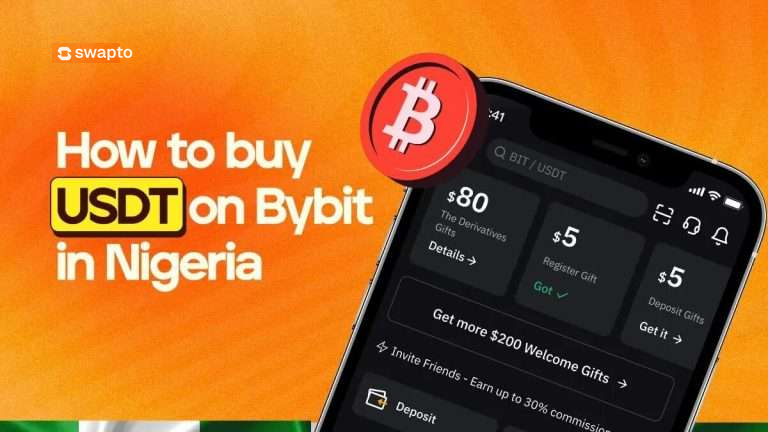
  • How to Buy USDT on Bybit in Nigeria

    How to Buy USDT on Bybit in Nigeria

    Buy USDT on Bybit in Nigeria: It is no news that Binance, the largest cryptocurrency exchange in the world has suspended its operations in Nigeria leaving cryptocurrency enthusiasts hanging.

    Now, a new alternative to Binance known as BYBIT has surfaced, and has made buying and selling of popular cryptocurrencies like USDT easy; so if you’re looking for how to buy USDT on Bybit in Nigeria, then you’re just in the right place.

    So, how about you stick around, huh?

    What is Bybit?

    BYBIT is a P2P trading platform where users can trade cryptocurencies, and also buy USDT in Nigeria. Not just cryptocurrencies and altcoins, users of the platform can also trade NFTs on the platform. But, let’s focus on crypto trading, especially USDT. Because that’s why we’re here, isn’t it?

    Bybit is a centralized trading platform, and just like other centralized exchanges, it is controlled by an entity and requires KYC verification. Bybit was established by founder and CEO Ben Zhou, and was launched in March 2018.

    Bybit is currently one of the easiest exchanges to buy and sell cryptocurrencies, and the platform has over a hundred crypto tokens listed including major coins like Bitcoin, Ethereum, Tether, Solana, and more. This means you can buy USDT on Bybit in Nigeria.

    To fully understand how to buy USDT on Bybit in Nigeria, let’s quickly talk about what USDT is just so we cover our basics.

    What is USDT?

    sell usdt in nigeria at high rate

    Again, for the crypto newbies who have zero knowledge what cryptocurrencies like USDT are, or are fresh into the crypto world, let’s briefly explain what USDT means.

    So USDT is also known as Tether, and Tether is a type of cryptocurrency known as a stablecoin. When we say stablecoin, it’s exactly what it means. Stable.

    Unlike other cryptocurrencies like Bitcoin, Ethereum, Litecoin, etc that are characterized by volatility, USDT isn’t.

     It is designed to maintain a stable value by pegging it to a reserve of real-world assets, usually traditional fiat currencies like the US Dollar. The primary purpose of Tether is to provide the crypto community with a stable and secure alternative to the often volatile market.

    How to Buy USDT on Bybit in Nigeria

    To buy USDT on Bybit in Nigeria, the first thing you have to do is to register on the platform first. Obviously. To do this, you have to download the app from the Google play store or Apple store, and install the app.

    Then create an account if you do not have one. Creating an account in easy, and in a couple of minutes, a verification code will be sent to your email address.

    Afterwards, you’ll need to verify your identity. Verifying your identity involves uploading a government ID such as Nigerian passport, NIN, BVN, Drivers’ licence and so on, and then uploading a selfie. This is a KYC (know your customer) verification process.

    To buy USDT on Bybit,

    • Go to the ‘Buy’ tab located at the P2P trading
    • Select the cryptocurrency or coin that you would like to purchase, USDT in this case. This is where you will see all available trades
    • Type in the amount you would like to buy, and orders that match your requirement will be displayed
    • Choose the one you’re most comfortable with. For example, you could choose one that offers you the highest rate.
    • Click on the listing to read the terms and conditions offered by the seller
    • If you’re okay with the terms, type in how much you’re willing to get from them with fiat or crypto
    • Click on buy, then you’ll see an account to pay into
    • Make payment

    Once payment is made and confirmed, you will automatically receive a deposit of the USDT in your wallet.

    An Alternative to Bybit

    Swapto(Formerly Dtunes) is the best alternative to Bybit. Swapto(Formerly Dtunes) is a prominent cryptocurrency exchange platform based in Nigeria, and its user-friendly interface is what makes it easy to use for both crypto newbies and expert traders.

    This cryptocurrency and gift card exchange platform offers the best rate, fast transactions, 24/7 customer support, and a seamless and secure platform to trade compared to any other platform.

    Conclusion

    By now, you should already know how to buy USDT on Bybit in Nigeria. And if you do not, we suggest you take another look at the article again, reading it slowly this time.

    Now, you can get started on buying your USDT on Bybit, but be sure to do more research. Or you can decide to explore other options like Swapto(Formerly Dtunes).

    Keep Reading: The Best Place to Sell USDT in Nigeria

  • Bitcoin White paper Publish Date | How to Access it

    Bitcoin White paper Publish Date | How to Access it

    To truly understand the origin of Bitcoin, we need to go back to the basics. More like the very beginning. This means we have to talk about the Bitcoin white paper publish date. Afterall, it signifies the origin of Bitcoin and other cryptocurrencies, innit?

    This is why in this article; we will talk about the Bitcoin whitepaper publish date and how to access it. Therefore, if you are entirely new to the world of cryptocurrencies and you’re looking for some pointers in the right direction, then this might be the place for you. So keep reading!

    What is Bitcoin?

    Of course, we have to briefly talk about Bitcoin before proceeding to talk about the Bitcoin white paper publish date.

    Bitcoin is the first and oldest cryptocurrency that was introduced by an anonymous entity named Satoshi Nakamoto. On October 31st 2008, this entity sent an email to a cryptography mailing list.

    The email read “I have been working on an electronic cash system that’s fully peer-to-peer. Here is a link to the paper”. He may not have said that verbatim but I think you got the point.

    Bitcoin Whitepaper Publish Date

    Maximum Supply of Bitcoin

    The Bitcoin white paper is very significant in the history of cryptocurrencies, and not only does it hold a significant value, it is also one of the best documents to read if you want to truly understand the origin of crypto, how it works, and how it’s revolutionalizing the world.

    The Bitcoin whitepaper has different sections, and here’s just a summary of each of them:

    The first section is titled “Introduction” where he introduces the paper.

    The second section is titled “Transactions”, and in this section, he defines what an electronic coin is and how it can/will be transferred from one person to another.

    The third section is titled “Timestamp Server”, and he talks about centralized blockchain and how this technology has been around for quite some time, but hasn’t been applied to electronic money or cryptocurrencies. Whatever you want to call it.

    The fourth section is titled “Proof of Work”, and here, proof of work is used to extend the centralized blockchain into a decentralized one

    The fifth section is titled “Network”, and it combines the second, third and fourth sections to tell us exactly how the network operates i.e. how do we interact with nodes, what to do when you receive a transaction from a node, etc.

    The sixth section is titled “Incentives”, and it has to do with incentivizing people to strengthen the network to run their own node and to help secure the blockchain

    The seventh section is titled “Reclaiming disk space”

    The eighth section is titled “Simplified Payment Verification”, which talks about the ability to run a lightweight node without much memory.

    The ninth section is titled “Combining and Splitting” which talks about combining lump sum transactions rather than having to do it one by one or send it individually.

    The tenth section is titled “Privacy”, and this is pretty much self –explanatory. It talks about how we’re private and have public keys identifying us rather than our real names.

    The eleventh section is titled “Calculations”, and it talks about an attacker trying to attack the network.

    The twelfth section is titled “Conclusion”, and it basically just concludes the paper.

    How to Trade Bitcoin in Nigeria

    Now that know the Bitcoin whitepaper publish date and have a glimpse of the content, let’s talk about how to trade your Bitcoin in Nigeria.

    There are so many platforms that you can trade your Bitcoin on, a good example is Swapto(Formerly Dtunes).

    Here’s how you can trade your Bitcoin on Swapto(Formerly Dtunes):

    The first thing you want to do is to download the Swapto(Formerly Dtunes) app either on the Google Play Store for Android or on the App Store for iOS. Then create an account if you don’t have one. It is free and it takes less than 3 minutes to create

    • Log in to your account
    • Click on “Trade Crypto”
    • Choose “Trade Crypto”
    • Select the type of Crypto you want to sell (BTC in this case)
    • Enter the amount in USD

    The rate is displayed and you can go ahead to sell your BTC.

    Conclusion

    Even though the Bitcoin whitepaper is quite accessible to everyone, which is not even a problem here, the main problem is trying to understand it.

    A lot of people say they have had to read the paper more than 10 times, and even read several books and articles before they could fully understand and grasp what the document entailed.

    Keep Reading: $1000, $100, $10 – Bitcoin to Naira exchange rate today

  • What is the Full Meaning of USDT?

    What is the Full Meaning of USDT?

    Swapto(Formerly Dtunes) is now a full-service crypto platform. Beyond gift cards, you can now sell BTC, USDT, and Ethereum directly through our app with 24/7 support and the best market rates. Join the crypto revolution with Swapto(Formerly Dtunes) today!

    Full Meaning of USDT: In the realm of cryptocurrency, USDT has emerged as a significant player. But what does USDT stand for, and what is its significance in the digital currency landscape?

    Full Meaning of USDT

    USDT stands for “Tether”, more specifically “USD Tether”. It is a type of cryptocurrency known as a stablecoin, designed to maintain a stable value by pegging it to a fiat currency, in this case, the US dollar. The full meaning of USDT encapsulates its purpose and function within the cryptocurrency market.

    Introduction to USDT

    Full Meaning of USDT

    USDT, or Tether, was introduced in 2014 as a cryptocurrency backed by fiat currency reserves. It was created to address the volatility concerns associated with other cryptocurrencies like Bitcoin and Ethereum. Unlike these volatile counterparts, USDT aims to maintain a stable value equivalent to one US dollar. This stability is achieved by backing each token with a corresponding amount of US dollars held in reserve.

    There are four different types of USDT, including TRC-20, ERC-20, EOS, and Algorand. TRC-20 is the version of USDT that is used on the Tron blockchain, while ERC-20 is the version used on the Ethereum blockchain. EOS and Algorand are newer blockchains that also support USDT.

    When it comes to selling USDT in Nigeria, the most common type you will encounter is ERC-20, as it is the most widely used. However, it is important to note that different platforms may only support certain types of USDT, so be sure to check before you start selling.

    What are the use cases of USDT?

    Full Meaning of USDT

    Stability in Volatile Markets

    The primary use case of USDT lies in providing stability in the inherently volatile cryptocurrency market. Traders and investors often use USDT as a safe haven to park their funds during times of market uncertainty or extreme price fluctuations. By converting their assets into USDT, they can preserve the value of their holdings without having to cash out into fiat currencies like USD.

    Trading Pair

    Another common use case for USDT is as a trading pair on cryptocurrency exchanges. Many exchanges offer USDT pairs for various cryptocurrencies, allowing users to trade between cryptocurrencies and USDT instead of directly with fiat currencies. This provides traders with a way to hedge against market volatility without exiting the cryptocurrency ecosystem.

    Remittance and Cross-Border Transactions

    USDT also facilitates cross-border transactions and remittances, offering a faster and more cost-effective alternative to traditional methods. Since USDT operates on blockchain technology, transactions can be executed quickly and with minimal fees compared to traditional banking systems. This makes USDT an attractive option for individuals and businesses seeking to transfer funds across borders.

    Arbitrage Opportunities

    Arbitrage traders leverage the stability of USDT to capitalize on price differences between exchanges. By buying cryptocurrencies on exchanges where prices are lower and selling them on exchanges where prices are higher, traders can profit from these discrepancies. USDT serves as a convenient medium for transferring funds between exchanges due to its stable value and widespread acceptance.

    How does USDT maintain its peg to the US dollar?

    Full Meaning of USDT

    Ensuring that USDT maintains a 1:1 peg with the US dollar is essential to its functionality and credibility. Several mechanisms are employed to achieve this peg:

    Reserve Backing

    USDT claims to be fully backed by reserves of fiat currency, primarily US dollars. Tether Limited, the company behind USDT, periodically publishes reports detailing the reserve holdings to provide transparency and assurance to users. However, concerns have been raised about the adequacy and transparency of these reserves, leading to debates about the true value and stability of USDT.

    Market Demand and Supply

    Market forces of demand and supply also play a role in maintaining the peg. When the price of USDT deviates from $1, arbitrage opportunities arise, incentivizing traders to buy or sell USDT until its price aligns with the peg. This constant arbitrage activity helps stabilize the price of USDT and keeps it close to the $1 mark.

    Redemption and Issuance

    Tether Limited facilitates the issuance and redemption of USDT tokens. When demand for USDT increases, new tokens are issued in exchange for fiat currency deposits. Conversely, when users redeem USDT for fiat currency, an equivalent amount of tokens is destroyed, thereby adjusting the supply to match demand and maintain the peg.

    Market Interventions

    In extreme cases where market forces alone are insufficient to maintain the peg, Tether Limited may intervene directly in the market by buying or selling USDT. These interventions aim to stabilize the price of USDT and reinforce confidence in its peg to the US dollar.

    Criticism and Controversies

    Full Meaning of USDT

    Despite its widespread adoption and utility, USDT has faced criticism and controversies throughout its existence. Some of the key concerns include:

    Lack of Transparency

    Critics argue that Tether Limited has not provided sufficient evidence to substantiate its claims of full reserve backing. The company’s opaque practices regarding reserve management and audits have raised doubts about the reliability of USDT’s peg to the US dollar.

    Regulatory Scrutiny

    USDT’s centralized nature and potential for market manipulation have drawn regulatory scrutiny from authorities worldwide. Concerns about money laundering, fraud, and market stability have prompted investigations and legal actions against Tether Limited and affiliated entities.

    Dependency Risks

    The cryptocurrency market’s heavy reliance on USDT as a stablecoin poses systemic risks in the event of a failure or loss of confidence in the token. A sudden collapse or devaluation of USDT could have far-reaching consequences for the broader cryptocurrency ecosystem, potentially leading to market turmoil and investor losses.

    Where and How to Trade USDT

    Full Meaning of USDT

    Trading USDT, or USD Tether, involves buying, selling, or exchanging the stablecoin for other cryptocurrencies or fiat currencies. Due to its widespread adoption and utility, USDT is available for trading on numerous cryptocurrency exchanges and platforms worldwide. Here’s a comprehensive guide on where and how to trade USDT:

    • Cryptocurrency exchanges

    Cryptocurrency exchanges serve as the primary platforms for trading USDT. These exchanges facilitate the buying, selling, and exchange of various cryptocurrencies, including USDT.

    • Peer-to-Peer (P2P) platforms

    Peer-to-peer platforms enable direct trading between users without the involvement of intermediaries. On P2P platforms, buyers and sellers can create listings to buy or sell USDT using different payment methods, such as bank transfers, PayPal, or cash.

    • Over-the-Counter (OTC) Desks

    Over-the-counter desks facilitate large-volume trades of cryptocurrencies outside of traditional exchanges. OTC desks cater to institutional investors, high-net-worth individuals, and cryptocurrency funds seeking to execute large trades without impacting market prices.

    The Future of USDT

    Full Meaning of USDT

    Looking ahead, the future of USDT is uncertain, as it navigates regulatory challenges and strives to address concerns surrounding transparency and stability. Competing stablecoins and central bank digital currencies (CBDCs) pose potential threats to USDT’s dominance, while technological advancements and evolving market dynamics may shape its evolution. Whether USDT can maintain its position as a leading stablecoin or faces obsolescence remains to be seen, but its impact on the cryptocurrency landscape is undeniable, shaping the way digital assets are traded and utilized across the globe.

    Conclusion

    In conclusion, USDT, or USD Tether, is a stablecoin designed to maintain a stable value pegged to the US dollar. Its primary use cases include providing stability in volatile markets, serving as a trading pair on exchanges, facilitating cross-border transactions, and enabling arbitrage opportunities. USDT maintains its peg through mechanisms such as reserve backing, market demand and supply dynamics, issuance and redemption, and occasional market interventions. However, it has also faced criticism and controversies, including concerns about transparency, regulatory scrutiny, and systemic risks. Despite these challenges, USDT remains one of the most widely used stablecoins in the cryptocurrency market, playing a crucial role in facilitating liquidity and stability for traders and investors alike.

    Swapto(Formerly Dtunes) is now a full-service crypto platform. Beyond gift cards, you can now sell BTC, USDT, and Ethereum directly through our app with 24/7 support and the best market rates. Join the crypto revolution with Swapto(Formerly Dtunes) today!

  • Unable to Send USDT on Trust Wallet: What to do?

    Unable to Send USDT on Trust Wallet: What to do?

    Send USDT on Trust Wallet: Cryptocurrency transactions have become an integral part of the digital economy, with various cryptocurrencies being used for diverse purposes. Tether (USDT), a popular stablecoin pegged to the US Dollar, is widely used for its stability and utility in the crypto space. Trust Wallet, a secure and user-friendly mobile wallet, is a preferred choice for many users to store and manage their digital assets, including USDT.

    However, encountering issues while attempting to send USDT on Trust Wallet can be frustrating. In this comprehensive guide, we will explore the possible reasons behind being unable to send USDT on Trust Wallet and provide step-by-step solutions to address these issues.

    Common Reasons for Unable to Send USDT on Trust Wallet

    1. Insufficient Balance:
      • One of the most basic reasons for transaction failures is having an insufficient balance in your Trust Wallet. Ensure that your wallet contains enough USDT to cover the intended transaction amount, including network fees.
    2. Network Congestion:
      • Cryptocurrency transactions are processed on blockchain networks, and during times of high demand, these networks can become congested. This congestion might lead to delays or failures in processing transactions. Check the current network status and adjust your transaction timing accordingly.
    3. Outdated Trust Wallet Version:
      • Regular updates are essential to ensure the security and functionality of any mobile application, including Trust Wallet. An outdated version of the Trust Wallet app may result in compatibility issues, leading to transaction failures. Make sure you are using the latest version of the Trust Wallet app available on your app store.
    4. Incorrect Recipient Address:
      • Double-check the recipient’s USDT address to ensure accuracy. Entering an incorrect address may result in the loss of funds or failed transactions. Cryptocurrency transactions are irreversible, so accuracy in the recipient address is crucial.
    5. Network Fee Settings:
      • Trust Wallet allows users to set their preferred transaction fees. If the fee set is too low, the transaction may get stuck or take an extended time to confirm. Adjust the network fee settings based on the current network conditions for a smoother transaction experience.

    Troubleshooting Steps for Unable to Send USDT

    Now, let’s delve into specific troubleshooting steps for each of the common issues mentioned above.

    1. Insufficient Balance:

    • Open your Trust Wallet app and check your USDT balance.
    • If the balance is insufficient, transfer additional USDT to your wallet from a supported exchange or another wallet.
    • Double-check the total amount, including the transaction fee, to ensure it does not exceed your available balance.

    2. Network Congestion:

    • Check the current status of the blockchain network you are using for the USDT transaction. Websites like blockchain explorers provide real-time information.
    • If the network is congested, consider waiting for a less busy period to initiate your transaction.
    • Adjust the transaction fee to a higher value to expedite the confirmation process during network congestion.

    3. Outdated Trust Wallet Version:

    • Visit your device’s app store (Google Play Store for Android or Apple App Store for iOS).
    • Search for Trust Wallet and check if there is an available update.
    • Download and install the latest version of Trust Wallet to ensure compatibility with the latest features and security measures.

    4. Incorrect Recipient Address:

    • Carefully review the USDT recipient address before confirming the transaction.
    • If you suspect an error, cancel the transaction immediately (if possible) and reinitiate with the correct address.
    • Cross-verify the address with the recipient to ensure accuracy and prevent irreversible mistakes.

    5. Network Fee Settings:

    • Navigate to the settings or transaction settings section within your Trust Wallet app.
    • Adjust the network fee settings based on the current blockchain network conditions. You can choose from options like low, medium, or high fees.
    • Opt for a higher fee if the transaction is time-sensitive or if the network is congested.

    Additional Tips for a Seamless USDT Transaction Experience:

    1. Regularly Update Trust Wallet:
      • Enable automatic updates on your device to ensure that Trust Wallet receives timely updates, including security patches and new features.
    2. Backup Your Wallet:
      • Regularly back up your Trust Wallet by securely storing your recovery phrase. This ensures that you can regain access to your funds in case of device loss or malfunction.
    3. Use Reliable Networks:
      • Ensure that you have a stable internet connection when initiating transactions. Unstable networks can lead to transaction failures or delays.
    4. Contact Trust Wallet Support:
      • If the issue persists despite following the troubleshooting steps, contact Trust Wallet support through their official channels. Provide relevant details such as transaction ID, wallet address, and a description of the issue for faster assistance.

    Sending USDT on Trust Wallet

    Sending USDT from Trust Wallet is a straightforward process that ensures users can efficiently transfer their Tether to other wallets or exchanges. Here’s a concise guide on sending USDT from Trust Wallet:

    1. Open Trust Wallet App:
      • Launch the Trust Wallet application on your mobile device and ensure it’s updated to the latest version for optimal functionality and security.
    2. Access USDT Wallet:
      • Navigate to your USDT wallet within the Trust Wallet app. If you don’t have a USDT wallet, add it by selecting “Add Coin” and searching for USDT.
    3. Initiate Send Transaction:
      • Locate and select the “Send” or “Send USDT” option within your USDT wallet.
    4. Enter Recipient Address:
      • Input the accurate recipient’s USDT address. Double-check the address to prevent irreversible errors.
    5. Specify Amount:
      • Enter the amount of USDT you wish to send. Ensure it doesn’t exceed your available balance, accounting for transaction fees.
    6. Adjust Network Fee (Optional):
      • Trust Wallet allows users to adjust the network fee. Consider the current network conditions and adjust the fee accordingly for faster or more cost-effective transactions.
    7. Confirm and Authenticate:
      • Review the transaction details, including the recipient address and transaction amount. Authenticate the transaction using any necessary security measures, such as biometrics or PIN.
    8. Wait for Confirmation:
      • Once confirmed, the USDT will be sent to the specified address. Monitor the transaction status within Trust Wallet or use the provided transaction ID to track it on the blockchain.

    Sending USDT from Trust Wallet is a user-friendly process, offering flexibility and control over transaction details. Users can easily manage and monitor their cryptocurrency transactions within the Trust Wallet app, ensuring a secure and efficient experience.

    Conclusion

    Experiencing difficulties in sending USDT on Trust Wallet can be stressful, but most issues can be resolved with careful analysis and the right troubleshooting steps. By following the guidelines provided in this comprehensive guide, users can address common problems and enjoy a seamless USDT transaction experience on Trust Wallet. Remember to stay informed about the latest updates and best practices in the ever-evolving world of cryptocurrency to enhance the security and efficiency of your digital asset transactions.

  • How to Convert USDT to TRX on Trust Wallet?

    How to Convert USDT to TRX on Trust Wallet?

    USDT to TRX on Trust Wallet: Cryptocurrency enthusiasts often find themselves navigating various platforms and wallets to execute seamless transactions. If you’re looking to convert USDT (Tether) to TRX (Tron) and prefer the Trust Wallet, you’re in the right place. In this comprehensive guide, we will walk you through the step-by-step process of converting USDT to TRX on Trust Wallet.

    What is Cryptocurrency?

    Cryptocurrency is a form of digital or virtual currency that relies on cryptographic techniques for secure financial transactions. Unlike traditional currencies issued by governments and central banks, cryptocurrencies operate on decentralized networks, typically based on blockchain technology. Blockchain is a distributed ledger that records all transactions across a network of computers, ensuring transparency, security, and immutability.

    The most well-known cryptocurrency is Bitcoin, created in 2009 by an unknown person or group using the pseudonym Satoshi Nakamoto. Since then, thousands of alternative cryptocurrencies, often referred to as altcoins, have emerged, each with its unique features and use cases.

    Cryptocurrencies use cryptographic algorithms to secure transactions and control the creation of new units. Blockchain ensures that transactions are tamper-resistant, as each block contains a cryptographic hash of the previous block, forming an unbroken chain. This decentralized and transparent nature eliminates the need for intermediaries like banks, providing users with greater financial autonomy.

    Cryptocurrencies serve various purposes, from being a medium of exchange to enabling smart contracts and decentralized applications (DApps). They have gained widespread recognition as a new asset class and have sparked discussions about the future of finance, offering unique opportunities and challenges in the evolving landscape of digital currencies.

    Understanding USDT and TRX

    Before we delve into the conversion process, let’s briefly understand the two cryptocurrencies involved in this transaction.

    USDT (Tether):

    USDT, commonly known as Tether, is a stablecoin pegged to the value of the US Dollar. It’s widely used for trading and investing due to its price stability, acting as a safe haven for traders during volatile market conditions.

    TRX (Tron):

    TRX, on the other hand, is the native cryptocurrency of the Tron blockchain. Tron aims to create a decentralized internet and is known for its high throughput and low transaction fees. TRX is used for various purposes on the Tron network, including smart contracts and decentralized applications (DApps).

    Trust Wallet

    Trust Wallet is a popular mobile cryptocurrency wallet that allows users to securely store, send, and receive various digital assets. Here are some key features and aspects of Trust Wallet:

    Key Features:

    1. Multi-Currency Support:
    2. Trust Wallet supports a wide range of cryptocurrencies, including popular ones like Bitcoin (BTC), Ethereum (ETH), Binance Coin (BNB), and numerous ERC-20 and BEP-2/BE-20 tokens.
    3. User-Friendly Interface:
    4. The wallet is designed with a simple and intuitive user interface, making it accessible for both beginners and experienced users.
    5. Decentralized Exchange (DEX):
    6. Trust Wallet includes a built-in decentralized exchange (DEX) that enables users to trade various cryptocurrencies directly within the app without relying on a centralized exchange.
    7. Security Features:
    8. Trust Wallet emphasizes security, allowing users to set up a secure password and use biometric authentication (fingerprint or face recognition) for added protection.
    9. Users are provided with a recovery phrase during the wallet creation process, which serves as a backup in case the device is lost or damaged.
    10. Cross-Platform Compatibility:
    11. Trust Wallet is available for both iOS and Android devices, providing a consistent experience across different mobile platforms.
    12. Open-Source and Non-Custodial:
    13. Trust Wallet is an open-source wallet, and it operates on a non-custodial basis, meaning users have full control of their private keys and funds.
    14. DApp Browser:
    15. The wallet features a decentralized application (DApp) browser, allowing users to interact with various decentralized applications directly from the Trust Wallet app.
    16. Token Swapping:
    17. Users can easily swap one cryptocurrency for another using the built-in token swapping feature.

    How to Convert USDT to TRX on Trust Wallet:

    Now, let’s dive into the step-by-step process of converting USDT to TRX on Trust Wallet.

    1. Ensure Trust Wallet is Installed:

    Make sure you have the Trust Wallet app installed on your mobile device. You can download it from the App Store (for iOS) or Google Play Store (for Android). If you already have the app installed, ensure it’s updated to the latest version.

    2. Fund Your Trust Wallet:

    Before initiating any conversion, ensure that your Trust Wallet is funded with USDT. You can transfer USDT to your Trust Wallet from other exchanges or wallets.

    3. Open Trust Wallet and Access DEX:

    Launch the Trust Wallet app on your mobile device. Once inside the app, navigate to the DEX (Decentralized Exchange) feature. This is where you’ll be able to convert your USDT to TRX.

    4. Connect Trust Wallet to a Decentralized Exchange:

    To convert your USDT to TRX, you’ll need to connect your Trust Wallet to a decentralized exchange. Trust Wallet supports various decentralized exchanges, so choose one that suits your preferences.

    5. Locate USDT in Trust Wallet:

    Once connected to the decentralized exchange, locate your USDT balance within the Trust Wallet. This is the amount you will be converting to TRX.

    6. Choose the TRX Trading Pair:

    Navigate to the trading pairs section and select the USDT to TRX pair. This step is crucial for initiating the conversion process. Ensure that you are converting USDT to TRX and vice versa.

    7. Set the Conversion Parameters:

    Specify the amount of USDT you wish to convert to TRX. The decentralized exchange will display the equivalent amount of TRX based on the current exchange rate. Review the details carefully before confirming the transaction.

    8. Confirm and Execute the Trade:

    Once you’ve set the conversion parameters, review the details one last time. If everything looks correct, confirm the transaction to execute the trade. Your USDT will be exchanged for TRX, and the new balance will reflect in your Trust Wallet.

    9. Check Your TRX Balance:

    After the conversion is complete, check your TRX balance within the Trust Wallet. This confirms that the USDT to TRX conversion was successful.

    Tips and Considerations

    Security Measures:

    • Always ensure that you are using the official Trust Wallet app to avoid potential scams or security risks.
    • Consider using hardware wallets for large transactions to enhance the security of your assets.

    Transaction Fees:

    • Be aware of transaction fees associated with converting USDT to TRX. Different decentralized exchanges may have varying fee structures.

    Market Conditions:

    • Cryptocurrency prices are subject to market fluctuations. Be mindful of market conditions when executing your conversion.

    Double-Check Details:

    • Before confirming any transaction, double-check the wallet addresses, transaction amounts, and other details to prevent any errors.

    Conclusion

    Converting USDT to TRX on Trust Wallet is a straightforward process, provided you follow the steps outlined in this guide. By understanding the basics of the Trust Wallet app and the decentralized exchange features it supports, you can seamlessly navigate the conversion process. Always prioritize security, stay informed about transaction fees, and be mindful of market conditions for a smooth and successful USDT to TRX conversion on Trust Wallet.

  • What is Bitcoin Transaction Accelerator?

    What is Bitcoin Transaction Accelerator?

    Swapto(Formerly Dtunes) is now a full-service crypto platform. Beyond gift cards, you can now sell BTC, USDT, and Ethereum directly through our app with 24/7 support and the best market rates. Join the crypto revolution with Swapto(Formerly Dtunes) today!

    Bitcoin Transaction Accelerator: Bitcoin, the pioneer of cryptocurrencies, has revolutionized the financial landscape with its decentralized and transparent nature. However, as the popularity of Bitcoin continues to grow, so does the demand for efficient and timely transactions. In this quest for faster transactions, the concept of a “Bitcoin Transaction Accelerator” has emerged. In this article, we will delve into the fundamentals of Bitcoin, explore the challenges of transaction speed, and understand how a Bitcoin Transaction Accelerator works to enhance the efficiency of Bitcoin transactions.

    What is Bitcoin?

    Bitcoin, introduced in 2009 by an anonymous entity known as Satoshi Nakamoto, is a decentralized digital currency that operates on a peer-to-peer network. Unlike traditional currencies issued by governments, Bitcoin relies on a technology called blockchain to validate and record transactions. The blockchain is a distributed ledger that is maintained by a network of nodes, ensuring transparency and security.

    Bitcoin transactions involve the transfer of value between two parties, recorded on the blockchain. Each transaction is grouped into a block, and these blocks are linked together, forming a chain – the blockchain. Miners, individuals or entities that contribute computing power to the network, validate and add these blocks to the blockchain through a process called mining.

    While Bitcoin transactions offer a secure and transparent alternative to traditional financial systems, one common challenge is transaction speed. The time it takes for a Bitcoin transaction to be confirmed and added to the blockchain can vary, depending on factors such as network congestion and transaction fees.

    Challenges of Transaction Speed in Bitcoin

    Bitcoin transactions are processed through a consensus mechanism known as Proof-of-Work (PoW). Miners compete to solve complex mathematical puzzles, and the first one to solve it gets the opportunity to add a new block to the blockchain. While this process ensures the security of the network, it introduces a variable element to transaction speed.

    Network Congestion: As the number of Bitcoin users and transactions increases, the network can experience congestion, causing delays in transaction confirmations. During peak times, the backlog of unconfirmed transactions may grow, leading to longer confirmation times.

    Transaction Fees: Bitcoin users have the option to include transaction fees to incentivize miners to prioritize their transactions. However, during times of high demand, users may find themselves in a bidding war, resulting in increased transaction fees. Those who opt for lower fees may experience slower transaction confirmations.

    Confirmation Time: The average time it takes for a Bitcoin transaction to be confirmed and added to the blockchain is around 10 minutes. However, this can vary, and users may find themselves waiting for multiple confirmations for larger transactions, especially for exchanges or significant transfers.

    Enter the Bitcoin Transaction Accelerator

    In response to the challenges posed by transaction speed, the concept of a Bitcoin Transaction Accelerator has gained prominence. A Bitcoin Transaction Accelerator is a service designed to expedite the confirmation of Bitcoin transactions, offering a solution to users facing delays or high fees.

    How Bitcoin Transaction Accelerator Works

    A Bitcoin Transaction Accelerator operates by leveraging the influence miners have over transaction processing. Here’s a step-by-step breakdown of how these accelerators work:

    1. User Submission: When a Bitcoin user initiates a transaction and experiences delays or wants to speed up the confirmation process, they can submit their transaction details to a Bitcoin Transaction Accelerator.
    2. Fee Payment (Optional): Some accelerators may require users to pay a fee for their service. This fee serves as an incentive for the miners to prioritize the submitted transaction. Users can choose to pay a higher fee to increase the chances of faster confirmation.
    3. Miner Prioritization: The Bitcoin Transaction Accelerator then broadcasts the submitted transaction and associated fees to a network of miners. Miners, incentivized by the additional fees, prioritize these transactions over others.
    4. Inclusion in the Next Block: Since miners have the authority to select which transactions to include in the next block they mine, the accelerated transaction is more likely to be included promptly, reducing the confirmation time.
    5. Confirmation Notification: Once the transaction is successfully included in a block and added to the blockchain, the Bitcoin Transaction Accelerator notifies the user of the successful acceleration.

    Benefits of Using a Bitcoin Transaction Accelerator

    1. Time Savings: The primary advantage of using a Bitcoin Transaction Accelerator is the significant reduction in transaction confirmation times. This is particularly beneficial for users who require quick confirmations for time-sensitive transactions.
    2. Mitigation of Congestion: During periods of network congestion, a transaction accelerator allows users to bypass the normal queuing process, ensuring their transactions are prioritized.
    3. Flexibility in Transaction Fees: Users have the flexibility to choose whether they want to pay an additional fee for acceleration. This can be advantageous during times of high network demand when users are competing to have their transactions processed quickly.
    4. Improved User Experience: Accelerating Bitcoin transactions contributes to an overall improved user experience, especially for those who rely on timely confirmations for various purposes such as trading or payments.

    Considerations and Limitations

    While Bitcoin Transaction Accelerators offer a valuable service, users should be aware of certain considerations and limitations:

    1. Fee Variability: The effectiveness of a Bitcoin Transaction Accelerator may depend on the offered fee and network conditions. During periods of extreme congestion, even accelerated transactions may face delays.
    2. Service Reliability: The reliability of a transaction accelerator depends on the reputation and infrastructure of the service provider. Users should choose reputable accelerators to ensure the effectiveness of the acceleration process.
    3. Confirmation Guarantees: While accelerators can significantly improve confirmation times, they do not guarantee instant confirmation. Users should manage their expectations and consider factors such as network conditions and the chosen fee.
    4. Availability: The availability of a Bitcoin Transaction Accelerator can vary, and users should verify the operational status of the service before relying on it for transaction acceleration.

    Conclusion

    As the demand for faster and more efficient Bitcoin transactions grows, the role of Bitcoin Transaction Accelerators becomes increasingly significant. These services offer users the ability to expedite their transactions, mitigating challenges related to network congestion and transaction fees. While accelerators provide a valuable solution, users should exercise caution, choose reliable service providers, and understand the variables that can impact the effectiveness of transaction acceleration. As the cryptocurrency landscape continues to evolve, innovations like Bitcoin Transaction Accelerators contribute to enhancing the usability and scalability of digital currencies like Bitcoin.

    Swapto(Formerly Dtunes) is now a full-service crypto platform. Beyond gift cards, you can now sell BTC, USDT, and Ethereum directly through our app with 24/7 support and the best market rates. Join the crypto revolution with Swapto(Formerly Dtunes) today!

  • A Guide: How to Verify Trust Wallet Account in Nigeria

    A Guide: How to Verify Trust Wallet Account in Nigeria

    Let’s discuss you can verify trust wallet account in Nigeria. In the fast-evolving landscape of cryptocurrency, Trust Wallet has emerged as a popular choice among users for securely managing their digital assets. To fully unlock the potential of this wallet, users need to go through the verification process. This guide will walk you through the steps to verify your Trust Wallet account in Nigeria, ensuring a seamless and secure experience.

    What is Trust Wallet?

    Trust Wallet is a mobile-based cryptocurrency wallet designed to provide users with a secure and intuitive platform for storing, sending, and receiving various cryptocurrencies. Trust Wallet, which Binance acquired in 2018, keeps its independence as an independent wallet with a focus on user control over their money and private keys.

    Key Features of Trust Wallet

    1. Security and Decentralization

    Trust Wallet prioritizes security by allowing users to have full control over their private keys. Private keys are stored locally on the user’s device, reducing the risk of unauthorized access or exposure to potential vulnerabilities associated with centralized exchanges. This commitment to decentralization aligns with the core principles of blockchain technology.

    2. Multi-Currency Support

    One of Trust Wallet’s notable features is its support for a wide range of cryptocurrencies. Initially designed for Ethereum and ERC-20 tokens, Trust Wallet has expanded its capabilities to include other major blockchains such as Binance Chain, Bitcoin, and many others. This versatility enables users to manage various digital assets within a single, user-friendly interface.

    3. User-Friendly Interface

    Trust Wallet is renowned for its simple and intuitive design, making it accessible even to users with minimal experience in the cryptocurrency space. The app’s clean layout and straightforward navigation contribute to a seamless user experience, whether you are a seasoned trader or a newcomer to the world of digital assets.

    4. In-App DApps Browser

    Trust Wallet integrates a decentralized applications (DApps) browser directly within the app. This feature allows users to access and interact with decentralized applications on supported blockchains without leaving the Trust Wallet environment. From decentralized finance (DeFi) platforms to blockchain games, users can explore a variety of applications and services seamlessly.

    5. Cross-Platform Compatibility

    Trust Wallet is not limited to a single operating system. It is available for download on both iOS and Android devices, providing a consistent experience across various mobile platforms. This cross-platform compatibility enhances accessibility and ensures users can manage their digital assets regardless of their preferred mobile device.

    Use Cases of Trust Wallet

    1. Storing and Managing Digital Assets

    Trust Wallet serves as a secure repository for various cryptocurrencies, allowing users to store and manage their digital assets conveniently. The ability to support multiple blockchains makes it a versatile option for users with diverse cryptocurrency portfolios.

    2. Sending and Receiving Cryptocurrencies

    The wallet’s user-friendly interface simplifies the process of sending and receiving cryptocurrencies. Users can initiate transactions with ease, and the decentralized nature of Trust Wallet adds an extra layer of security to these processes.

    3. Participating in Initial Coin Offerings (ICOs) and Token Sales

    Trust Wallet’s compatibility with ERC-20 tokens makes it a suitable choice for individuals looking to participate in ICOs and token sales. Users can send and receive these tokens directly through the wallet, providing a streamlined experience for crowdfunding activities.

    4. Interacting with Decentralized Finance (DeFi) Platforms

    The in-app DApps browser enables users to access various decentralized finance (DeFi) platforms, such as decentralized exchanges (DEXs), lending protocols, and yield farming applications. This allows Trust Wallet users to engage in a wide array of financial activities within the decentralized ecosystem.

    5. NFT Support

    Trust Wallet has adapted to the growing popularity of non-fungible tokens (NFTs) by supporting their storage and management. Users can store NFTs directly within the Trust Wallet app, making it a comprehensive solution for those involved in the burgeoning NFT space.

    Understanding the Importance of Verification

    Before delving into the verification process, it’s crucial to understand why it is necessary. Verification adds an extra layer of security to your Trust Wallet account, protecting your assets from unauthorized access. Additionally, it enables you to access advanced features and services offered by Trust Wallet, enhancing your overall cryptocurrency experience.

    Why Verify Trust Wallet Account in Nigeria?

    Nigeria has seen a significant surge in cryptocurrency adoption, with more individuals embracing the digital asset revolution. Verifying your Trust Wallet account in Nigeria is particularly important due to regulatory compliance and the need to adhere to local laws governing cryptocurrency transactions. It also ensures that you can seamlessly buy, sell, and trade cryptocurrencies within the Nigerian market.

    How to Verify Trust Wallet Account in Nigeria

    Step 1: Download and Install Trust Wallet

    Before you can initiate the verification process, ensure that you have Trust Wallet installed on your device. You can download the app from the official app store for your device.

    Step 2: Create a Trust Wallet Account

    If you don’t already have a Trust Wallet account, you will need to create one. Follow the on-screen instructions to set up your account, providing the necessary details.

    Step 3: Access the Verification Section

    Once your account is set up, navigate to the Trust Wallet app’s settings or account section. Look for the verification option; it is usually prominently displayed in the app’s menu.

    Step 4: Provide Personal Information

    To comply with regulatory requirements, Trust Wallet will request some personal information for verification purposes. This may include your full name, address, date of birth, and a valid form of identification.

    Step 5: Upload Identification Documents

    As part of the verification process, you will need to upload a valid government-issued identification document. This could be a national ID card, driver’s license, or passport. Ensure that the document is clear and all details are easily readable.

    Step 6: Facial Recognition

    Some verification processes may include facial recognition as an additional security measure. Follow the prompts to capture a clear image of your face, ensuring that it matches the photo on the uploaded identification document.

    Step 7: Verification Review

    After submitting your information and documents, the Trust Wallet team will review your verification request. This process may take some time, so be patient. You may receive notifications or emails regarding the status of your verification.

    Step 8: Successful Verification

    Once your verification is successful, you will receive a confirmation from Trust Wallet. Your account is now fully verified, granting you access to all features and services offered by the wallet.

    Tips for a Smooth Verification Process

    1. Provide Accurate Information: Ensure that the information you provide during the verification process is accurate and matches the details on your identification document.
    2. Clear Document Images: When uploading identification documents, make sure the images are clear, with all details easily readable. This helps expedite the verification process.
    3. Stable Internet Connection: A stable internet connection is essential for a smooth verification process. This ensures that you can upload documents and complete the process without interruptions.
    4. Follow Instructions Carefully: Pay close attention to the instructions provided during the verification process. This includes capturing facial recognition images and any additional steps outlined by Trust Wallet.
    5. Check Spam Folder: Verification updates and communications from Trust Wallet may be sent via email. Check your spam folder regularly to ensure you don’t miss any important notifications.

    Common Challenges and Solutions

    Document Rejection

    If your uploaded documents are rejected, carefully review the rejection reasons provided by Trust Wallet. Common issues include unclear images, expired documents, or mismatched information. Rectify the issues and resubmit your documents for verification.

    Delayed Verification

    Verification processes can sometimes experience delays due to high demand or technical issues. If your verification is taking longer than expected, reach out to Trust Wallet support for assistance.

    Failed Facial Recognition

    If facial recognition fails, ensure that you are in a well-lit area and that your face is clearly visible. Follow the on-screen instructions for capturing the image, and try again. If issues persist, contact Trust Wallet support.

    Conclusion

    Verifying your Trust Wallet account in Nigeria is a crucial step towards ensuring the security of your digital assets and complying with local regulations. By following the steps outlined in this guide and paying attention to the tips provided, you can navigate the verification process smoothly. As the cryptocurrency landscape continues to evolve, Trust Wallet remains a trusted companion for users in Nigeria and beyond, offering a secure and user-friendly platform for managing digital assets.

  • How to Buy Bitcoin with PayPal

    How to Buy Bitcoin with PayPal

    Do you know you can buy Bitcoin with PayPal? In recent years, the world of digital finance has witnessed a remarkable surge in interest and investment in cryptocurrencies. Bitcoin, often dubbed as digital gold, has been at the forefront of this financial revolution. However, acquiring Bitcoin has historically been a somewhat complex process, involving various exchanges and payment methods.

    Buy Bitcoin with PayPal

    One popular method for purchasing Bitcoin is through PayPal, a global online payment platform. In this comprehensive guide, we will explore the intricacies of how to buy Bitcoin with PayPal. Moreover, we will introduce you to Swapto(Formerly Dtunes), a platform that simplifies and streamlines this process, making it more convenient and user-friendly.

    The Popularity of Bitcoin and PayPal

    Before we delve into the process of buying Bitcoin with PayPal, let’s understand why both Bitcoin and PayPal have garnered such popularity in their own right.

    Bitcoin, created in 2009 by an anonymous person or group of people using the pseudonym Satoshi Nakamoto, was the first cryptocurrency. It has become the poster child for the crypto industry, often regarded as a store of value, a hedge against inflation, and an innovative digital currency. Bitcoin’s decentralized nature and limited supply have piqued the interest of both individual and institutional investors worldwide.

    On the other hand, PayPal, founded in 1998, revolutionized online payments by providing a secure and convenient way for users to send and receive money over the internet. With over 400 million active users, PayPal has played a pivotal role in shaping the digital payment landscape.

    Given the widespread adoption of both Bitcoin and PayPal, the idea of combining them into a seamless payment method has gained considerable traction. Many individuals want to know how to buy Bitcoin with PayPal to take advantage of the benefits offered by both platforms.

    Buying Bitcoin with PayPal

    Traditionally, purchasing Bitcoin with PayPal has been a challenging endeavor due to the discrepancies in the services offered by these two platforms. While PayPal allows users to transfer funds easily, it has been cautious about the volatile nature of cryptocurrencies.

    Here is a typical way to buy Bitcoin with PayPal using the traditional method:

    1. Linking a Bank Account or Debit Card: Start by linking your PayPal account to your bank account or debit card. This is a crucial step as it enables you to load your PayPal wallet with funds.
    2. Verify Your Identity: Many platforms that facilitate Bitcoin purchases require users to verify their identity due to anti-money laundering (AML) and know your customer (KYC) regulations. PayPal itself may also require identity verification.
    3. Choose a Cryptocurrency Exchange: Select a cryptocurrency exchange that accepts PayPal as a payment method. Not all exchanges support PayPal, so you’ll need to find one that suits your needs.
    4. Transfer Funds to the Exchange: Once you’ve chosen an exchange, transfer funds from your PayPal account to the exchange. Keep in mind that not all exchanges support direct PayPal deposits. You may need to use PayPal to buy a stablecoin like USDT (Tether) first and then use that to purchase Bitcoin.
    5. Buy Bitcoin: After transferring funds to the exchange, place an order to buy Bitcoin. The exchange will execute the order, and you will have Bitcoin in your exchange wallet.
    6. Withdraw to a Secure Wallet: It is advisable to move your Bitcoin to a secure cryptocurrency wallet rather than keeping it on the exchange, as wallets offer greater security.

    While this method allows you to buy Bitcoin with PayPal, it’s not the most straightforward process and may involve multiple fees. Additionally, it may not be as user-friendly as some would prefer, especially for newcomers to the world of cryptocurrencies.

    Swapto(Formerly Dtunes): The Easier Way to Buy Bitcoin

    Swapto(Formerly Dtunes) homepage

    Swapto(Formerly Dtunes) is a platform that aims to simplify and streamline the process of buying and selling Bitcoin. It acts as a bridge between the world of cryptocurrency and traditional payment systems. The platform is designed to provide a user-friendly experience, making it accessible to both beginners and experienced crypto enthusiasts.

    Swapto(Formerly Dtunes) offers a range of services, including the ability to buy and sell Bitcoin, manage your cryptocurrency portfolio, and access educational resources to enhance your understanding of the crypto market.

    With the goal of making Bitcoin accessible to a broader audience, Swapto(Formerly Dtunes) has emerged as a promising solution for those seeking a straightforward and secure way to purchase Bitcoin.

    Setting up Your Swapto(Formerly Dtunes) Account

    Before you can start to buy Bitcoin with PayPal on Swapto(Formerly Dtunes), you’ll need to create an account. Here’s a step-by-step guide:

    1. Visit the Swapto(Formerly Dtunes) Website: Begin by visiting the official Swapto(Formerly Dtunes) website (https://useswapto.com/ ).
    2. Sign Up: Click on the “Sign Up” or “Create Account” button. You’ll be prompted to provide your email address and create a secure password. Make sure your password is strong and unique to enhance the security of your account.
    3. Complete Your Profile: After creating your account, you will need to complete your profile by providing the necessary information. This typically includes your full name, date of birth, and contact details. Swapto(Formerly Dtunes) follows strict KYC and AML procedures to ensure a secure trading environment.
    4. Verify Your Identity: To use Swapto(Formerly Dtunes) for buying Bitcoin, you may need to complete an identity verification process. This often includes submitting a photo of your ID or passport. Verification is essential for both your safety and compliance with financial regulations.
    5. Set Up Two-Factor Authentication (2FA): For added security, enable two-factor authentication on your Swapto(Formerly Dtunes) account. This will require you to enter a one-time code sent to your mobile device or email whenever you log in.

    Why Use Swapto(Formerly Dtunes)

    Swapto(Formerly Dtunes) offers several advantages that make it an attractive platform for buying Bitcoin with PayPal:

    1. User-Friendly Interface: Swapto(Formerly Dtunes) is designed with a user-friendly interface, making it accessible to both beginners and experienced traders. The platform’s intuitive design simplifies the buying process.
    2. Fast and Convenient: Buying Bitcoin with PayPal on Swapto(Formerly Dtunes) is a quick and convenient process. The integration with PayPal streamlines the payment process, and you can start investing in Bitcoin within minutes.
    3. Educational Resources: Swapto(Formerly Dtunes) provides educational resources to help users understand the crypto market better. This includes articles, tutorials, and guides that can benefit both newcomers and experienced traders.
    4. Security Measures: Swapto(Formerly Dtunes) takes security seriously, employing industry-standard security protocols to protect users’ data and funds. Two-factor authentication (2FA) adds an extra layer of security to your account.
    5. Responsive Customer Support: If you encounter any issues or have questions about the platform, Swapto(Formerly Dtunes) offers responsive customer support to assist you.
    6. Access to a Diverse Cryptocurrency Portfolio: While this guide focuses on buying Bitcoin, Swapto(Formerly Dtunes) also allows users to trade and invest in various other cryptocurrencies, offering a well-rounded trading experience.
    7. Competitive Exchange Rates: Swapto(Formerly Dtunes) offers competitive exchange rates, helping users get the most value for their money when purchasing Bitcoin.

    By addressing these advantages, Swapto(Formerly Dtunes) aims to make cryptocurrency more accessible and appealing to a broader range of users, fostering the adoption of digital assets like Bitcoin.

    Security and Safety on Swapto(Formerly Dtunes)

    Safety and security are paramount in the world of cryptocurrency, and Swapto(Formerly Dtunes) takes several measures to ensure a secure trading environment for its users:

    1. Identity Verification: As mentioned earlier, Swapto(Formerly Dtunes) follows strict KYC and AML procedures. Identity verification is essential for protecting users from fraudulent activities and ensuring compliance with regulations.
    2. Two-Factor Authentication (2FA): Users are encouraged to enable 2FA to add an extra layer of security to their accounts. This makes it much more challenging for unauthorized individuals to access your account.
    3. Secure Wallets: Swapto(Formerly Dtunes) employs secure wallets to store users’ funds. These wallets use advanced encryption technology to safeguard your assets.
    4. Regular Security Audits: The platform conducts regular security audits to identify and address vulnerabilities. This ongoing commitment to security helps protect user accounts and data.
    5. Fraud Prevention: Swapto(Formerly Dtunes) implements fraud prevention measures to detect and prevent fraudulent activities on the platform. This helps ensure the safety of user transactions.
    6. Encryption: The platform uses encryption protocols to secure data transmission and protect user information.
    7. Email and Notification Alerts: Users receive email and notification alerts for critical actions, such as login attempts, withdrawals, and account changes. This keeps users informed about their account activity and enhances security.

    While no platform can guarantee absolute security, Swapto(Formerly Dtunes) takes security seriously and employs multiple layers of protection to mitigate risks.

    Conclusion

    The ability to buy Bitcoin with PayPal, as demonstrated by Swapto(Formerly Dtunes), represents a significant step forward in making cryptocurrencies more accessible to a broader audience. By streamlining the process and offering user-friendly features, Swapto(Formerly Dtunes) aims to bridge the gap between traditional finance and the digital world of cryptocurrency.

    As the adoption of cryptocurrencies continues to grow, platforms like Swapto(Formerly Dtunes) play a vital role in making digital assets more user-friendly and secure. While it’s essential to remain cautious and informed when investing in cryptocurrencies, Swapto(Formerly Dtunes) offers a promising solution for those looking to purchase Bitcoin with PayPal.

    In conclusion, if you’ve been wondering how to buy Bitcoin with PayPal, Swapto(Formerly Dtunes) provides an excellent option to explore. With its straightforward interface, secure practices, and integration with PayPal, Swapto(Formerly Dtunes) offers a convenient and user-friendly way to enter the exciting world of Bitcoin and other cryptocurrencies.

    Start your journey into the world of cryptocurrencies by creating an account on Swapto(Formerly Dtunes), and discover the ease of buying Bitcoin with PayPal for yourself. The future of digital finance is here, and platforms like Swapto(Formerly Dtunes) are helping to make it more accessible to everyone.